
The United States’ naval blockade of maritime traffic entering and leaving Iranian ports is disrupting Iran’s sea-based economic trade, according to senior defense officials who said Thursday that at least 13 ships have retreated and turned back since the military operation was initiated on Monday.
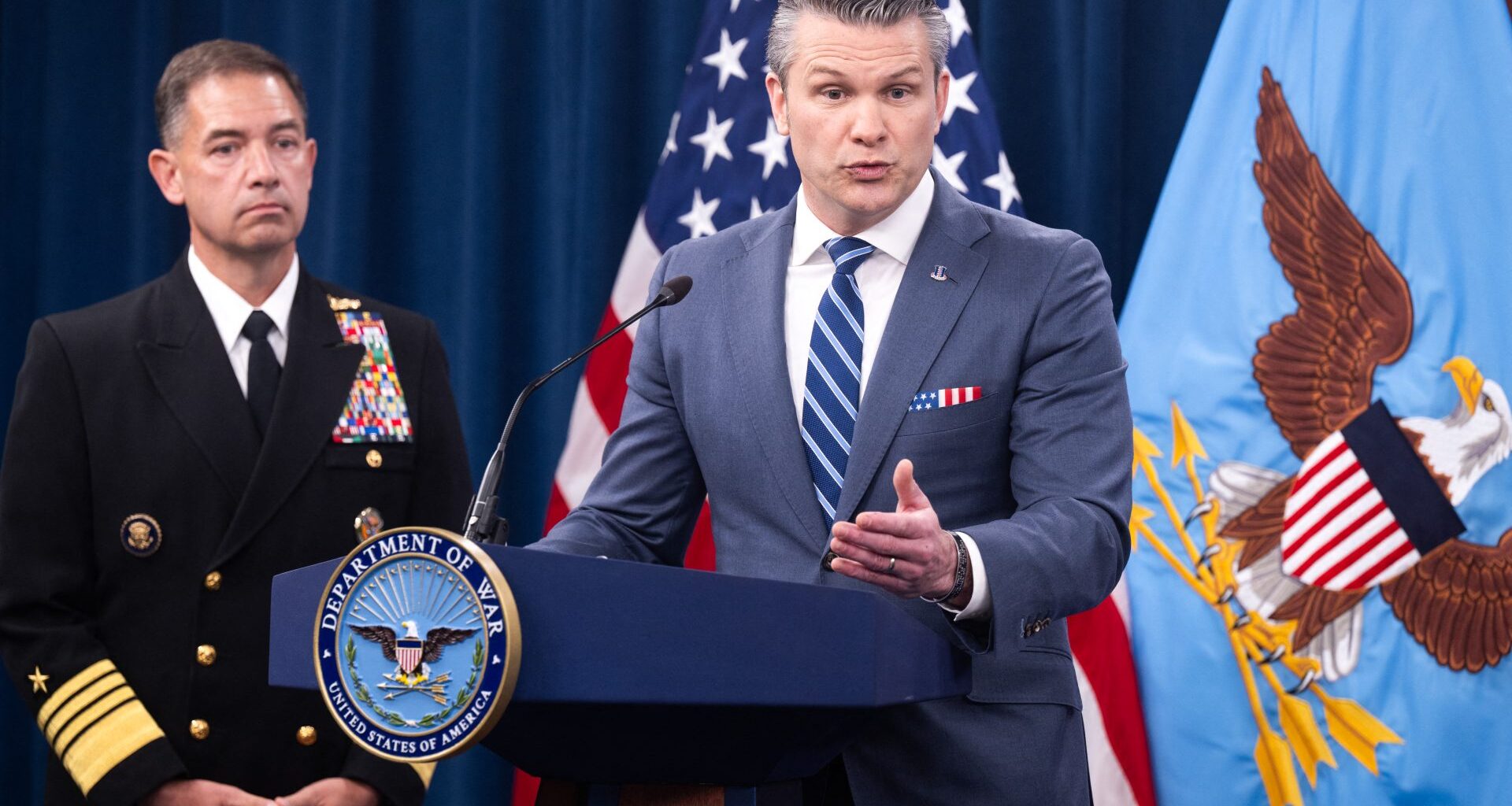
At a Pentagon press briefing, Defense Secretary Pete Hegseth, Chairman of the Joint Chiefs of Staff Gen. Dan Caine and commander of U.S. Central Command Adm. Brad Cooper discussed Operation Epic Fury and the associated, unfolding blockade, which they indicated is being enforced with a combination of integrated intelligence, surveillance and tactical assets.
“You, Iran, can choose a prosperous future, a golden bridge, and we hope that you do for the people of Iran. In the meantime, and for as long as it takes, we will maintain this blockade, this successful blockade. But if Iran chooses poorly, then they will have a blockade and bombs dropping on infrastructure, power and energy,” Hegseth said. “And at the same time, Treasury Secretary Scott Bessent and our friends over at [the Treasury Department] are launching Operation Economic Fury as well, maximizing economic pressure across the entirety of the government to Iran. Choose wisely.”
Treasury’s Office of Foreign Assets Control revealed on Wednesday that it has been intensifying pressure on Iran’s allegedly criminally-run oil transportation infrastructure.
OFAC sanctioned more than two dozen individuals, companies, and vessels operating within the network of Iranian oil shipping magnate Mohammad Hossein Shamkhani. He’s the son of senior Iranian security official Ali Shamkhani, who was killed by U.S. strikes on the first day of the war.
“Treasury is moving aggressively with Economic Fury by targeting regime elites like the Shamkhani family that attempt to profit at the expense of the Iranian people,” Bessent said in a statement. “Under President Trump’s leadership, Treasury will continue to cut off Iran’s illicit smuggling and terror proxy networks. Financial institutions should be on notice that Treasury will leverage all tools and authorities, including secondary sanctions, against those that continue to support Tehran’s terrorist activities.”
Notably, earlier this month, Deputy Defense Secretary Steve Feinberg formally established a new organization to lead Pentagon efforts that fuse economic leverage and requirements into joint U.S. military planning and operations.
Although senior defense officials did not explicitly call out the Pentagon’s new Economic Defense Unit in Thursday’s briefing, their comments signaled how the government is augmenting the war effort with economic pressure against Iran amid the fragile ceasefire.
“We are reloading with more power than ever before and, even more importantly, better intelligence than ever before. As you expose yourself with your movements to our watchful eye, we are locked and loaded on your critical dual-use infrastructure, on your remaining power generation, and on your energy industry. We’d rather not have to do it, but we’re ready to go at the command of our president and at the push of the button,” Hegseth said, addressing Iran from the podium. “This blockade, which the chairman will detail this morning, is the polite way that this can go.”
Trump launched Epic Fury on Feb. 28. Since the start, Hegseth and other senior defense officials have repeatedly billed it as a U.S.-led, Israel-coordinated military operation to destroy Iran’s leadership, ballistic missile and drone capabilities, naval power, manufacturing capacity and nuclear infrastructure.
In response, Iran has attacked the U.S. military and a variety of sites around the Middle East with deadly drone and missile barrages, and at times suspended nearly all maritime traffic flowing on a major global shipping route and chokepoint for oil near the Strait of Hormuz.
At a congressional hearing Thursday, Marine Lt. Gen. James Adams, director of the Defense Intelligence Agency, told members of a House Armed Services subcommittee that Iran still “retains thousands of missiles and one-way attack UAVs that can threaten U.S. and partner forces throughout the region, despite degradations to its capabilities from both attrition and expenditure.”
At least 13 U.S. military fatalities have been confirmed, including six U.S. Army Reserve soldiers who were killed in a drone strike in Kuwait in the early days of the war.
Navy Capt. Tim Hawkins, Centcom’s spokesperson, told DefenseScoop that in total 398 U.S. troops have been wounded in action as of April 16, with 358 having returned to duty and three currently characterized as seriously wounded.
“Personally, I’ve met many who were reported as wounded and are back [in the fight],” Cooper said at the Pentagon briefing. “It can give you a sense of purpose and motivation. We have collected dozens — if not hundreds — of lessons learned. And as we sit here right now, the joint force across the board has taken them and is very tactically applying them.”
The Centcom commander said he’d just returned from his second trip to the Middle East in the past 15 days. On both, he visited U.S. service members, who are deployed in the region across more than 70 different locations.
“I spent time with our troops who are employing cutting-edge tactics and technology for the first time in warfare. I won’t be able to talk about what those are, but these young men and women are breaking new ground,” Cooper said. “I met with teams who launched our own one-way attack drones into Iran. These were originally Iranian-designed drones that we brought back to America, took their guts out, put a ‘Made in America’ stamp on it, and fired them right back to Iran.”
He also connected with teams who he said “are employing AI every single day to help us sift through vast amounts of information, to help us make decisions faster” — as well as Space Force guardians and cybersecurity specialists “whose work cannot be discussed, but who serve with indispensable impact,” Cooper noted.
In a social media post over the weekend, Trump announced that he had ordered the Navy to impose a blockade near the Strait of Hormuz, in response to Iranian negotiators who met with senior U.S. officials in Pakistan but did not agree to America’s demands about Tehran’s nuclear program.
Caine said on Thursday that “more than 10,000 sailors, Marines and airmen, over a dozen ships and dozens of aircraft are executing this mission.” At that time, according to the chairman, Centcom had not been required to board any ships.
He emphasized that it “is a blockade of Iran’s ports and coastline, not a blockade of the Strait of Hormuz,” and that enforcement would primarily occur inside the country’s territorial seas or in international waters.
“In addition to this blockade, the joint force through operations and activities in other areas of responsibility — like the [U.S. Indo-Pacific Command] area of responsibility, under the command of [Adm. Sam Paparo] — will actively pursue any Iranian-flagged vessel or any vessel attempting to provide material support to Iran,” Caine said. “This includes ‘dark fleet’ vessels carrying Iranian oil. As most of you know, ‘dark fleet’ vessels are those illicit or illegal ships evading international regulations, sanctions or insurance requirements.”

Written by Brandi Vincent
Brandi Vincent is a Senior Reporter at DefenseScoop, where she reports on disruptive technologies and associated policies impacting Pentagon and military personnel. Prior to joining SNG, she produced a documentary and worked as a journalist at Nextgov, Snapchat and NBC Network. Brandi grew up in Louisiana and received a master’s degree in journalism from the University of Maryland. She was named Best New Journalist at the 2024 Defence Media Awards.