
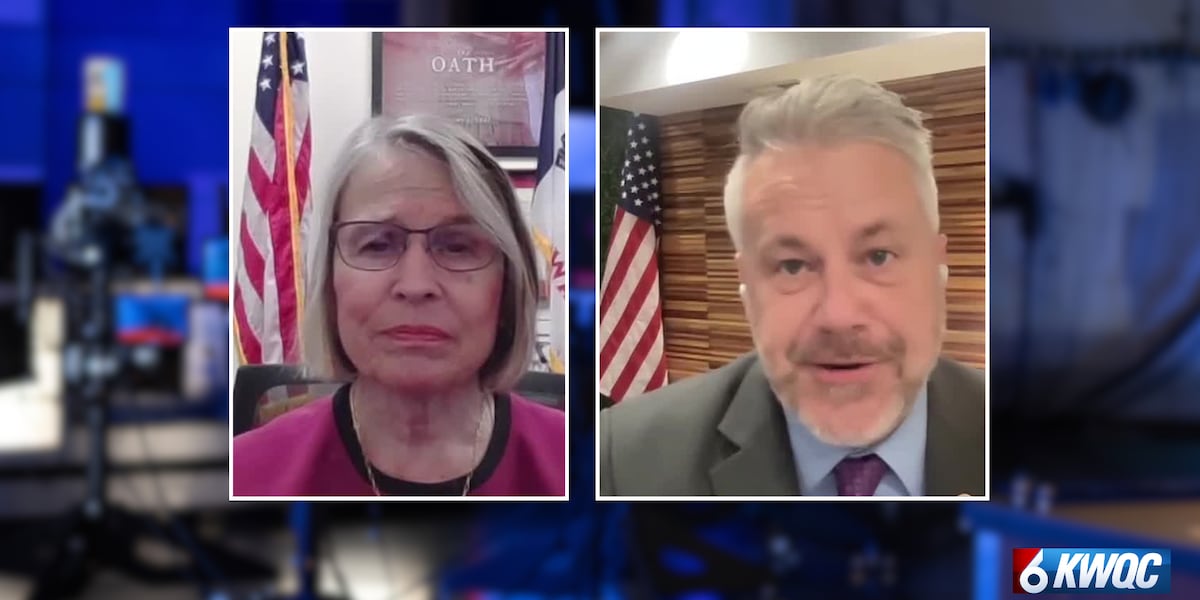
DAVENPORT, Iowa (KWQC) – With a fragile cease-fire holding in the Iran conflict, two members of Congress who represent the Quad Cities region say the U.S. must keep pressure on Iran and restore stability in the Strait of Hormuz — but they differ on how the administration and Congress should proceed.
U.S. Rep. Mariannette Miller-Meeks, R-Iowa, said new tensions around the Strait of Hormuz highlight what she called the need to return to the “central focus” of preventing Iran from obtaining a nuclear weapon.
“Iran was perilously close to a nuclear weapon,” Miller-Meeks said in a recent interview on Quad Cities Today, adding that a nuclear-armed Iran would have “profound implications” for the U.S., the Middle East and the global economy.
She said the president’s blockade has “diminished the leverage that Iran has had over … the entire world and the international community,” arguing international shipping lanes “should be open” and are “not in the possession of Iran or within its borders.”
U.S. Rep. Eric Sorensen, D-Ill. who serves on the Armed Services Committee, said lawmakers are demanding transparency about a reported ten-point peace plan, arguing Congress does not have enough information.
“To be quite frank, we don’t know what these plans are,” Sorensen said. “Those of us on the Armed Services Committee are demanding that we understand what those are, what the president could be giving away.”
Sorensen also criticized the administration’s handling of the conflict, saying there is no clear exit strategy and service members have been deployed without clarity on their mission.
“Donald Trump made a choice to put us in harm’s way,” Sorensen said. “Are they going to a ground war or not?”
Both representatives pointed to the importance of restoring activity through the Strait of Hormuz. Sorensen said the waterway must be reopened “expeditiously,” noting about 20% of the world’s energy supply moves through it.
Shutdown negotiations and DHS funding
The two lawmakers’ approaches diverge on shutdown negotiations and Department of Homeland Security funding.
Miller-Meeks said she believes many Democratic demands involving the DHS have already been met, including funding for body cameras. She argued delays risk public safety, including investigations into sex trafficking at U.S. borders.
“Our basic responsibility is to fund the government,” Miller-Meeks said.
Sorensen said Congress is expected to return to session early next week and argued House leaders should advance what the Senate has already approved.
“We shouldn’t be asking anybody to keep working without getting paid,” Sorensen said.
Sorensen said he will not support additional funding for ICE and U.S. Customs and Border Protection unless agents remove masks, wear name tags and body cameras and focus on border security duties. He also said Americans do not want ICE operating in neighborhoods, and called on Miller-Meeks and Rep. Darin LaHood, R-Ill., to return to Washington to negotiate.
Copyright 2026 KWQC. All rights reserved.