
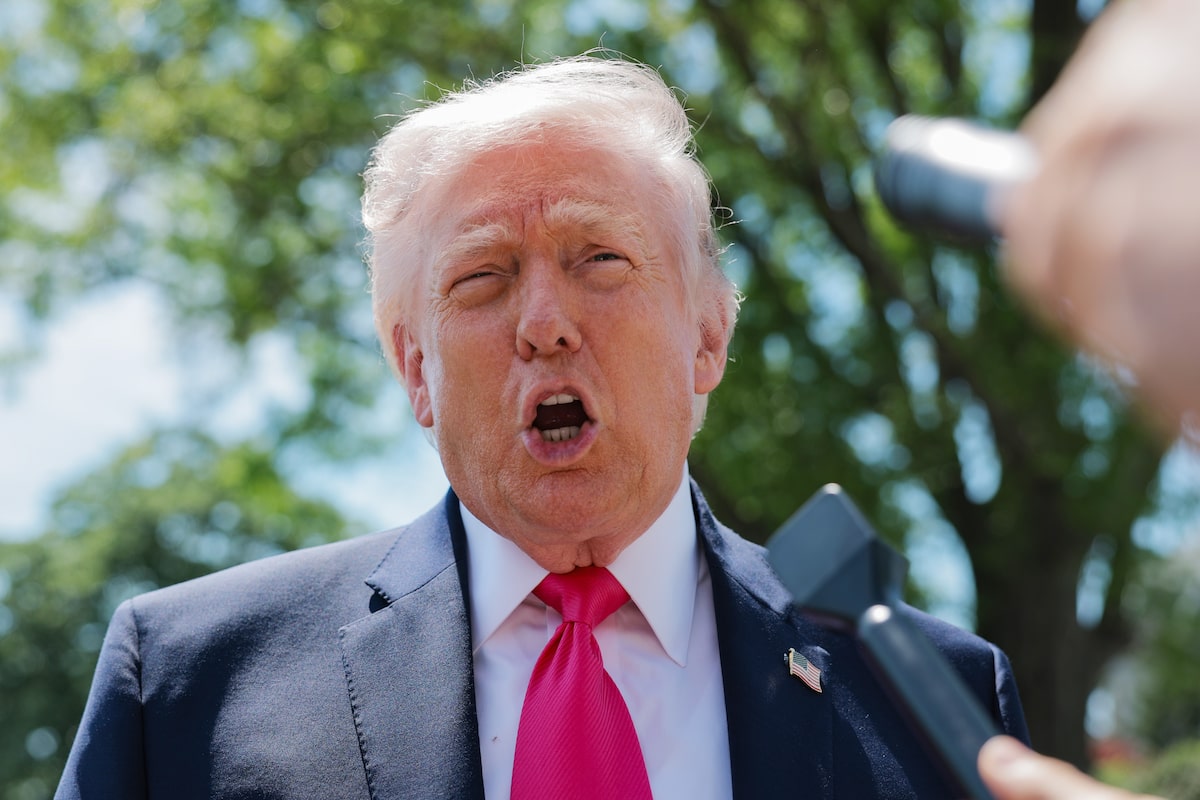
U.S. President Donald Trump speaks to reporters outside the White House on Thursday. The decision to blockade Iranian ports may help him orchestrate a swift end to the war, writes Tony Keller.Anna Moneymaker/Getty Images
The United States has changed tactics in its test of wills with Iran – and that may allow U.S. President Donald Trump to not only end the war, but to do so on terms less unfavourable than he was facing at the start of the month.
The American blockade of Iranian ports, which began Monday, is the smartest thing the Trump administration has done in this war. It involves no bombs, cruise missiles or amphibious landings. It escalates the economic pressure on Iran – but with the same tools as Iran has used against its neighbours since the start of the war, and continues to use today.
The U.S. appears to be escalating in an attempt to de-escalate.
And the oil market is still betting that the war is closer to the end than the beginning.
When the U.S. and Israel attacked Iran on Feb. 28, the Trump administration made an odd decision. It was likely born of extreme overconfidence. Washington thought it could have a quick, easy and cost-free war – with no bump in oil prices.
Even as the U.S. and Israel launched thousands of air strikes against Iran, Washington did not stop Tehran from exporting oil. It did the opposite.
How U.S. hopes to resolve Iran conflict with economic warfare
The Iranians immediately closed the Strait of Hormuz to nearly all oil exports from other Persian Gulf countries. In response, Mr. Trump did … nothing. The U.S. allowed Iran to continue shipping oil through the strait. It even moderated sanctions to facilitate sales.
Gulf countries suffered a dramatic drop in oil exports and revenues – but not Iran. It sold as much oil as before, while reaping a windfall from the higher prices its blockade engineered. It did all that with the permission of its mortal enemy, the Trump administration.
Iran used the oil weapon against the world, but Mr. Trump did not use the weapon against Iran, for fear of pushing oil prices even higher and ticking off even more American voters.
Iran’s chess move was, for the first six weeks of the war, met with paralysis in Washington.
In a March column, I pointed out that though the narrow Strait of Hormuz gives Iran leverage over the global economy and its Gulf neighbours, it gives the U.S. far greater leverage over Iran’s economy. Starting the war was a mistake, but the U.S. could use this leverage to bring the fighting to a speedier and better conclusion.
That’s what the U.S. Navy is finally doing. Commercial vessels attempting to sail from Iranian ports have been told to turn back.
Gen. Dan Caine, the chairman of the joint chiefs of staff, says that U.S. forces carrying out the naval blockade of Iran will actively pursue any vessel attempting to provide material support to Iran.
The Associated Press
As of Thursday afternoon, no shots had been fired, no ships had been boarded and no cargoes had been seized. The threat of action has been enough to stop nearly all traffic to and from Iran – just as Iran stopped nearly all traffic to and from the rest of the Gulf.
The mystery is why the U.S. waited so long.
Approximately 20 million barrels of oil a day, roughly 20 per cent of world supply, is from the Gulf. Half of that flow stopped in March. But the remainder continued, by such means as a Saudi Arabian pipeline that can divert seven million barrels a day to the Red Sea.
Iran’s oil exports are less than two million barrels a day – and oil is the country’s only significant export. One port, Kharg Island, is responsible for around 90 per cent of its shipments.
Iran’s economy is exceptionally dependent on oil exports. But the world economy is not particularly dependent on Iranian oil, which makes up less than 2 per cent of global supply.
Comparing the Iran war to other U.S. conflicts yields little of value
Somebody in Washington finally did the math. A temporary blockade of Iranian oil will have a minimal impact on global prices – and maximal impact on Tehran’s wallet.
Oil investors have so far taken the U.S. blockade in stride. Oil prices were around US$60 a barrel at the start of the year, but the futures contract for the West Texas Intermediate benchmark rose to more than US$110 by early April. It thereafter dropped sharply with the announcement of the ceasefire.
As of Thursday afternoon, the WTI futures price for May delivery was trading at just under US$95. Futures contracts for delivery in later months are priced progressively lower.
There are no guarantees as to what happens next. Tehran may escalate in turn, and Mr. Trump’s impatient and mercurial nature may overturn the table.
But Iran appears eager to end the war. The high cost imposed on the regime by the U.S. blockade may open the door for both sides to climb down and agree to mutually unblocking the strait. Fingers crossed.