
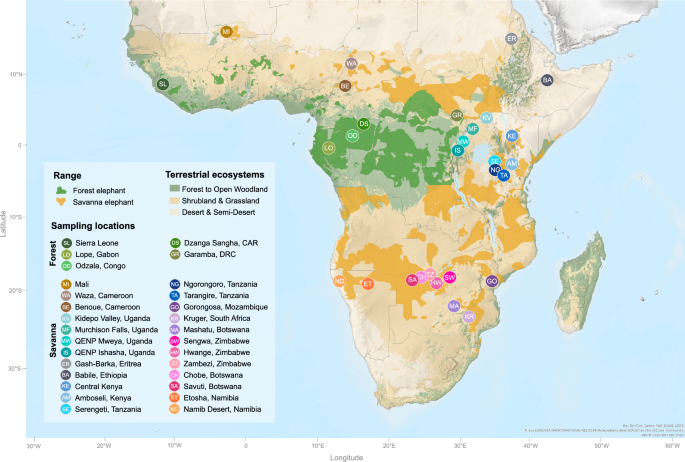
Cardillo, M. et al. Multiple causes of high extinction risk in large mammal species. Science 309, 1239–1241 (2005).
Ripple, W. J. et al. Extinction risk is most acute for the world’s largest and smallest vertebrates. Proc. Natl. Acad. Sci. USA. 114, 10678–10683 (2017).
Ripple, W. J. et al. Collapse of the world’s largest herbivores. Sci. Adv. 1, e1400103 (2015).
Dirzo, R. et al. Defaunation in the Anthropocene. Science 345, 401–406 (2014).
Wittemyer, G. et al. Illegal killing for ivory drives global decline in African elephants. Proc. Natl. Acad. Sci. USA. 111, 13117–13121 (2014).
Chase, M. J. et al. Continent-wide survey reveals massive decline in African savannah elephants. PeerJ 4, e2354 (2016).
Maisels, F. et al. Devastating decline of forest elephants in central Africa. PLoS ONE 8, e59469 (2013).
Hoare, R. Lessons from 20 years of human–elephant conflict mitigation in Africa. Hum. Dimens. Wildl. 20, 289–295 (2015).
Gobush, K. S. et al. Loxodonta africana (Amended Version of 2021 Assessment) https://doi.org/10.2305/iucn.uk.2021-1.rlts.t181008073a181022663.en (The IUCN Red List of Threatened Species 2022, 2022).
Gobush, K. S. et al. Loxodonta cyclotis (Errata Version Published in 2021) https://doi.org/10.2305/iucn.uk.2021-1.rlts.t181007989a181019888.en (The IUCN Red List of Threatened Species 2021, 2021).
Frade, F. Ordre des proboscidiens. In Traité de Zoologie (ed. Grassé, P.-P .) 715–875 (Masson et Cie Editeurs, Paris, 1955).
Frade, F. Sur l’existence en Afrique de deux espéces d’eléphants. Bull. Soc. Port. Sci. Nat. 11, 135–138 (1931).
Ellerman, J. R., Morrison-Scott, T. C. S. & Hayman, R. W. Southern African Mammals 1758 to 1951: A Reclassification (British Museum Trustees, London, 1953).
Backhaus, D. Zur Variabilität der äusseren systematischen Merkmale des afrikanischen Elefanten (Loxodonta Cuvier, 1825). Säugetierkund. Mitt. 6, 166–173 (1958).
Groves, C. P. & Grubb, P. Do Loxodonta cyclotis and L. africana interbreed? Elephant 2, 4–7 (2000).
Roca, A. L., Georgiadis, N., Pecon-Slattery, J. & O’Brien, S. J. Genetic evidence for two species of elephants in Africa. Science 293, 1473–1477 (2001).
Palkopoulou, E. et al. A comprehensive genomic history of extinct and living elephants. Proc. Natl. Acad. Sci. USA. 115, E2566–E2574 (2018).
Kim, H. J. & Wasser, S. K. Loxodonta africana Subspecies Distribution across African Elephant Database Input Zones. (University of Washington, 2019).
Bonnald, J. et al. Who are the elephants living in the hybridization zone? How genetics may guide conservation to better protect endangered elephants. Glob. Ecol. Conserv. 32, e01917 (2021).
Mondol, S. et al. New evidence for hybrid zones of forest and savanna elephants in Central and West Africa. Mol. Ecol. 24, 6134–6147 (2015).
Kuhner, M. K., Gobush, K. S., Kaliszewska, Z. A., Horwitz, R. & Wasser, S. K. Distribution of African savanna elephants (Loxodonta africana), African forest elephants (L. cyclotis), and their hybrids across Africa based on genetic evidence. Glob. Ecol. Conserv. 59, e03530 (2025).
Brandt, A. L., Ishida, Y., Georgiadis, N. J. & Roca, A. L. Forest elephant mitochondrial genomes reveal that elephantid diversification in Africa tracked climate transitions. Mol. Ecol. 21, 1175–1189 (2012).
Ishida, Y., Georgiadis, N. J., Hondo, T. & Roca, A. L. Triangulating the provenance of African elephants using mitochondrial DNA. Evol. Appl. 6, 253–265 (2013).
Eggert, L. S., Rasner, C. A. & Woodruff, D. S. The evolution and phylogeography of the African elephant inferred from mitochondrial DNA sequence and nuclear microsatellite markers. Proc. Biol. Sci. 269, 1993–2006 (2002).
Hewitt, G. The genetic legacy of the Quaternary ice ages. Nature 405, 907–913 (2000).
Maley, J. The impact of arid phases on the African rain forest through geological history. In African Rain Forest Ecology and Conservation(eds. Weber, W., White, L., Vedder, A., Naughton-Treves, L.) 68–87 (Yale University Press, Yale, 2001).
Mayr, E. & O’Hara, R. J. The biogeographic evidence supporting the Pleistocene forest refuge hypothesis. Evolution 40, 55–67 (1986).
Bryja, J. et al. The role of dispersal and vicariance in the Pleistocene history of an East African mountain rodent, Praomys delectorum. J. Biogeogr. 41, 196–208 (2014).
Bertola, L. D. et al. Phylogeographic patterns in Africa and high resolution delineation of genetic clades in the lion (Panthera leo). Sci. Rep. 6, 30807 (2016).
Lorenzen, E. D., Heller, R. & Siegismund, H. R. Comparative phylogeography of African savannah ungulates 1. Mol. Ecol. 21, 3656–3670 (2012).
Ishida, Y., Gugala, N. A., Georgiadis, N. J. & Roca, A. L. Evolutionary and demographic processes shaping geographic patterns of genetic diversity in a keystone species, the African forest elephant (Loxodonta cyclotis). Ecol. Evol. 8, 4919–4931 (2018).
Barnes, R. F. W. Is there a future for elephants in West Africa? Mamm. Rev. 29, 175–200 (1999).
Douglas-Hamilton, I. African elephants: population trends and their causes. Oryx 21, 11–24 (1987).
UNEP, CITES, IUCN & TRAFFIC. Elephants in the Dust. A Rapid Response Assessment (UNEP, GRID-Arendal, 2013).
Odada, E. O., Olago, D. O. & Olaka, L. A. An East African perspective of the Anthropocene. Sci. Afr. 10, e00553 (2020).
Sinha, S. & Getachew, M. As Africa’s Population Crosses 1.5 Billion, The Demographic Window Is Opening; Getting The Dividend Requires More Time And Stronger Effort. https://www.uneca.org/stories/%28blog%29-as-africa%E2%80%99s-population-crosses-1.5-billion%2C-the-demographic-window-is-opening-getting (United Nation’s Economic Commission for Africa, 2024).
Wall, J. et al. Human footprint and protected areas shape elephant range across Africa. Curr. Biol. 31, 2437–2445.e4 (2021).
Ezeh, A., Kissling, F. & Singer, P. Why sub-Saharan Africa might exceed its projected population size by 2100. Lancet 396, 1131–1133 (2020).
Chapman, C. A. et al. The future of sub-Saharan Africa’s biodiversity in the face of climate and societal change. Front. Ecol. Evol. 10, 790552 (2022).
United Nations. World Population Prospects 2024: Summary of Results (United Nations, New York, 2024).
Edwards, C. T. T. et al. Survey-based inference of continental African elephant decline. Proc. Natl. Acad. Sci. USA. 121, e2403816121 (2024).
Milner-Gulland, E. J. & Beddington, J. R. The exploitation of elephants for the ivory trade: an historical perspective. Proc. Biol. Sci. 252, 29–37 (1993).
Douglas-Hamilton, I. African Elephant Ivory Trade (US Fish and Wildlife Service, Washington, D.C., 1979).
Thouless, C. R. African Elephant Status Report 2016: An Update from the African Elephant Database (IUCN/SSC African Elephant Specialist Group, 2016).
Grueber, C. E. & Sunnucks, P. Using genomics to fight extinction. Science 376, 574–575 (2022).
Mooney, J. A., Marsden, C. D., Yohannes, A., Wayne, R. K. & Lohmueller, K. E. Long-term small population size, deleterious variation, and altitude adaptation in the Ethiopian wolf, a severely endangered canid. Mol. Biol. Evol. 40, msac277 (2023).
Xue, Y. et al. Mountain gorilla genomes reveal the impact of long-term population decline and inbreeding. Science 348, 242–245 (2015).
Westbury, M. V. et al. Extended and continuous decline in effective population size results in low genomic diversity in the world’s rarest hyena species, the brown hyena. Mol. Biol. Evol. 35, 1225–1237 (2018).
Dehasque, M. et al. Temporal dynamics of woolly mammoth genome erosion prior to extinction. Cell 187, 3531–3540.e13 (2024).
Nyakaana, S., Arctander, P. & Siegismund, H. R. Population structure of the African savannah elephant inferred from mitochondrial control region sequences and nuclear microsatellite loci. Heredity 89, 90–98 (2002).
Tollis, M. et al. Elephant genomes reveal accelerated evolution in mechanisms underlying disease defenses. Mol. Biol. Evol. 38, 3606–3620 (2021).
Campbell-Staton, S. C. et al. Ivory poaching and the rapid evolution of tusklessness in African elephants. Science 374, 483–487 (2021).
Ishida, Y. et al. Reconciling apparent conflicts between mitochondrial and nuclear phylogenies in African elephants. PLoS ONE 6, e20642 (2011).
Purcell, S. et al. PLINK: a tool set for whole-genome association and population-based linkage analyses. Am. J. Hum. Genet. 81, 559–575 (2007).
Alexander, D. H., Novembre, J. & Lange, K. Fast model-based estimation of ancestry in unrelated individuals. Genome Res. 19, 1655–1664 (2009).
Garcia-Erill, G. & Albrechtsen, A. Evaluation of model fit of inferred admixture proportions. Mol. Ecol. Resour. 20, 936–949 (2020).
Durand, E. Y., Patterson, N., Reich, D. & Slatkin, M. Testing for ancient admixture between closely related populations. Mol. Biol. Evol. 28, 2239–2252 (2011).
Green, R. E. et al. A draft sequence of the Neandertal genome. Science 328, 710–722 (2010).
Garcia-Erill, G., Hanghøj, K., Heller, R., Wiuf, C. & Albrechtsen, A. Estimating admixture pedigrees of recent hybrids without a contiguous reference genome. Mol. Ecol. Resour. 23, 1604–1619 (2023).
Maier, R. et al. On the limits of fitting complex models of population history to f-statistics. Elife 12, e85492 (2023).
Lovett, J. C. & Wasser, S. Biogeography and Ecology of the Rain Forests of Eastern Africa (Cambridge University Press, Cambridge, England, 1993).
Lovett, J. C. Climatic history and forest distribution in eastern Africa. In Biogeography and Ecology of the Rain Forests of Eastern Africa (eds. Lovett, J. C. & Wasser, S. K.) 23–30 (Cambridge University Press, Cambridge, 1993).
Roca, A. L., Georgiadis, N. & O’Brien, S. J. Cytonuclear genomic dissociation in African elephant species. Nat. Genet. 37, 96–100 (2005).
Galanti, V., Preatoni, D., Martinoli, A., Wauters, L. A. & Tosi, G. Space and habitat use of the African elephant in the Tarangire–Manyara ecosystem, Tanzania: implications for conservation. Mamm. Biol. 71, 99–114 (2006).
Lohay, G. G., Weathers, T. C., Estes, A. B., McGrath, B. C. & Cavener, D. R. Genetic connectivity and population structure of African savanna elephants (Loxodonta africana) in Tanzania. Ecol. Evol. 10, 11069–11089 (2020).
Thouless, C. R., King, J., Omondi, P., Kahumbu, P. & Douglas-Hamilton, I. The Status of Kenya’s Elephants (Save the Elephants, Nairobi, 2008).
Pickrell, J. K. & Pritchard, J. K. Inference of population splits and mixtures from genome-wide allele frequency data. PLoS Genet. 8, e1002967 (2012).
Nguyen, L.-T., Schmidt, H. A., von Haeseler, A. & Minh, B. Q. IQ-TREE: a fast and effective stochastic algorithm for estimating maximum-likelihood phylogenies. Mol. Biol. Evol. 32, 268–274 (2015).
Kalyaanamoorthy, S., Minh, B. Q., Wong, T. K. F., von Haeseler, A. & Jermiin, L. S. ModelFinder: fast model selection for accurate phylogenetic estimates. Nat. Methods 14, 587–589 (2017).
Bonnald, J., Cornette, R., Pichard, M., Asalu, E. & Krief, S. Phenotypical characterization of African savannah and forest elephants, with special emphasis on hybrids: the case of Kibale National Park, Uganda. Oryx 57, 188–195 (2023).
Meyer, M. et al. Palaeogenomes of Eurasian straight-tusked elephants challenge the current view of elephant evolution. Elife 6, e25413 (2017).
van der Valk, T. et al. Million-year-old DNA sheds light on the genomic history of mammoths. Nature 591, 265–269 (2021).
Sánchez-Guillén, R. A. et al. Hybridization rate and climate change: are endangered species at risk? J. Insect Conserv. 18, 295–305 (2014).
Allendorf, F. W., Leary, R. F., Spruell, P. & Wenburg, J. K. The problems with hybrids: setting conservation guidelines. Trends Ecol. Evol. 16, 613–622 (2001).
Bauer, H. et al. Ignoring species hybrids in the IUCN Red List assessments for African elephants may bias conservation policy. Nat. Ecol. Evol. 5, 1050–1051 (2021).
Bertola, L. D. et al. Whole genome sequencing and the application of a SNP panel reveal primary evolutionary lineages and genomic variation in the lion (Panthera leo). BMC Genomics 23, 321 (2022).
Pečnerová, P. et al. High genetic diversity and low differentiation reflect the ecological versatility of the African leopard. Curr. Biol. 31, 1862–1871.e5 (2021).
Quinn, L. et al. Colonialism in South Africa leaves a lasting legacy of reduced genetic diversity in Cape buffalo. Mol. Ecol. 32, 1860–1874 (2023).
Laguardia, A. et al. Nationwide abundance and distribution of African forest elephants across Gabon using non-invasive SNP genotyping. Glob. Ecol. Conserv. 32, e01894 (2021).
Barnes, R. F. W., Blom, A., Alers, M. P. T. & Barnes, K. L. An estimate of the numbers of forest elephants in Gabon. J. Trop. Ecol. 11, 27–37 (1995).
Fay, J. M. An elephant (Loxodonta africana) survey using dung counts in the forests of the Central African Republic. J. Trop. Ecol. 7, 25–36 (1991).
Barnes, R. F. W., Blom, A. & Alers, M. P. T. A review of the status of forest elephants Loxodonta africana in Central Africa. Biol. Conserv. 71, 125–132 (1995).
Alpers, E. A. The ivory trade in Africa. An historical perspective. In Elephant: The Animal and Its Ivory in African Culture (ed. Ross, D. H.) 349–386 (Los Angeles, 1992).
Bouché, P. et al. Will elephants soon disappear from West African savannahs? PLoS ONE 6, e20619 (2011).
Brandt, A. L. et al. The elephants of Gash-Barka, Eritrea: nuclear and mitochondrial genetic patterns. J. Hered. 105, 82–90 (2014).
Demeke, Y., Renfree, M. B. & Short, R. V. Historical range and movements of the Elephants in Babile Elephant Sanctuary, Ethiopia. Afr. J. Ecol. 50, 439–445 (2012).
Archie, E. A. et al. Behavioural inbreeding avoidance in wild African elephants. Mol. Ecol. 16, 4138–4148 (2007).
Ishida, Y. et al. Genetic connectivity across marginal habitats: the elephants of the Namib Desert. Ecol. Evol. 6, 6189–6201 (2016).
Epps, C. W., Wasser, S. K., Keim, J. L., Mutayoba, B. M. & Brashares, J. S. Quantifying past and present connectivity illuminates a rapidly changing landscape for the African elephant. Mol. Ecol. 22, 1574–1588 (2013).
Newmark, W. D. Isolation of African protected areas. Front. Ecol. Environ. 6, 321–328 (2008).
Graham, M. D., Douglas-Hamilton, I., Adams, W. M. & Lee, P. C. The movement of African elephants in a human-dominated land-use mosaic. Anim. Conserv. 12, 445–455 (2009).
Naidoo, R. et al. Landscape connectivity for African elephants in the world’s largest transfrontier conservation area: a collaborative, multi-scalar assessment. J. Appl. Ecol. 61, 2483–2496 (2024).
Douglas-Hamilton, I., Krink, T. & Vollrath, F. Movements and corridors of African elephants in relation to protected areas. Sci. Nat. 92, 158–163 (2005).
Geldmann, J., Manica, A., Burgess, N. D., Coad, L. & Balmford, A. A global-level assessment of the effectiveness of protected areas at resisting anthropogenic pressures. Proc. Natl. Acad. Sci. USA. 116, 23209–23215 (2019).
Correa, R. J. et al. Performance of protected areas in conserving African elephants. Conserv. Lett. 17, e13041 (2024).
van de Water, A., Di Minin, E. & Slotow, R. Human-elephant coexistence through aligning conservation with societal aspirations. Glob. Ecol. Conserv. 37, e02165 (2022).
de Flamingh, A. et al. Integrating habitat suitability modeling with gene flow improves delineation of landscape connections among African savanna elephants. Biodivers. Conserv. 33, 3231–3252 (2024).
Comstock, K. E. et al. Patterns of molecular genetic variation among African elephant populations. Mol. Ecol. 11, 2489–2498 (2002).
Manthi, F. K., Sanders, W. J., Plavcan, J. M., Cerling, T. E. & Brown, F. H. Late middle Pleistocene elephants from natodomeri, Kenya and the disappearance of Elephas (Proboscidea, Mammalia) in Africa. J. Mamm. Evol. 27, 483–495 (2020).
Sanders, W. J., Gheerbrant, E., Harris, J. M., Saegusa, H. & Delmer, C. Proboscidea. In Cenozoic Mammals of Africa (eds. Werdelin, L., Sanders, W.J.) 161–251 (University of California Press, 2010).
Maglio, V. J. Origin and evolution of the elephantidae. Trans. Am. Philos. Soc. 63, 1 (1973).
Hollister-Smith, J. A. et al. Age, musth and paternity success in wild male African elephants, Loxodonta africana. Anim. Behav. 74, 287–296 (2007).
Li, H. & Durbin, R. Inference of human population history from individual whole-genome sequences. Nature 475, 493–496 (2011).
Cerling, T. E. et al. Woody cover and hominin environments in the past 6 million years. Nature 476, 51–56 (2011).
Lister, A. M. The role of behaviour in adaptive morphological evolution of African proboscideans. Nature 500, 331–334 (2013).
deMenocal, P. B. Plio-pleistocene African climate. Science 270, 53–59 (1995).
Kingdon, J. East African Mammals: V. 3B (University of Chicago Press, Chicago, IL, 1989).
van der Valk, T., Díez-Del-Molino, D., Marques-Bonet, T., Guschanski, K. & Dalén, L. Historical genomes reveal the genomic consequences of recent population decline in eastern gorillas. Curr. Biol. 29, 165–170.e6 (2019).
Zhou, X. et al. Baiji genomes reveal low genetic variability and new insights into secondary aquatic adaptations. Nat. Commun. 4, 2708 (2013).
Robinson, J. A. et al. Genomic signatures of extensive inbreeding in Isle Royale wolves, a population on the threshold of extinction. Sci. Adv. 5, eaau0757 (2019).
van der Valk, T., de Manuel, M., Marques-Bonet, T. & Guschanski, K. Estimates of genetic load suggest frequent purging of deleterious alleles in small populations. Preprint at bioRxiv https://doi.org/10.1101/696831 (2021).
Cingolani, P. et al. A program for annotating and predicting the effects of single nucleotide polymorphisms, SnpEff: SNPs in the genome of Drosophila melanogaster strain w1118; iso-2; iso-3. Fly 6, 80–92 (2012).
Bertorelle, G. et al. Genetic load: genomic estimates and applications in non-model animals. Nat. Rev. Genet. 23, 492–503 (2022).
Fontsere, C. et al. Persistent genomic erosion in whooping cranes despite demographic recovery. Mol. Ecol. 34, e70088 (2025).
Caughley, G. Directions in conservation biology. J. Anim. Ecol. 63, 215–244 (1994).
Shaffer, M. L. Minimum population sizes for species conservation. Bioscience 31, 131–134 (1981).
Lynch, M., Conery, J. & Burger, R. Mutational meltdowns in sexual populations. Evolution 49, 1067 (1995).
Díez-Del-Molino, D. et al. Genomics of adaptive evolution in the woolly mammoth. Curr. Biol. 33, 1753–1764.e4 (2023).
Karesh, W. B., Smith, F. & Frazier-Taylor, H. A remote method for obtaining skin biopsy samples. Conserv. Biol. 1, 261–262 (1987).
Eltringham, S. K. The numbers and distribution of elephant Loxodonta africana in the Rwenzori National Park and Chambura Game Reserve, Uganda. Afr. J. Ecol. 15, 19–39 (1977).
Buss, I. O. & Savidge, J. M. Change in population number and reproductive rate of elephants in Uganda. J. Wildl. Manag. 30, 791 (1966).
Muwanika, V. B., Nyakaana, S. & Siegismund, H. R. Genetic consequences of war and social strife in sub-Saharan Africa: the case of Uganda’s large mammals. Afr. Zool. 40, 107–113 (2005).
Liu, X. et al. Introgression and disruption of migration routes have shaped the genetic integrity of wildebeest populations. Nat. Commun. 15, 2921 (2024).
Balboa, R. F. et al. African bushpigs exhibit porous species boundaries and appeared in Madagascar concurrently with human arrival. Nat. Commun. 15, 172 (2024).
Schubert, M., Lindgreen, S. & Orlando, L. AdapterRemoval v2: rapid adapter trimming, identification, and read merging. BMC Res. Notes 9, 88 (2016).
Li, H. et al. The sequence alignment/map format and SAMtools. Bioinformatics 25, 2078–2079 (2009).
Li, H. A statistical framework for SNP calling, mutation discovery, association mapping and population genetical parameter estimation from sequencing data. Bioinformatics 27, 2987–2993 (2011).
Pečnerová, P. et al. Population genomics of the muskox’ resilience in the near absence of genetic variation. Mol. Ecol. 33, e17205 (2024).
Flynn, J. M. et al. RepeatModeler2 for automated genomic discovery of transposable element families. Proc. Natl. Acad. Sci. USA. 117, 9451–9457 (2020).
Smit, A. F. A., Hubley, R. & Green, P. RepeatMasker Open-4.0 http://www.repeatmasker.org (2013-2015).
Smit, A. & Hubley, R. RMBlast. Seattle, WA: Institute for Systems Biology. [cited 2017 Dec 15] http://www.repeatmasker.org/RMBlast.html (2017).
Derrien, T. et al. Fast computation and applications of genome mappability. PLoS ONE 7, e30377 (2012).
Meisner, J. & Albrechtsen, A. Inferring population structure and admixture proportions in low-depth NGS data. Genetics 210, 719–731 (2018).
Meisner, J. & Albrechtsen, A. Testing for Hardy–Weinberg equilibrium in structured populations using genotype or low-depth next generation sequencing data. Mol. Ecol. Resour. 19, 1144–1152 (2019).
Bertola, L. D. et al. Giraffe lineages are shaped by major ancient admixture events. Curr. Biol. 34, 1576–1586.e5 (2024).
Waples, R. K., Albrechtsen, A. & Moltke, I. Allele frequency-free inference of close familial relationships from genotypes or low-depth sequencing data. Mol. Ecol. 28, 35–48 (2019).
Manichaikul, A. et al. Robust relationship inference in genome-wide association studies. Bioinformatics 26, 2867–2873 (2010).
Hanghøj, K., Moltke, I., Andersen, P. A., Manica, A. & Korneliussen, T. S. Fast and accurate relatedness estimation from high-throughput sequencing data in the presence of inbreeding. Gigascience 8, giz034 (2019).
Browning, B. L., Zhou, Y. & Browning, S. R. A one-penny imputed genome from next-generation reference panels. Am. J. Hum. Genet. 103, 338–348 (2018).
Korneliussen, T. S., Albrechtsen, A. & Nielsen, R. ANGSD: analysis of next generation sequencing data. BMC Bioinforma. 15, 356 (2014).
R Core Team. R: A Language and Environment for Statistical Computing https://www.R-project.org/ (2025).
Paradis, E. & Schliep, K. ape 5.0: an environment for modern phylogenetics and evolutionary analyses in R. Bioinformatics 35, 526–528 (2019).
Petkova, D., Novembre, J. & Stephens, M. Visualizing spatial population structure with estimated effective migration surfaces. Nat. Genet. 48, 94–100 (2016).
Bhatia, G., Patterson, N., Sankararaman, S. & Price, A. L. Estimating and interpreting FST: the impact of rare variants. Genome Res. 23, 1514–1521 (2013).
Patterson, N. et al. Ancient admixture in human history. Genetics 192, 1065–1093 (2012).
Haak, W. et al. Massive migration from the steppe was a source for Indo-European languages in Europe. Nature 522, 207–211 (2015).
Olson, D. M. et al. Terrestrial ecoregions of the world: a new map of life on earth. Bioscience 51, 933 (2001).
Oksanen, J. et al. The Vegan Package: Community Ecology Package. https://github.com/vegandevs/vegan (Posit, Boston, 2008).
Posit team. RStudio: Integrated Development Environment for R. http://www.posit.co/ (2025).
Nøhr, A. K. et al. NGSremix: a software tool for estimating pairwise relatedness between admixed individuals from next-generation sequencing data. G3 (Bethesda) 11, jkab174 (2021).
Danecek, P. et al. Twelve years of SAMtools and BCFtools. Gigascience 10, giab008 (2021).
Hilgers, L. et al. Avoidable false PSMC population size peaks occur across numerous studies. Curr. Biol. 35, 927-930.e3 (2025).
Boitard, S., Rodríguez, W., Jay, F., Mona, S. & Austerlitz, F. Inferring population size history from large samples of genome-wide molecular data – An approximate Bayesian computation approach. PLoS Genet. 12, e1005877 (2016).
Rohland, N. et al. Genomic DNA sequences from mastodon and woolly mammoth reveal deep speciation of forest and savanna elephants. PLoS Biol. 8, e1000564 (2010).
Moss, C. J. The demography of an African elephant (Loxodonta africana) population in Amboseli, Kenya. J. Zool. 255, 145–156 (2001).
Sukumar, R. The Asian Elephant: Ecology and Management (Cambridge University Press, Cambridge, England, 1993).
Rasmussen, H. B. et al. Age- and tactic-related paternity success in male African elephants. Behav. Ecol. 19, 9–15 (2008).
Turkalo, A. K., Wrege, P. H. & Wittemyer, G. Demography of a forest elephant population. PLoS ONE 13, e0192777 (2018).
Freeman, E. W., Whyte, I. & Brown, J. L. Reproductive evaluation of elephants culled in Kruger National Park, South Africa between 1975 and 1995. Afr. J. Ecol. 47, 192–201 (2009).
Wittemyer, G., Daballen, D. & Douglas-Hamilton, I. Comparative demography of an at-risk African elephant population. PLoS ONE 8, e53726 (2013).
Dussex, N. et al. Constraints to gene flow increase the risk of genome erosion in the Ngorongoro Crater lion population. Commun. Biol. 8, 640 (2025).
Pertea, G. & Pertea, M. GFF utilities: GffRead and GffCompare. F1000Res 9, 304 (2020).
Cingolani, P. et al. Using Drosophila melanogaster as a model for genotoxic chemical mutational studies with a new program. SnpSift. Front. Genet. 3, 35 (2012).
Torchiano, M. effsize: Efficient Effect Size Computation., R package version 0.8.1, https://doi.org/10.5281/zenodo.1480624 (2020).
Sayre, R. G. et al. A new map of standardized terrestrial ecosystems of Africa. Afr. Geogr. Rev. 70045097 (2013).
Esri. Terrain with labels. [basemap] (accessed 22 November 2024); https://www.arcgis.com/home/item.html?id=a52ab98763904006aa382d90e906fdd5 (2024).
Esri. Terrain. [imagery layer] (accessed 22 November 2024); https://elevation.arcgis.com/arcgis/rest/services/WorldElevation/Terrain/ImageServer (2024).
Esri. Africa Terrestrial Ecosystems. [imagery layer] (accessed 22 November 2024); https://www.arcgis.com/home/item.html?id=ab06bbc6ecbb42d59d9379d4c64bf8a3 (2019).
Esri Africa. Africa countries. [feature layer] (accessed 22 November 2024); https://hub.arcgis.com/datasets/africa::africa-countries/about (2018).
Wickham, H. https://ggplot2.tidyverse.org (2016).
Wickham, H., François, R., Henry, L., Müller, K. & Vaughan, D. dplyr: A Grammar of Data Manipulation https://dplyr.tidyverse.org (2025).
Pebesma, E. Simple features for R: standardized support for spatial vector data. R. J. 10, 439–446 (2018).
Pebesma, E. & Bivand, R. Spatial Data Science (Chapman and Hall/CRC, New York, 2023).