
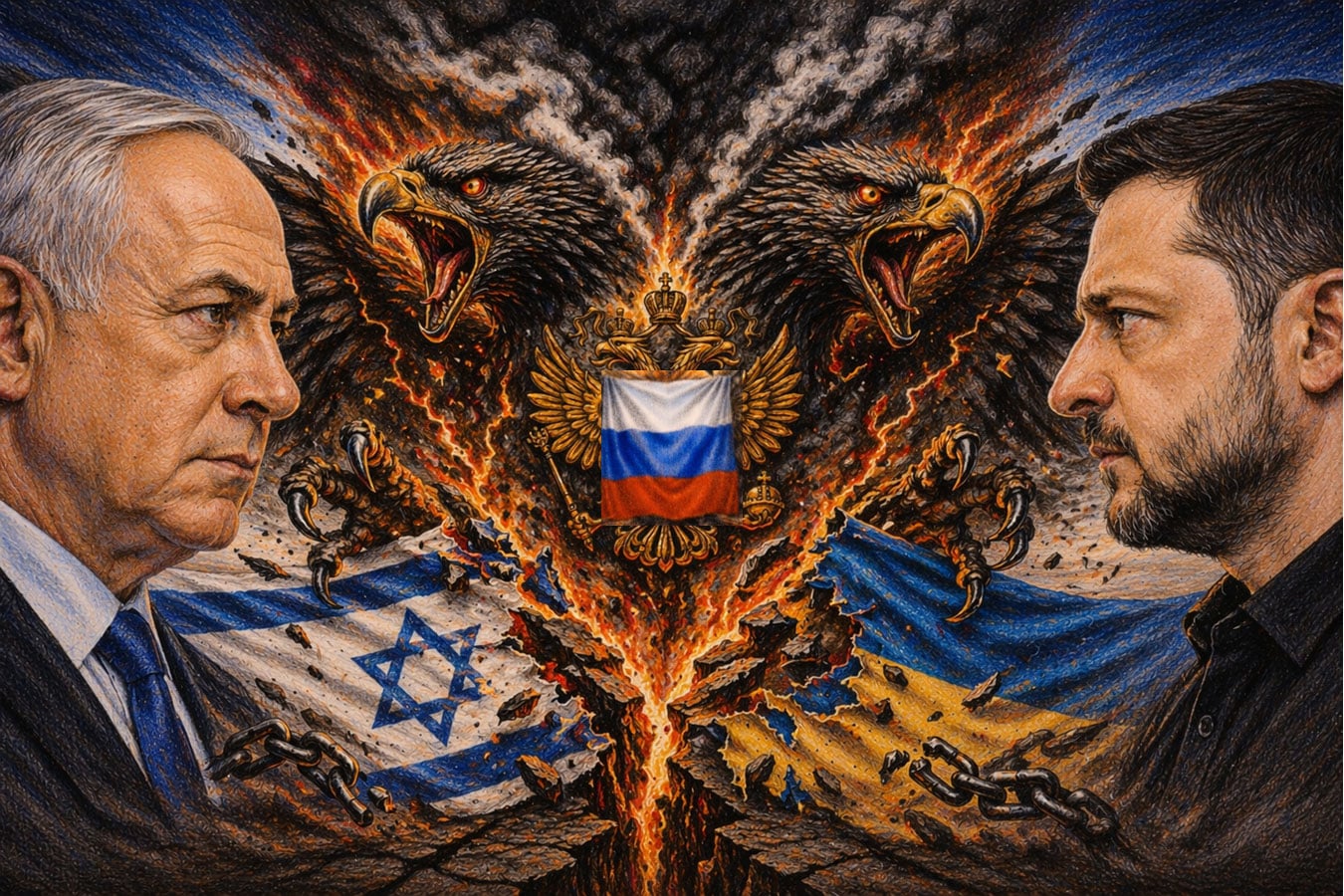
Will the Jewish state defend its sovereign freedom of decision, or allow Moscow to define the limits of what is permissible?
As tensions rise once again in the Middle East, Russia is turning the information sphere into a separate front of pressure. Moscow is trying to portray Ukraine as a source of danger for the region, tie Israel to that narrative, and at the same time intimidate companies that cooperate with Kyiv or may be interested in Ukraine’s hard-earned experience in countering drones and missile threats.
For Israel, this is not some distant geopolitical subplot.
Russia is not acting only against Ukraine. It is also testing whether the Jewish state itself can be pressured — through fear, media noise, threats against businesses, and carefully planted hints about possible consequences. That is why the real question is no longer just what Russia is doing to Ukraine. The real question is whether Israel will preserve its freedom of decision, or begin adjusting its behavior to Russian pressure.
How Moscow is linking Ukraine, Iran, and Israel
In recent weeks, a coordinated information campaign has emerged aimed at undermining trust in Ukrainian defense technologies and in Ukrainian specialists who gained unique expertise during the full-scale war. A key element of that campaign is the attempt to depict Ukraine as somehow involved in “aggression” against Iran, while manipulating official information about Kyiv’s contacts with Gulf states.
Israel is increasingly being woven into that same narrative.
This is precisely how the structure Moscow wants is built: Ukraine, Iran, Israel, drones, security ties, hidden escalation. The goal is not to prove anything. The goal is to trigger anxiety, spread mistrust, and make Ukraine’s partners wary of any cooperation in advance.
To achieve this, Russian propaganda is using not only familiar disinformation tactics but also newer tools, including AI-generated fake videos designed to look like the content of respected international media outlets. These videos aim to discredit Ukrainian counter-drone systems and the professionalism of Ukrainian experts.
At the same time, cruder falsehoods are circulating as well, including reports about the alleged deaths of Ukrainian military personnel in Gulf countries. In one case, propagandists used a real photograph of a fallen Ukrainian defender, changed his name, and fabricated the circumstances of his death. False reports also spread about the supposed destruction of a warehouse of Ukrainian anti-drone systems in Dubai and the alleged deaths of twenty-one Ukrainian specialists. Ukraine’s Foreign Ministry officially denied those claims.
While Moscow spreads fear, real interest in Ukraine is growing
In practice, the actual trend is moving in the opposite direction.
The Gulf states — above all Saudi Arabia, the UAE, and Qatar — are showing growing interest in Ukraine’s experience in countering Iranian drone and missile threats. That contrast matters. While Russia is trying to disrupt growing confidence in Ukraine, real interest in Ukrainian solutions is only increasing.
During President Volodymyr Zelensky’s visit to the region in late March 2026, agreements were reportedly reached on expanding defense cooperation. The discussions included technology exchange, joint production, and the development of air defense systems. Ukrainian experts continue to work in the region, assessing current threats, identifying vulnerabilities, and proposing ways to strengthen the protection of civilians and critical infrastructure.
This is not only about narrow military cooperation.
A more durable partnership is taking shape, one that includes the energy sector and broader technological interaction. In other words, Moscow is trying to strike not at random contacts, but at a growing and potentially strategic format of cooperation that is already beginning to matter.
Why this should concern Israel personally
For Israel, there is nothing abstract about this story.
The country has spent decades living with the reality of drones, missiles, attacks on infrastructure, and constant external pressure. That is why Ukrainian experience matters here not as distant theory, but as a practical resource.
There is also a concrete example. Israel’s Defense Ministry has already sent inquiries to defense companies regarding solutions against fiber-optic drones — precisely the kind of threat that became especially visible during Russia’s war against Ukraine. This is no longer general curiosity about Ukrainian experience. It is a practical response by Israel’s own security system to lessons learned on the Ukrainian battlefield.
Another telling episode came after the appointment of Roman Hofman as the new head of the Mossad. Russian state media immediately tried to connect this internal Israeli personnel decision to Ukraine, suggesting that under his leadership the Mossad’s activity “on the Russian track” might take on a new dimension. The explanation offered was Israel’s supposedly “extremely dense ties” with Ukraine, along with speculation about possible Israeli intelligence involvement in operations by Ukrainian services against Russia.
That matters not as an isolated media detail, but as a symptom.
Moscow is trying to attach a “Ukrainian label” even to Israel’s own internal security decisions. That means the target of pressure is no longer Ukraine alone, but Israel’s strategic freedom of maneuver.
From fakes to direct intimidation
The next step already looks much harsher.
Russia’s Ministry of Defense has published a list of twenty-one companies in twelve countries that it claims may be treated as “legitimate military targets” because of their alleged involvement in producing components for Ukrainian drones.
The list includes companies from Britain, Germany, Denmark, Latvia, Lithuania, the Netherlands, Poland, the Czech Republic, Spain, Italy, Israel, and Turkey. Yet no concrete explanation has been given for the inclusion of Israeli firms. That points less to verified intelligence and more to a politically motivated attempt at intimidation.
A closer look at the list also shows how arbitrary it is. Many companies that have openly declared cooperation with Ukraine were not included. This is not a coherent intelligence picture. It is a tool of fear, designed to provoke a nervous reaction from businesses, politicians, and the wider public.
In effect, this is an attempt to create an atmosphere of threat, pressure European and Israeli companies, and influence how governments think about cooperation with Ukraine. For Israel, this is no longer merely propaganda.
Placing Israeli companies on such a list is a form of external pressure on the sovereign right of the state to determine its own international partnerships, including in the field of security.
The Haifa grain case shows that pressure may already be affecting real decisions
One especially sensitive example for Israel is the case of the dry cargo vessel ABINSK in the port of Haifa.
Ukraine demanded that the vessel be detained and that more than 43,000 tons of wheat, which Kyiv considers to have been taken from occupied Ukrainian territory, be confiscated. Yet on April 16, 2026, Israeli Foreign Minister Gideon Sa’ar informed his Ukrainian counterpart Andrii Sybiha that this was no longer possible because the ship had already left the port.
This is not documentary proof of direct Russian intervention.
But politically, the most plausible explanation is that in a case highly sensitive for the Kremlin, Israel did not take a firm step even though there had reportedly been prior awareness of the vessel’s arrival. That is why the possibility that Russian pressure played some role appears to be one of the most convincing political explanations.
In that sense, the grain case matters not as an isolated port episode, but as an example of how Moscow’s pressure may work not only through fake narratives and public threats, but also through an atmosphere of extreme caution in situations involving principle, reputation, and Israel’s right to act on its own judgment.
The next stage could be hybrid action
The move from abstract rhetoric to naming specific “targets” is already alarming in itself.
But the sequence may go further. First come the fakes. Then comes an atmosphere of threat. Then come published lists of enterprises and psychological pressure on companies and governments. The next stage could be hybrid action — from intimidation campaigns to sabotage attempts.
For Israeli readers, this risk is especially easy to understand. Israelis know too well that the distance between a “warning” and real action can sometimes be very short. That is why Russia’s current line regarding Ukraine, Iran, and Israel should not be dismissed as noise. It should be seen as a steady escalation in the tools of pressure.
Will Netanyahu hold the line?
This is the point where an external story becomes an internal Israeli test.
At the center stands a simple but harsh question: will the state preserve its freedom of decision, or will Netanyahu’s government begin treating pressure from Moscow as a factor that cannot be ignored?
If, after fake stories, media pressure, lists of “legitimate targets,” and sensitive episodes like the grain case, Israel’s leadership begins de facto limiting itself in order not to irritate Russia — even when legitimate Israeli interests are at stake — then Russia’s strategy will have worked.
And it will have worked without a single shot fired at Israel.
That is why this issue cuts so deeply. Israelis understand the price of sovereignty better than most. Sovereignty is not measured in slogans. It is measured by the ability to make decisions when someone is trying to intimidate you. In that sense, Moscow today is not testing Ukraine alone. It is also testing Netanyahu’s government and Israel’s willingness to defend its right to choose its own course.
What this means for Israel and the region
Russia’s campaign is not only about Ukraine. It is about redefining the political space around Israel as well.
If Moscow succeeds in making Israeli officials, Israeli companies, or Israeli institutions think twice every time Ukraine is involved, then it gains leverage far beyond the battlefield. It creates a precedent in which outside intimidation begins shaping Israeli calculations.
That is why the issue goes far beyond propaganda.
For Israel, this is a question of sovereign judgment. For the region, it is a question of whether countries confronting Iranian threats will be free to learn from one another, cooperate openly, and build defensive partnerships without fear of Russian coercion.
In the end, the issue is not whether Moscow wants to intimidate. It clearly does.
The issue is whether Israel will allow itself to be intimidated.