
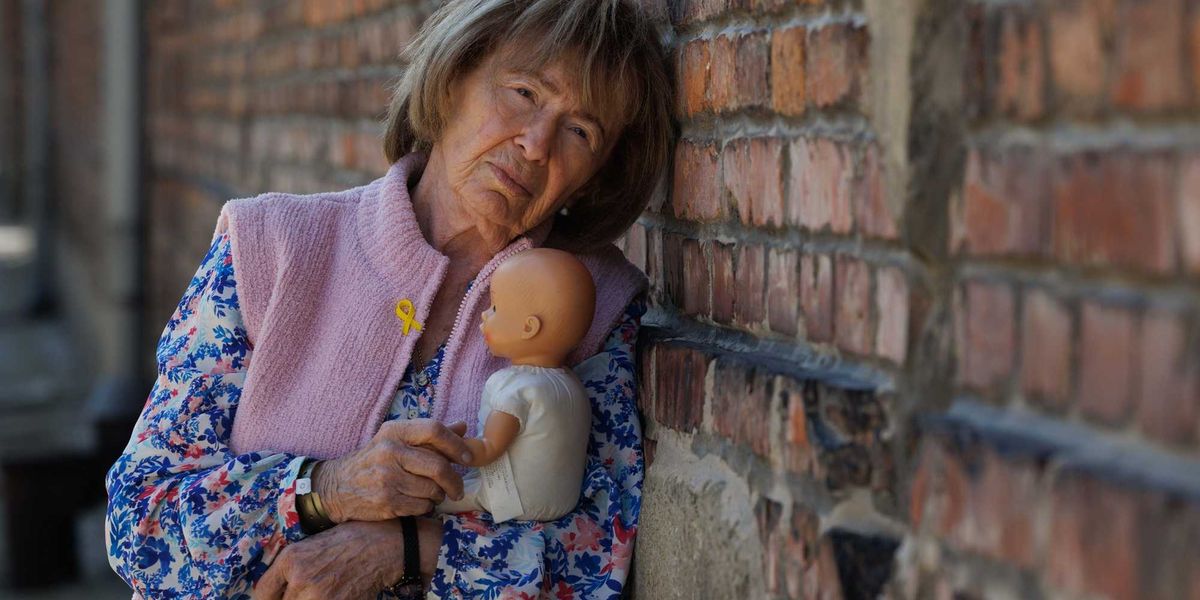
Irene Shashar walked hand in hand with her mother through the streets of the Jewish ghetto in Warsaw, Poland, surrounded by three‑meter‑high walls with electric wires, lifeless bodies, and German soldiers — their mission was to look for food to bring back and share with her father.
“They’re coming! They’re coming!” a crowd shouted in Polish when they saw Irene (then named Ruth) and her mother returning from their errand. Her mother pulled her quickly by the arm, and they ran up the stairs. When they reached the top, they saw that the kitchen floor was no longer white — it was covered with her father’s blood after a German soldier shot him in the neck.
“My mommy… she threw herself on top of him and let out a scream that could be heard on the other side of the globe. There was my father, lifeless, white shirt, suspenders, navy‑blue pants, lying on the kitchen floor,” recalls Shashar, a Holocaust survivor.
wenty percent of the world’s population has never heard of the Holocaust; 48% do not recognize its historical accuracy, and 4% claim it was a myth. Distortion and minimization continue to grow steadily, according to the Anti‑Defamation League’s 2025 survey.
There are fewer and fewer Holocaust survivors who can testify to future generations. Many of the few who remain are those who survived as children, like Shashar — the last generation of Jews born before the founding of the State of Israel.
After the war, Shashar was orphaned in Paris and arrived in Peru, where — she says — life smiled at her for the first time. “I went from one country to another… I thank Peru for welcoming me. It wasn’t easy,” she said from her home in Israel, where she later became the youngest professor at the Hebrew University of Jerusalem.
Shashar explains that her dream had always been to reach Israel someday, after living as a wanderer and immigrant during the early years of her life because of World War II.
Not only are there conspiracy theories that deny the Holocaust, but also attempts to minimize or deny that it was a crime against humanity — evidence that antisemitism remains very much alive worldwide.
Ofer Laszewicki, a Spanish‑Israeli journalist and descendant of Holocaust survivors, is an example of this phenomenon. He grew up without cousins, uncles, or any relatives on his mother’s side, leaving a deep void in his life.
That absence led him to investigate his family’s past in Lublin, Poland. Laszewicki was in Lipowa Square, where the Nazis established their first small concentration site in 1939 to detain local Jews.
“I go there, and there’s only a tiny plaque… I was just going to take photos when a woman with a murderous look approaches me… she looks me in the eyes and says in English: ‘Lublin is very Jewish, Hitler was right, f*** you,’” Laszewicki testified, explaining that the woman said this while mimicking a beheading gesture with her hand.
This happened in February.
In the United States, antisemitism increased by approximately 360% in the months following Hamas’s attack on Israel on October 7, 2023, according to the Anti‑Defamation League (ADL).
Especially on university campuses.
In response, the U.S. Commission on Civil Rights met on February 19 to investigate allegations of antisemitic incidents reported by students and faculty and to evaluate whether these institutions have violated federal civil rights protections.
“I believed I could bring my full Jewish identity into this space and still feel welcome, and on my first day of classes, that belief was shattered. That morning I woke up and discovered that my mezuzah had been ripped off my doorframe,” testified Sarah Silverman, a Harvard student.
Courts and institutions in the country have openly stated that Zionism and anti‑Zionism are purely political perspectives or positions. Therefore, they would be considered protected speech under Title VI of the Civil Rights Act, even if such speech creates a hostile environment for Jewish students.
“Title VI is a law against discrimination, not a general law against hostility, and the essence of discrimination is adverse treatment because of a protected characteristic (race, color, or origin). People treat each other badly in many ways,” said Ben Idelson, a professor at Harvard University.
Carly Gammill, director of legal policy at StandWithUs — an international, nonpartisan organization dedicated to education about Israel — explained:
“Zionism is not a partisan platform. It is not a public‑policy preference. For the vast majority of Jews around the world, Zionism is a central component of their Jewish identity: an ancestral connection to the land of Israel, historically known as Zion, regardless of government policies or actions. In fact, those who organize anti‑Zionist campaigns on campuses know this perfectly well.”
Shashar has made her life a mission: to remain silent no more and continue sharing her testimony. She has been invited to the March of the Living in Poland and to speak before the United Nations. She explains that arriving in Israel was a crucial moment in her life.
“Little by little, I began to feel like I belonged, like an integral part. And when David, my son, was born,” she said, pointing to the cover of her book, I Defeated Hitler, which shows a family photo with her children and grandchildren. “That’s when I became 100% Israeli,” she said with a smile that reflected victory and peace.
Danna Matheus is a senior Journalism student at the University of Maryland, with an interest in covering vulnerable communities worldwide and social justice. Matheus completed this piece as a media fellow with Fuente Latina.