
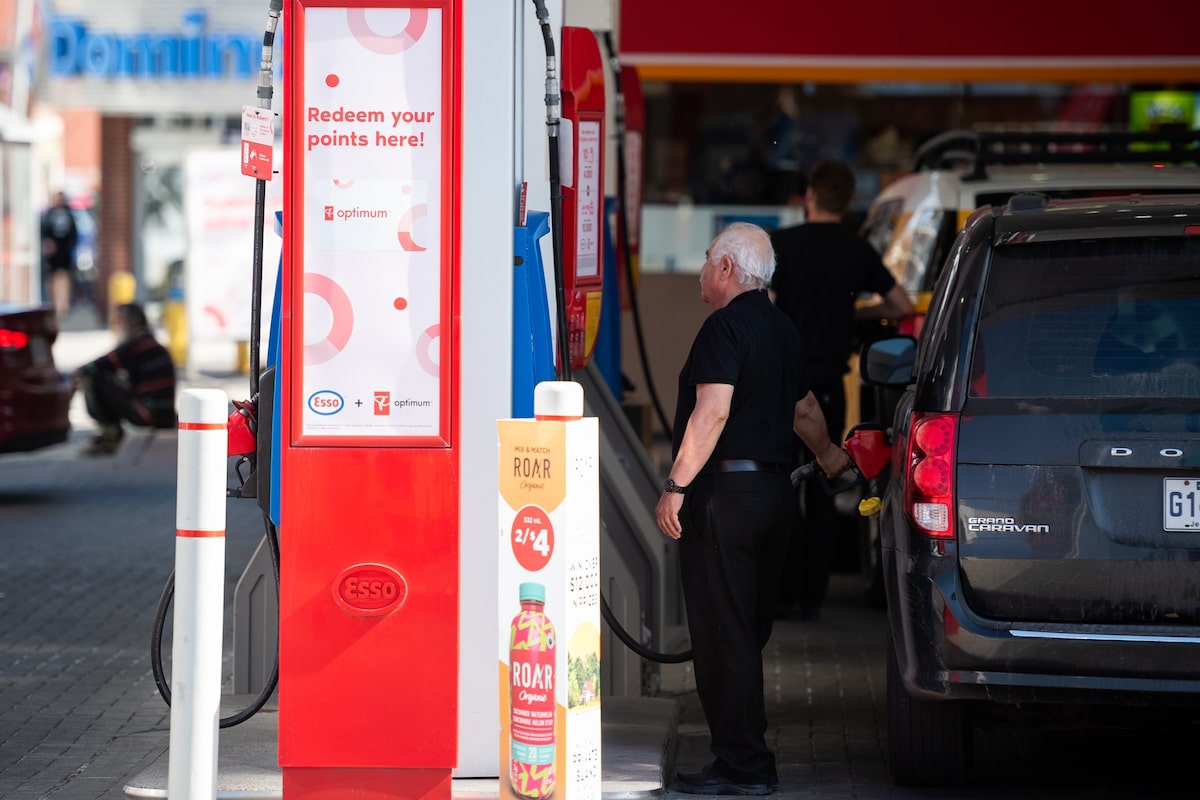
Motorists fill up their cars at a gas station in Ottawa. Gas prices surged 21.2 per cent in March from February.Spencer Colby/The Globe and Mail
Canada’s inflation rate jumped in March as consumers faced the largest monthly gas-price increase on record, owing to the Iran war.
The annual inflation rate hit 2.4 per cent last month, accelerating from 1.8 per cent in February, Statistics Canada reported Monday in its consumer price index report. Despite the quickening of inflation, the figures came in weaker than analyst expectations of 2.6 per cent.
Gasoline prices have risen sharply in recent weeks because of the Middle Eastern conflict, which has throttled deliveries of crude oil and other commodities through the critical Strait of Hormuz.
Prices at the pump surged by 21.2 per cent in March from February, the largest monthly increase recorded by Statscan. Excluding gas, the CPI rose by an annual 2.2 per cent in March, versus 2.4 per cent in February.
“It could have been worse,” said Bank of Montreal chief economist Doug Porter in a note to clients. He added that “the picture for underlying inflation was a bit better than expected, and continues the recent pattern of steadily moderating core inflation trends.”
Monday’s report did little to sway predictions for the Bank of Canada.
The central bank is widely expected to hold interest rates at 2.25 per cent at next week’s announcement on April 29. Interest rate swaps, which capture market expectations of monetary policy, were pricing in one quarter-point hike by the end of the year as of Monday, according to Bloomberg data, similar to odds on Friday.
Revised BoC survey of firms found higher expected input prices after Iran war
The Bank of Canada held rates steady in March, in the early days of the world and oil-price shock. Governor Tiff Macklem has said the central bank is prepared to raise interest rates if the shock feeds into a broader set of prices and pushes up inflation expectations. But he has generally downplayed the risk of this happening in the near-term, with slack in the Canadian economy acting as a counterweight to inflationary pressures from energy prices.
Energy costs are largely the only factor pushing up inflation, CIBC Capital Markets senior economist Andrew Grantham said in a note to clients.
“For now we expect few signs of increased inflationary pressures outside of the direct impact on energy costs,” he said. Food inflation is expected to ease and higher air-travel costs will likely impact inflation rates in the summer, he added.
Food costs rose 4.4 per cent year-over-year in March, up slightly from February’s rate increase. The price of fresh vegetables saw the largest increase since August, 2023, with the reading coming in at a 7.8-per-cent increase year-over-year. Consumers shopping for cucumbers, peppers and celery in particular felt the pinch, with all three products seeing “notable price growth” linked to shorter supplies because of “adverse growing conditions in producing countries,” Statscan said.
Economists expect April’s inflation rate to rise again, to around 3 per cent.
Gas prices are again expected to be a key factor, according to TD senior economist Leslie Preston. Despite having fallen as a result of the U.S.-Iran ceasefire agreement earlier this month – an agreement that is set to expire on Wednesday – oil prices are still nearly 40-per-cent higher than they were a year ago, she said.
Mr. Porter said the April CPI report “already has two strikes against it.” Gasoline prices remain high, despite the gas tax break announced last week by Prime Minister Mark Carney. Further, the removal of the consumer carbon levy last spring – which had created a drag on inflation numbers – will no longer be part of the year-over-year calculation.
“Depending on where oil prices go and how long the Strait remains closed, it’s possible that April will mark the high-water point for inflation this year (with heavy, heavy emphasis on ‘possible’),” Mr. Porter wrote.
Mr. Grantham of CIBC expects inflation rates to likely climb over the summer before easing toward the end of the year.
The central bank’s quarterly business and consumer surveys published Monday showed that near-term inflation expectations have risen in response to the Middle East conflict. However, longer-term inflation expectations – the key concern for the central bank – remain relatively subdued.
The business survey took place before the outbreak of the war. Follow-up calls by the central bank found that businesses in “upstream” segments of the value chain – agriculture, oil and gas, manufacturing and transportation – have already experienced cost increases. Some companies further down supply chains expect input costs to rise in the coming months.
At the same time, businesses reported constraints on their ability to pass rising input costs along to customers. A weak demand environment, constrained consumer budgets and elevated competition all makes it difficult to raise prices.
Even if the Iran war continues, the spike in energy prices is a “relative price shock that will have only minor spillovers to core inflation metrics,” Royce Mendes, head of macro strategy at Desjardins Securities, said in a note to clients.
“The Bank of Canada should be able to remain on the sidelines for the rest of this year,” he said.
With a report from Mark Rendell