
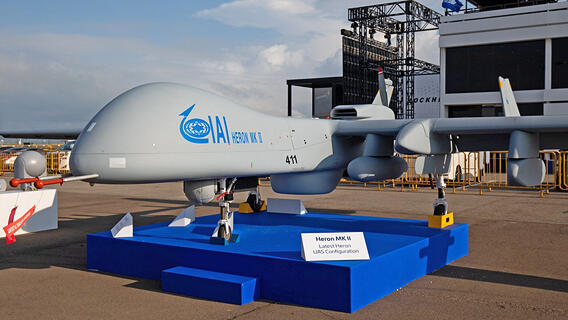
The Israeli Air Force is establishing a new squadron of unmanned aerial vehicles (UAVs) based on the Heron MK II, developed by Israel Aerospace Industries. Calcalist has learned that the first aircraft are expected to be delivered as early as next month, with the squadron scheduled to become operational this summer at Hatzor Airbase.
The new unit will operate alongside an existing squadron at the base that already uses similar UAVs for intelligence gathering, real-time surveillance, and long-range strike missions, including operations deep inside Iran.
1 View gallery
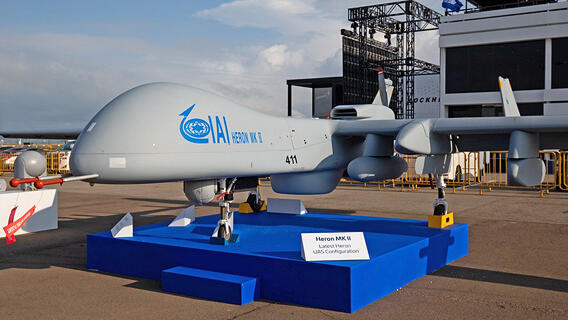
Heron MK II.
(Photo: Bloomberg)
The procurement comes amid a sharp increase in operational demand since the outbreak of the October 7 war. “We need a significant number of remotely piloted aircraft, and we are in the process of strengthening this capability,” said Col. K., head of the Air Force’s Remotely Piloted Aircraft Department. “Before the war, these aircraft flew hundreds of thousands of hours annually. Since then, their activity has increased fivefold.”
Neither the Air Force nor the IDF disclosed the total value of the deal, under which approximately 20 Heron MK II UAVs will be supplied. The agreement also includes mission-specific payloads tailored to operational needs, ranging from surveillance systems and real-time intelligence collection tools to strike capabilities.
The base price of each UAV is estimated at around $10 million, with additional payloads potentially increasing the cost by several million dollars per unit.
For comparison, last year Israel Aerospace Industries sold three Heron TP UAVs to Germany for approximately $1.2 billion. That deal included ground systems, munitions, payloads, training, and long-term support services.
Alongside advanced fighter jets such as the F-35 Lightning II, the UAV fleet has played a central role in Israel’s recent military campaigns. In the two rounds of fighting involving Iran over the past year, unmanned systems operated intensively and remain on high alert amid an unstable ceasefire that could collapse at any time.
“We have demonstrated extensive capabilities, including operations reaching Iran,” said Col. K. “These systems help open corridors for manned aircraft, locate missile launchers, and strike strategic targets. Their main advantage is that they can operate in complex environments without risking human life.”
The Air Force confirmed that several UAVs were lost during operations, including nearly ten during last summer’s campaign. While it did not provide figures for the most recent fighting, officials described an incident in which a missile exploded near a UAV, damaging its fuel tank and wings. Despite the damage, the aircraft returned safely to base.
“It landed at Hatzor despite significant damage and was repaired and returned to service within about a week and a half,” said Col. K. “The systems themselves functioned properly. Losses were caused by enemy fire, not technical failures. This is part of warfare, and our operational capabilities were not affected.”
The continued conflicts across multiple fronts have stretched the Air Force’s operational demands. UAVs are now deployed not only in Iran and Lebanon, but also along Israel’s borders, over offshore gas infrastructure, in the Red Sea and Yemen, in Syria, and in Gaza.
The new squadron will be the latest addition to a growing UAV fleet that includes Heron TP (“Eitan”), Hermes 450 (“Zik”), and Hermes 900 (“Kochav”) systems, alongside newer platforms still undergoing testing.
In parallel, the Air Force is advancing plans to introduce the Hermes 650, developed by Elbit Systems, which is expected to enter service within the next two years. The aircraft is designed to complement, and eventually replace, older systems such as the Hermes 450.
The Hermes 650 features a more powerful engine and greater payload capacity, enabling it to carry more advanced systems and weaponry. For now, it will operate alongside existing platforms, with potential expansion depending on future operational needs.
“The UAV array will continue to expand in both capability and operational scope,” said Col. K. “These systems are becoming central across all theaters. Their development in Israel allows for faster integration and adaptation to operational requirements.”