
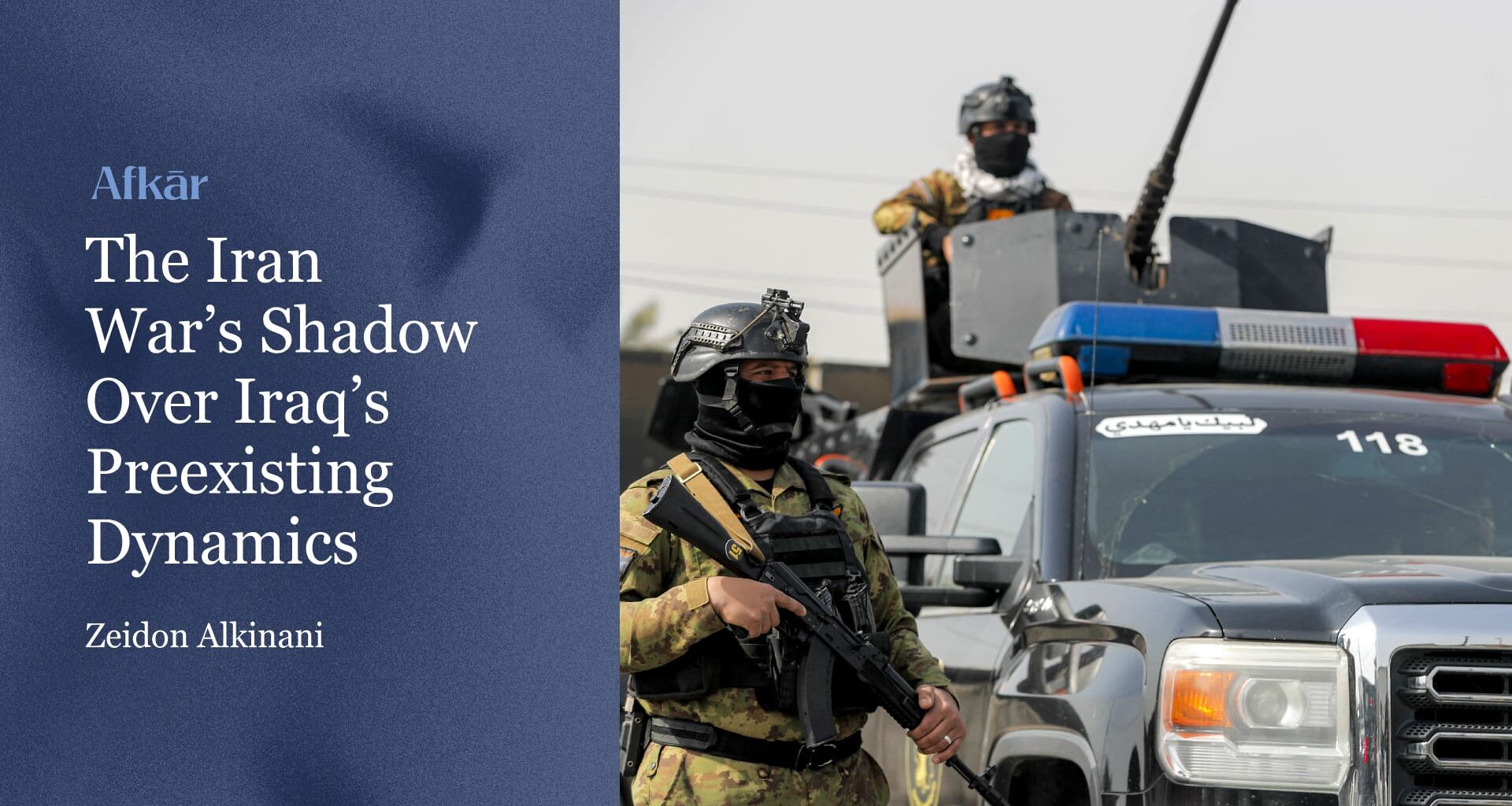
For Iraq, the Iran war is not simply another regional crisis spilling across its borders. It is foregrounding fundamental questions about the country’s post-2003 political order itself: the extent of Iranian influence, the future of relations with the Arab Gulf and the United States, and the role of Iran-aligned factions within the state-sanctioned Popular Mobilization Forces (PMF).
Yet changes on these fronts are not a result of the war alone. They were already underway during a transformative period in Iraq’s political environment that preceded the assassination of Iran’s Supreme Leader Ali Khamenei on February 28, and the conflict that has followed. Over the past several years, Iran’s position inside Iraq had become more contested, Gulf states were recalibrating their approach to Baghdad, and Iraqi leaders were grappling with how to manage powerful armed factions that operate both within and beyond the state.
Thus, rather than creating an entirely new political reality, the war has accelerated existing trends and exposed unresolved tensions. It has also sharpened U.S. and the GCC expectations, as Baghdad is forced to navigate long-standing questions of sovereignty, security, and regional alignment under far greater pressure.
The Pre-War Evolving Iranian Influence in Iraq
Iran proved to be the principal beneficiary of the 2003 U.S.-led invasion of Iraq. The collapse of the Ba’athist state created a power vacuum that Tehran was uniquely positioned to exploit, embedding itself within the Iraqi political order through a dual strategy of armed patronage and the cultivation of political proxy networks. Iran-aligned factions secured representation in parliament and ministerial cabinets, ensuring Tehran retained institutional leverage over Baghdad’s decision-making.
This foothold deepened further with the establishment of the PMF in 2014—an umbrella coalition of predominantly Shia armed factions mobilized in response to the Islamic State’s sweeping advance across northern and western Iraq. Iran moved swiftly to shape the PMF from within, positioning its most loyal factions—Asaib Ahl al-Haq, Kataib Hezbollah, and al-Nujaba—at the helm of its leadership structure and securing their access to state funding. In so doing, Tehran helped transform parts of a nationally sanctioned defense body into instruments of its regional strategy.
Yet Tehran’s role in Iraq has always been more contested than conventional narratives suggest. Much of the scholarship on post-2003 Iraq situates the primary resistance to Iranian influence within Sunni and Kurdish political blocs—a framing that obscures a more consequential dynamic. It is within the Shia political landscape itself that the most persistent and structurally significant challenges to Tehran have emerged, reflecting the ideological diversity of Iraq’s Shia community rather than the monolithic bloc it is often portrayed to be.
The Sadrist Movement carved out a distinctly Iraqi Shia identity resistant to Iranian tutelage, while prominent Shia leader Ammar al-Hakim’s break from the Iran-aligned Badr Organization to found al-Hikma represented a deliberate repositioning toward a more balanced engagement with both Washington and the Arab Gulf. The sharpest rupture, however, emerged not from elite realignment but from the streets. The Tishreen protest movement, which swept across Shia-majority provinces beginning in October 2019, constituted the most consequential grassroots challenge to the post-2003 order. Young Shia Iraqis turned their anger on their own political class, and especially on those operating within Iran’s sphere of influence. The protests made clear that limiting Tehran’s reach had become—in the public imagination—inseparable from the broader reform agenda: fighting corruption, ending political impunity, and finally improving economic conditions and public services.
These various stances within Iraq’s Shia political elite reflect its ideological diversity. The Shia political community is far more heterogeneous than Iraq’s consociational “Muhasasa” system suggests—a political framework that artificially flattens these divisions by simply allocating the prime ministership to Shia Arabs, the presidency to Kurds, and the parliamentary speakership to Sunni Arabs.
Reviving Unresolved Issues Amid the War
It was not long before the ongoing war rapidly drew Iraq into its orbit. Iran-aligned PMF factions launched attacks against U.S. interests in Iraq and neighboring countries, while Baghdad simultaneously found itself a target of U.S. military strikes, cementing its position as a battleground for competing foreign agendas.
The economic fallout has been equally severe. Disruption to oil flows through the Strait of Hormuz has dealt a critical blow to Iraqi oil revenues, which account for more than 90 percent of the national budget. This threatens the government’s ability to fund public services and sustain its already fragile social contract with its citizens.
This has renewed a longstanding question in Iraqi politics: what to do with the PMF? For years, the answer has oscillated between containment and elimination. Containment has been the default position of successive Iraqi governments, recognizing that dismantling the PMF is neither politically feasible nor militarily prudent. Its most powerful factions are deeply embedded within the state, draw government salaries, maintain independent command structures, and retain backing from Tehran. Past efforts to absorb PMF factions into the formal military chain of command, most notably under former Prime Minister Mustafa al-Kadhimi, yielded limited results as Iran-aligned groups resisted integration and continued to operate as a state within a state.
Formally subordinate to Iraq’s prime minister, the PMF’s most Iran-aligned factions have repeatedly acted outside state orders—most visibly in their posture toward the United States. The PMF is not monolithic: some factions treat confrontation with U.S. forces as an ideological duty, while others favor de-escalation, fearing devastating strikes and the erosion of Iraqi state legitimacy. This divide reflects the broader tension between Iraqi national interest and alignment with Iran.
Eliminating the PMF, meanwhile, has remained largely within the realm of public discourse rather than actionable policy, given the risk of armed confrontation and political destabilization. The Iran war has sharpened this debate, with Baghdad facing growing external pressure to move beyond containment. Yet the structural conditions that made the PMF’s dismantlement implausible before the war remain firmly in place.
Caught Between Sovereignty and Proxy Politics
Iran also benefited from years of Iraq’s strained relations with its GCC neighbors. Unlike its Gulf rivals, particularly Saudi Arabia, Tehran astutely recognized that influence in Iraq could not be secured through Baghdad alone. Instead, it engaged Iraq’s full political ecosystem: cultivating armed factions, navigating the weight of the Shia clerical establishment—the Marja’iyah—under Sayyid Ali al-Sistani in Najaf, and building ties with both Kurdish and Sunni political elites. This granular understanding of Iraq’s fragmented political landscape allowed Iran to consistently outmaneuver its GCC counterparts.
In recent years, however, the GCC’s approach toward Iraq has undergone a notable recalibration. Gulf states have progressively moved away from a sect-centric foreign policy framework, driven by a growing recognition of the distinction between the Iraqi state and the deep state cultivated by Iran-aligned factions. This shift has translated into deeper Gulf economic engagement with Baghdad as a sovereign partner, while maintaining a wariness toward the parallel structures operating beneath it.
The current war has tested the limits of that distinction and prompted a firmer diplomatic posture from GCC states toward Baghdad. When Iran-aligned factions in Iraq launched direct strikes against Gulf countries as part of Iran’s wartime retaliatory strategy, Gulf governments made clear that Baghdad would be held to a higher standard of accountability for actions conducted from its soil.
For Iraqi leaders, the balancing act has become more difficult. Baghdad had sought to insulate itself from the region’s post-October 7 conflicts through an “Iraq first” policy that projected an image of greater control over its own security environment. But as the war expanded, Iraqi officials once again found themselves walking a tightrope—offering public condolences over Khamenei’s assassination while rebuffing Iranian pressure to enter the war, directing security forces to safeguard diplomatic missions and oilfields, and dismissing senior military and intelligence officers to demonstrate their resolve.
The Iraqi government finds itself caught between pressures it cannot fully escape. In March 2026, the National Security Council authorized the PMF to respond defensively to attacks on their positions in an attempt to balance force protection with avoiding open confrontation with Washington. Yet Iran-aligned factions retain sufficient autonomy to operate without Baghdad’s approval, and authority on paper does not translate into command on the ground. The March decision is best understood not as a policy of escalation, but as a managed concession to factions the state cannot control, and a telling measure of how constrained Iraqi sovereignty truly is.
Still, a shared interest unites the Iraqi government, the Iraqi public, Washington, and the Gulf states: strengthening Iraq’s autonomy from Iranian influence. Yet Baghdad and its GCC neighbors share an additional, more delicate calculus—that this influence must be curtailed in a manner that stops short of threatening Iran’s national security, lest the resulting instability ripple across an already fragile regional order.
The Iran war has not resolved these tensions; it has intensified them. The central question now is whether Baghdad can—amid this moment’s extreme geopolitical volatility—simultaneously curtail Iran-aligned networks, preserve external partnerships, and deepen state sovereignty without provoking internal rupture or external escalation. Equally, the U.S. and Gulf states must also tread carefully, ensuring that pressure on Iraq does not tip into the type of isolation that Tehran could readily exploit to reassert the very influence these parties seek to diminish.
The opinions expressed in this article are those of the author and do not necessarily reflect the views of the Middle East Council on Global Affairs.