
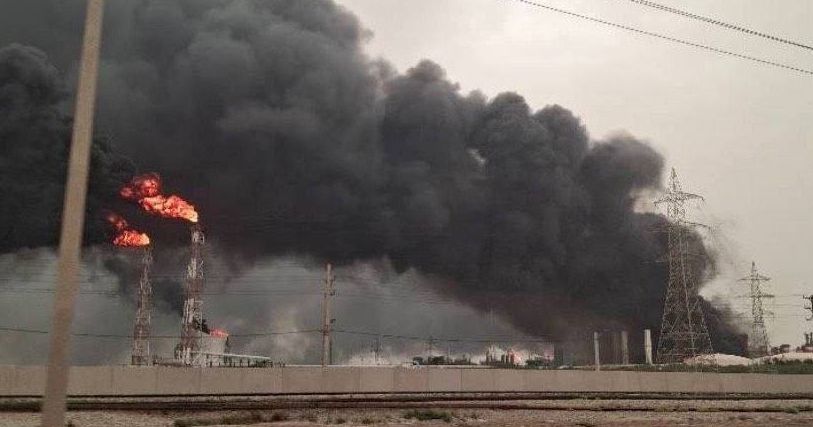
The war launched by the United States and Israel against Iran began on February 28 and continued until April 7, when a two-week ceasefire was announced. The ceasefire was extended on April 21, but a US blockade of Iranian ports remained in place.
Miad Maleki, a senior fellow at the Foundation for Defense of Democracies and a former senior sanctions strategist at the US Treasury, said Iran had spent decades threatening to close the Strait of Hormuz but had never prepared its own economy for the consequences including the naval blockade.
“If we’re at the point that we have to close the Strait of Hormuz, can our own economy handle $455 million a day in trade that we have to rely on going through the Strait of Hormuz?” Maleki said, referring to his earlier estimate of Iran’s daily loss during the US blockade which has been in place since April 13.
100%
Miad Maleki
He said the answer was becoming clearer as the war, blockade, currency crisis and damage to key export sectors placed Iran under pressure faster than its adversaries.
While Hormuz disruption has created serious risks for global energy markets, Maleki argued that Iran’s own economic exposure to the waterway made Tehran more vulnerable than the countries it was trying to pressure.
 What the US naval blockade would mean for Iran’s economy
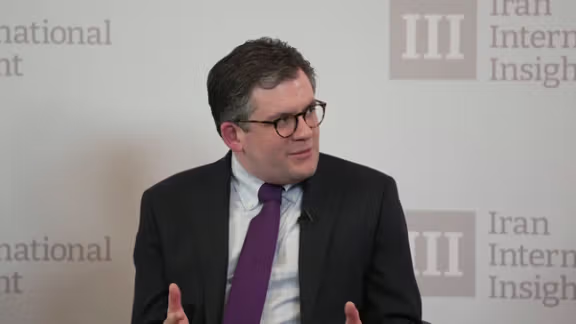
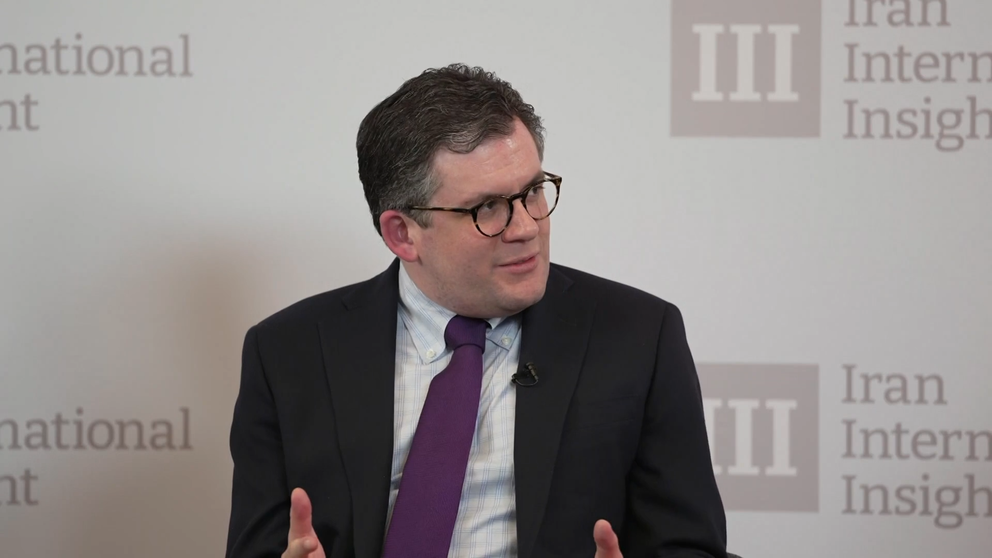
Jason Brodsky, policy director at United Against Nuclear Iran, said Trump appeared willing to test that weakness through a strategy of coercive diplomacy backed by military force.
“He lays out the military option, prepares the theatre for US Central Command,” Brodsky said. “He then offers a diplomatic off-ramp for the Iranian regime. He lays out US terms and gives a deadline. And if the Iranian regime doesn’t play ball, he strikes.”
Who blinks first?
The discussion repeatedly returned to the question of who would break first: Iran, the United States, or the global economy. The blockade, imposed on April 13, has added to the pressure on Iranian trade, while Tehran’s disruption of Hormuz has turned the confrontation into a test of economic endurance for Iran, Washington and major Asian energy consumers.
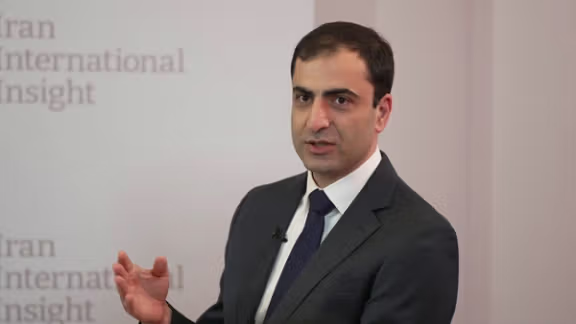
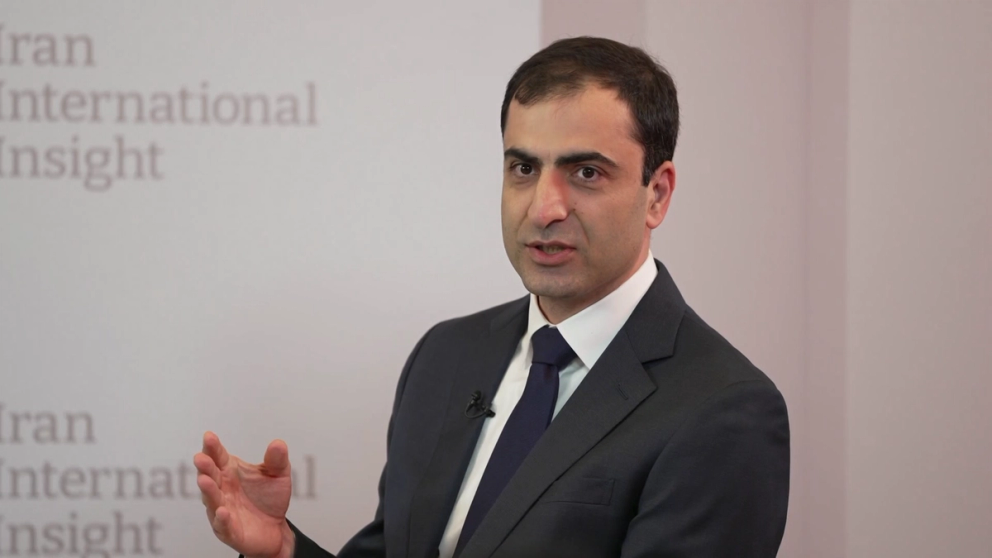
Bozorgmehr Sharafedin, head of digital at Iran International and moderator of the townhall, said Iran’s disruption of Hormuz amounted to Tehran “putting sanctions on the world,” while the US blockade showed Washington using military power to enforce sanctions.
100%
Bozorgmehr Sharafedin
Maleki said Asian economies would be the first major external victims of a prolonged Hormuz crisis because of their heavy dependence on energy flows through the strait. But he said the global impact did not change the basic balance of vulnerability.
“Asia is the first,” Maleki said, referring to economies dependent on energy flows through Hormuz. “North Korea, Japan, China and India, 89, 90 percent of their petroleum, 75 percent of their natural gas comes through the Strait of Hormuz. We’re not here in the US the main target of the economic ramifications of the Strait of Hormuz, but what’s happening in those countries will affect our economy.”
Still, he said, Iran had far less time to absorb the shock.
“The clock is much faster on Iran’s economy side than it is on our own side,” Maleki said. “But we know historically that the Iranian regime doesn’t really care to the extent that Iranians are starved or dealing with major economic issues.”
Brodsky said Trump was also likely willing to sustain pressure longer than many expected because he was in his second term and focused on legacy.
He argued that Washington had achieved through force what diplomacy alone had failed to achieve, including pushing Tehran to reportedly consider a one-year suspension of uranium enrichment.
100%
Jason Brodsky
“President Trump is willing to go at this for longer than most people expect,” Brodsky said. “He is willing to take that risk because he is in legacy-building mode at the moment.”
Iran’s postwar economy
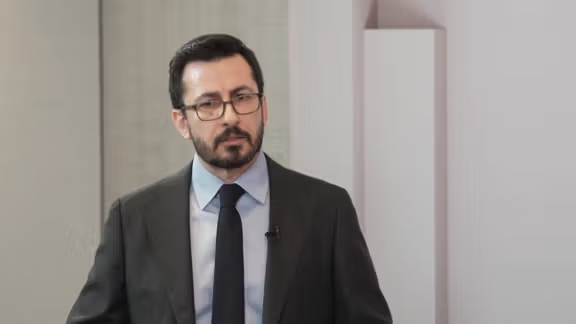
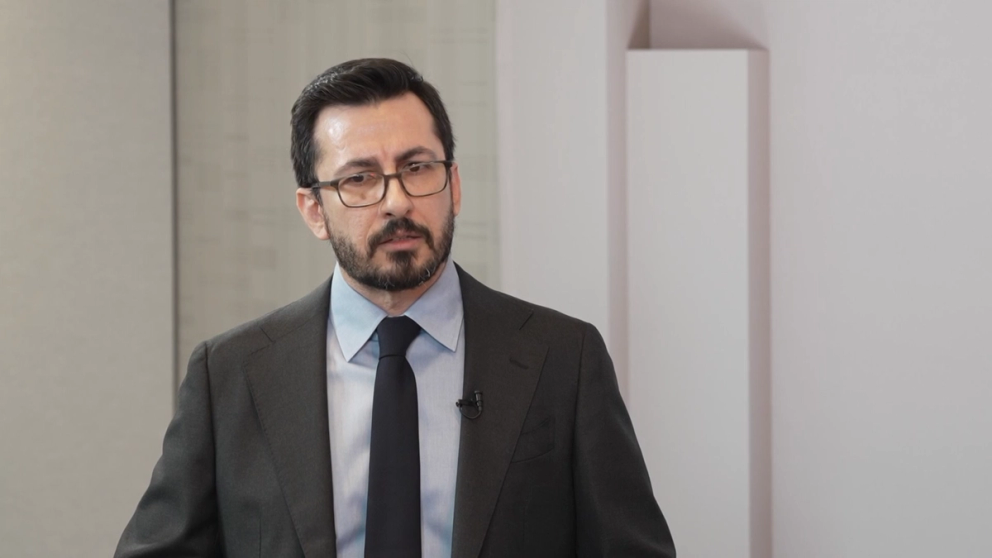
Mohammad Machine-Chian, a senior journalist covering economic affairs at Iran International and former head of market research at EcoIran, said Iran’s stock market had been closed for eight weeks, an unprecedented development in the history of the Tehran Stock Exchange.
He said the closure allowed policymakers to pretend prices had remained normal, while in reality the war had changed the value of companies, assets and investor expectations. The market, he said, was already in crisis before the war, even though nominal gains had masked the impact of inflation above 70 percent.
100%
Mohammad Machine-Chian
Machine-Chian said banking was “in shambles,” the auto industry was deep in trouble, and the market had been relying heavily on export-oriented sectors such as petrochemicals, steel, oil and gas-related companies. Many of those sectors, he said, had been damaged or disrupted by the war.
“Even if they reopen the market, there’s no petrochemical, there’s no steel,” Machine-Chian said. “They have to rely on the banks, car manufacturers and other industries that rely on basically petrochemicals to begin with in the supply chain.”
He said a crash was likely if trading resumed, even with official limits preventing shares from falling by more than five percent a day.
“It doesn’t make any sense,” Machine-Chian said of those limits. “Nonetheless, that’s the way they’re managing it, but even in that scenario, I don’t think they can afford to open the markets.”
Machine-Chian said the economic crisis had reached a point where inflation should be discussed monthly rather than annually. In a best-case scenario involving a comprehensive agreement, he estimated inflation could still average at least five percent a month for the rest of 2026.
“I’m talking about inflation in months, no longer in years, and that is the reality we’re dealing with,” he said.
He said that in a “no war, no peace” scenario, prices could triple over the year. In the event of another conflict, he warned monthly inflation could exceed 20 percent, pushing annual price increases toward 500 percent.
Sanctions relief would not be quick
Maleki said even a diplomatic agreement would not quickly revive Iran’s economy because the sanctions regime is complex and private banks and companies remain deeply reluctant to handle Iran-related business.
He said the experience of the 2015 nuclear deal showed the limits of formal sanctions relief. Even when the US government tried to facilitate limited access to funds, he said, banks refused to touch Iranian money.
“They couldn’t find one single bank,” Maleki said. “Not just US banks, but little, tiny banks without any corresponding relationship with US banks to actually touch the money. At the end of the day they had to put the funds on a pallet and send them in cash.”
Maleki said Iran’s sanctions architecture was more layered than Syria’s and could take months or years to unwind. He added that even regime change would not automatically solve the immediate fiscal crisis.
“If we have a democratic government today, a transitional government established in Iran today, and the Islamic Republic is gone, that transitional government probably is not going to be able to pay government salaries for more than a week or two,” he said.
The warning underscored one of the main themes of the townhall: Iran’s economy is not merely under wartime pressure, but faces deeper structural damage that may outlast the fighting and any short-term diplomatic arrangement.
No access to cash
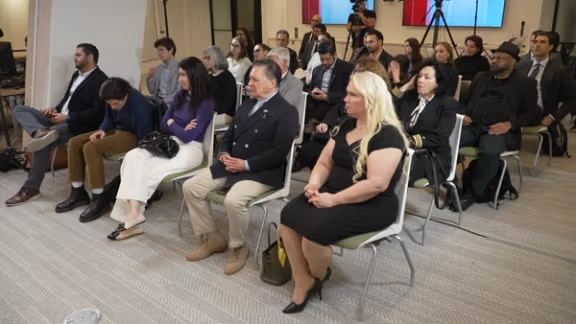
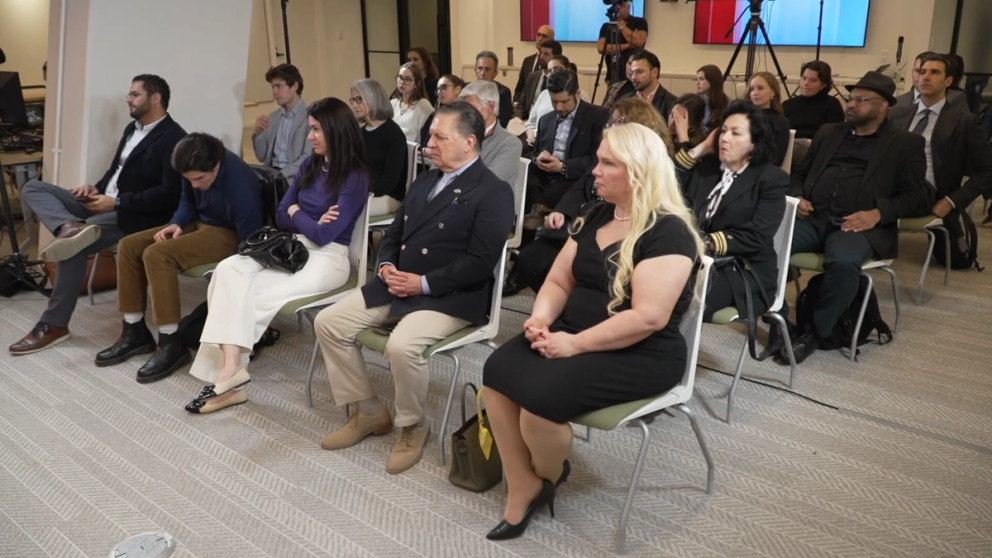
In the Q&A section, an audience member asked whether cash or access to frozen funds could allow the Islamic Republic to recover and rebuild its capabilities after the war.
Brodsky said that would be the worst possible move, arguing that Tehran would use any financial relief to rebuild the same military and security structures targeted during the conflict.
100%
“The worst thing that we could do right now is to flush the regime with cash,” Brodsky said. “It’s going to use that to rebuild its missile program, its nuclear program, its drone program, and all of its repression architecture.”
Maleki said direct cash transfers were unlikely because of legal restrictions, but access to restricted funds or sanctions relief for metals and petrochemicals could still provide Tehran with a lifeline.
He said those details would determine whether Iran’s weakened economy remains under pressure or gains enough room to recover.