
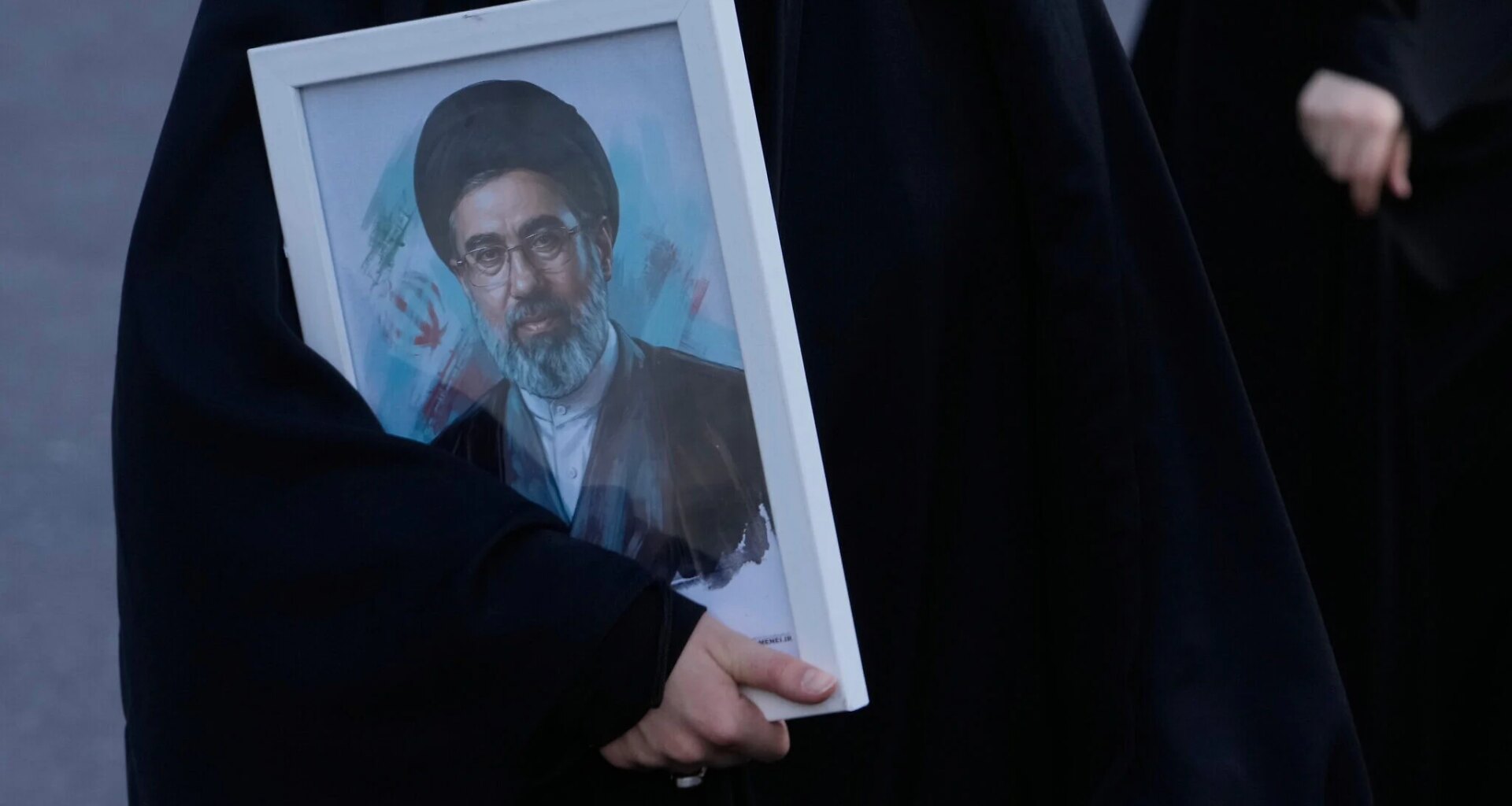
AP — After US-Israeli bombardment eliminated Iran’s supreme leader and much of its top echelons, the Islamic Republic’s leadership didn’t fall apart — but negotiations to end the war offer a new test.
For decades, the supreme leader successfully managed several powerful factions, bringing to heel those who challenged his authority while listening to rival opinions. It’s now unclear who wields that kind of authority over the collection of civilian figures and powerful generals from the paramilitary Islamic Revolutionary Guard Corps who appear to be in charge.
They have found unity — for now — by taking a tough line. But disagreements over how much to concede in negotiations with the United States could reveal fault lines, as Pakistani mediators try to host a new round of talks this week.
A committee now appears to be in charge
In the past, supreme leader Ayatollah Ali Khamenei was able to impose his will on the Islamic Republic’s disparate power centers. After Israeli strikes killed him on the first day of the war, his son Ayatollah Mojtaba Khamenei succeeded him.
But doubts continue to swirl over the younger Khamenei’s role after reports he was wounded in the strikes. Still in hiding, he has not appeared in public since becoming supreme leader and how he gives orders to top leaders is a mystery.
Get The Times of Israel’s Daily Edition
by email and never miss our top stories
By signing up, you agree to the terms
The regime is openly committed to destroying Israel, funds and arms terror groups including Hamas and Hezbollah that share the goal, and has maintained a rogue nuclear program.
At the center of power now is a politburo-like body known as the Supreme National Security Council, which includes Iran’s top civilian and military officials. Mohammad Bagher Ghalibaf, the parliament speaker and a veteran insider with strong contacts on all sides, has emerged as its face and the chief negotiator with the US.
The late Khamenei began giving more authority to the council before his death, but the war has consolidated its power.
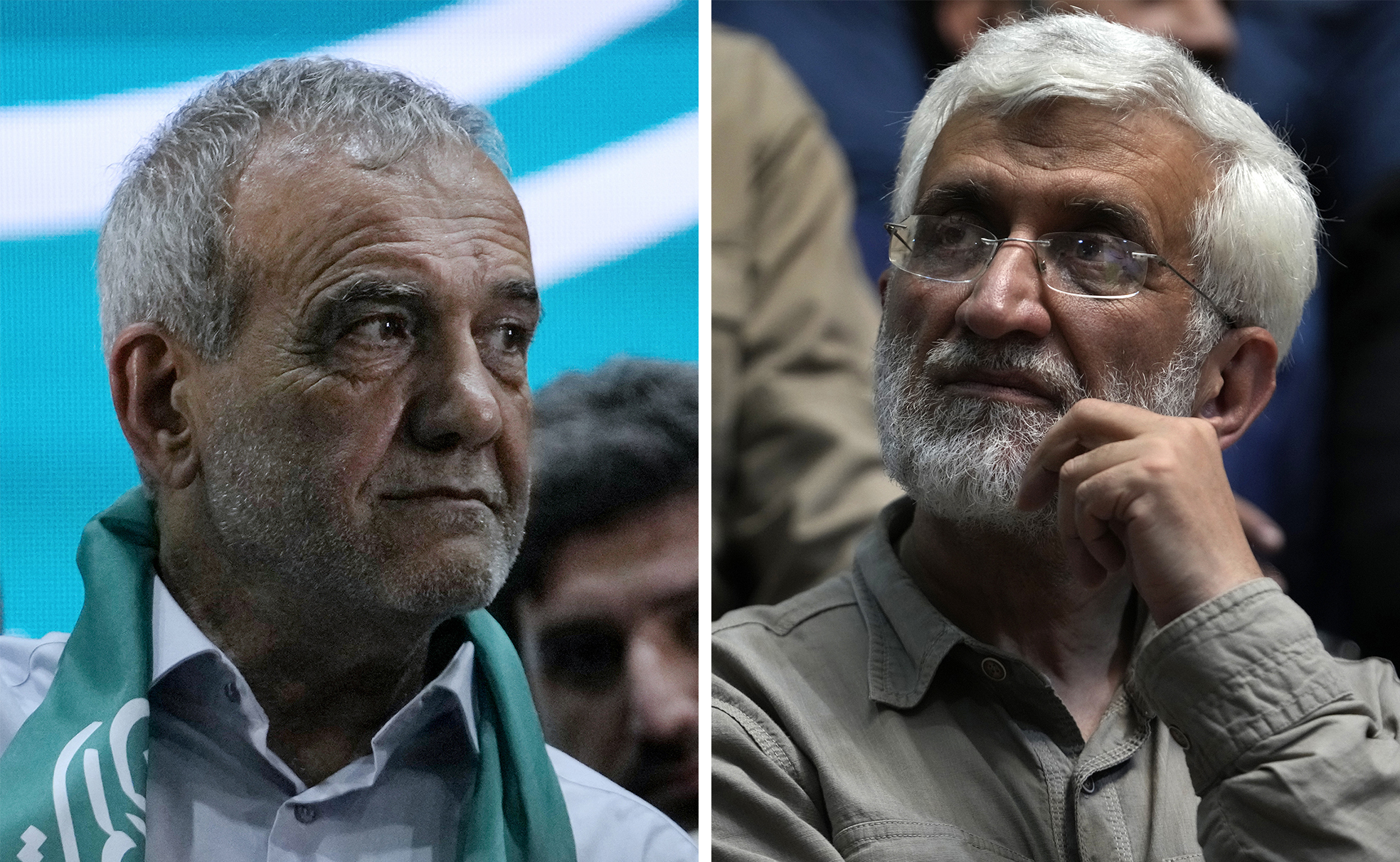
Combination of photos showing Masoud Pezeshkian, left, and Saeed Jalili. (AP/Vahid Salemi)
The council contains a range of political opinions and often acute rivalries. A political rival of Ghalibaf and uncompromising opponent of the US, Saeed Jalili, represents the supreme leader on the council, while the body’s nominal head is reformist President Masoud Pezeshkian.
Hard-liner members include the IRGC’s new chief commander, Ahmad Vahidi, and the council’s new secretary, Mohammad Bagher Zolghadr, also a commander in the IRGC.
But Israel’s strategy of eliminating top leaders points to a misreading of how the Islamic Republic works, experts say.
Iran’s leadership survived “precisely because there are multiple power centers with overlapping authorities,” said Ali Vaez, Iran director at the International Crisis Group. “Factionalism is just built into the DNA of this system.”
But since the war, the IRGC’s growing clout on the council has also stoked speculation that a fundamental change could be coming.
Negotiations with the US will stress test the power structure
The council now faces potentially divisive questions over how far to go to reach a deal with the US, which is demanding Iran make major concessions aimed at ensuring it is never able to develop a nuclear weapon. Iran has long insisted its program is peaceful while saying it has the right to uranium enrichment.
In an interview with Iranian state TV on Sunday, Ghalibaf said Iran wants a comprehensive accord that brings “a lasting peace” where the US no longer attacks the country.
“This dangerous loop needs to be cut,” he said. The US has twice launched strikes on Iran during high-level negotiations: once in the 12-day war in June, then again in the current conflict.
Council members have projected confidence that Iran holds the upper hand now, particularly because its grip on the Strait of Hormuz — a crucial passage for the world’s oil — enables it to drive up fuel prices, thus threatening the global economy and exerting political pressure on US President Donald Trump back home.
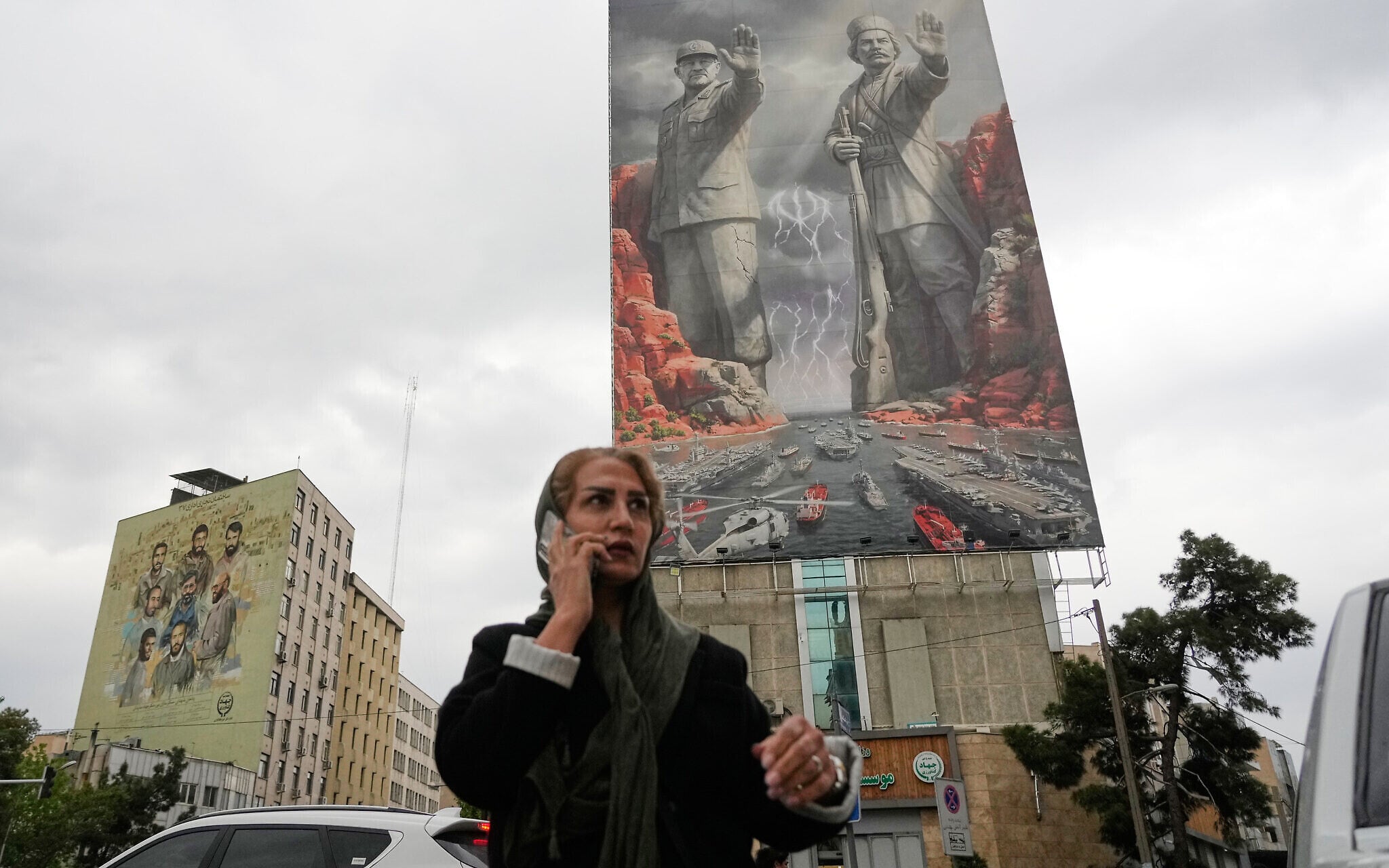
A woman talks on her cellphone as she walks past a billboard showing Rais Ali Delvari, a national hero in an early 1900 uprising against British forces in southern Iran in the Persian Gulf, right, and the late Islamic Revolutionary Guard Corps’ navy chief Alireza Tangsiri, who was killed in the US-Israeli strike in late March 2026, commanding the closure of the Strait of Hormuz, on a building at a square in downtown Tehran, Iran, April 20, 2026. (AP Photo/Vahid Salemi)
Senior officials have insisted they can hold out for assurances that Iran won’t be attacked again — even risking the war reigniting — because they believe Iran can endure the pain longer than the United States and its allies.
But ultimately, the leadership’s priority remains its own survival. The war and the US blockade — which is threatening Iran’s oil trade — are tightening the screws on the country’s cratering economy.
Economic hardship has fueled waves of unrest over the past two decades, including protests in January that openly called for the Islamic Republic’s overthrow. A deal with the West lifting sanctions could help it keep its grip at home.
“It is easier to imagine that the regime would try to make a concession to the West in order to ensure its survival than to its own people,” Vaez said.
Signs of disagreement
Events over the weekend surrounding the Strait of Hormuz gave an indication of serious differences over how much to concede in negotiations. Engagement with Washington has long divided Iran’s top ranks, despite a shared deep mistrust of the US.
On Friday, Foreign Minister Abbas Araghchi announced in a posting on X that Iran was opening the strait to commercial traffic as part of the ceasefire agreement with the US. Hours later, Trump proclaimed that the US would continue its blockade to keep pressure on Iran to reach a deal over its nuclear program.
On Saturday morning, Iran’s military announced that it was reclosing the strait in retaliation for the blockade.
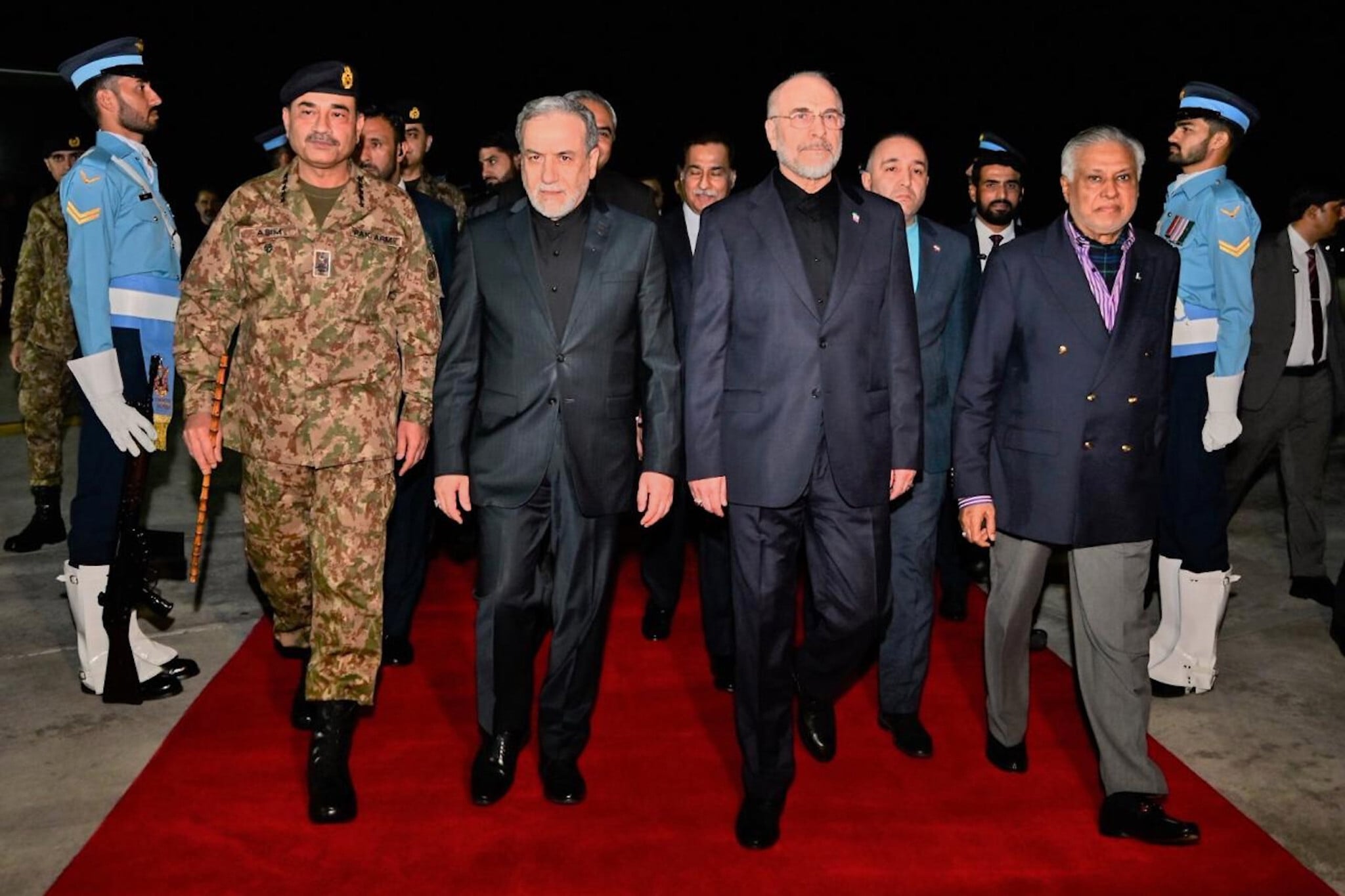
In this photo released by the Pakistan Foreign Ministry, Iran’s Parliament Speaker Mohammad Bagher Ghalibaf, center right, and Iran’s Foreign Minister Abbas Araghchi, center left, are greeted by Pakistan Foreign Minister Ishaq Dar, right, and Army Chief Field Marshal Gen. Asim Munir, left, upon their arrival at Nur Khan airbase in Rawalpindi, Pakistan, April 11, 2026. (Pakistan Ministry of Foreign Affairs via AP)
Some Iranian media criticized Araghchi, suggesting his post created the impression Iran was showing weakness — and revealing the differing positions behind the scenes. A report by the Tasnim news agency, seen as close to the IRGC, said the position on the strait should have come from the National Security Council itself.
Araghchi’s office pushed back, saying the Foreign Ministry “does not take any action without coordinating with higher-level institutions.”
In his interview Sunday, Ghalibaf tried to paper over any divisions, emphasizing that everyone in the leadership was on the same page on Iran’s strategy in US talks.
A possible regime bridge builder
The 64-year-old Ghalibaf is best positioned to bridge divides among Iran’s factions, said Arash Azizi, an Iranian journalist and columnist at the Atlantic who has written on the insider politician and the IRGC.
Ghalibaf is a former general in the IRGC and national police chief and kept close to the IRGC throughout his long political career. As Tehran’s mayor from 2005 to 2017, Ghalibaf gained a reputation as a pragmatist able to get things done — like overhauling an ailing public transport system — even as he faced major corruption and human rights abuse allegations.
Ghalibaf has political currency within the IRGC, “and he has the conservatives on his side. But he also now has very robust backing from the reformists and the centrists,” Azizi said.
Ali Rabie, a well-known reformist and an assistant to the president, wrote last week in a newspaper editorial that Ghalibaf was “the representative of the country and the regime.”
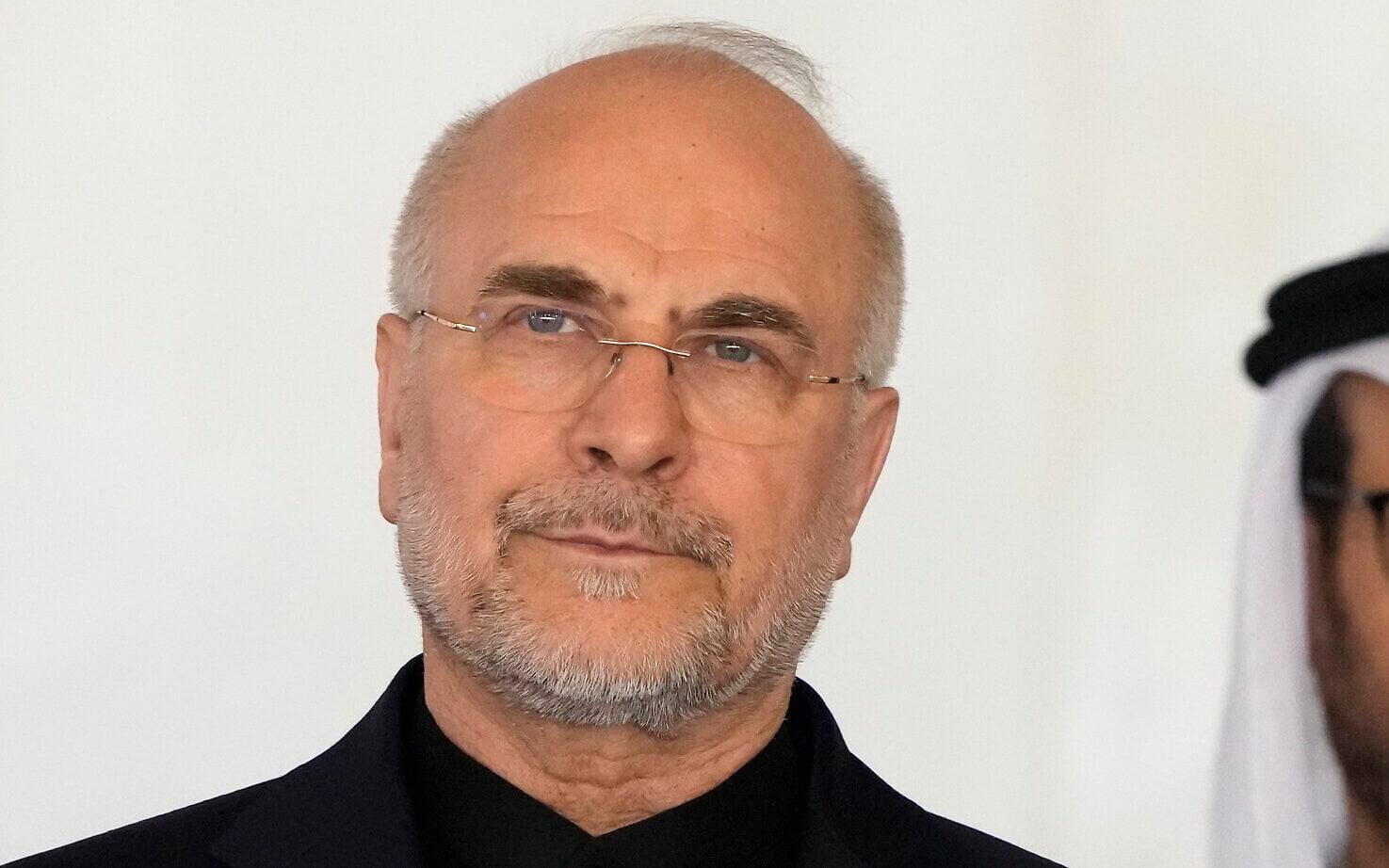
Iran’s Mohammad Bagher Ghalibaf poses during a group photo at the 11th BRICS Parliamentary Forum held at the Federal Senate in Brasilia, Brazil, June 4, 2025. (AP Photo/Eraldo Peres)
At the same time, Ghalibaf is close to the Khamenei family both hailing from the area of the eastern shrine city of Mashhad, said Mohsen Sazegara, one of the founders of the IRGC in the 1980s who is now an opposition figure living in the US During his father’s rule, Mojtaba Khamenei backed Ghalibaf’s several unsuccessful attempts to run for president.
Ghalibaf is also close to the senior Guard figures who stepped in to replace those killed by Israel — and who are widely seen as holding the key to any future agreement with the US His cross-factional backing could enable him to ensure support at home for a deal against blowback from ideologues who will resist compromise.
Times of Israel staff contributed to this article.