
The October 7, 2023, attack
The election of Hamas in 2006 and its subsequent takeover of the Gaza Strip in 2007 prompted Israel and Egypt to blockade the enclave. A series of short conflicts took place between Hamas and Israel, most notably in 2008, 2012, 2014, and 2021, but Israel generally considered the security threat from Hamas to be contained and manageable. With the conclusion in 2020 of the Abraham Accords, a set of normalization agreements between Israel and several Muslim-majority countries, the Arab states increasingly put aside the issue of Palestinian self-determination while other international actors, such as the United States, sought to shift global interest away from the Middle East to other regions. With the world’s eyes turned elsewhere, frustration was mounting in the Gaza Strip and the West Bank with the continued expansion of Israeli settlements, new provocations in Jerusalem around Al-Aqsa Mosque and in nearby neighborhoods, and, beginning in 2022, some of the worst confrontations between Israelis and Palestinians in the West Bank in decades. In late 2023 the United States was reportedly on the verge of concluding an agreement between Israel and Saudi Arabia to normalize relations, a development that was later considered to be a factor in the timing of the October 7 attack.
Hamas, along with other militants in the Gaza Strip, such as the Palestinian Islamic Jihad (PIJ), carried out the October 7 attack on Shemini Atzeret, a Jewish holiday that closes the autumn thanksgiving festival of Sukkot. Many soldiers of the Israel Defense Forces (IDF) were on leave, and its available forces were focused on protecting Israel’s northern border rather than on the Gaza Strip in the south, which analysts considered to be pacified.
The assault began about 6:30 am with a barrage of at least 2,200 rockets launched into Israel in just 20 minutes. During that opening salvo, Hamas used more than half the total number of rockets launched from Gaza during all of 2021’s 11-day conflict. The barrage reportedly overwhelmed the Iron Dome system, the highly successful antimissile defense system deployed throughout Israel, although the IDF did not specify how many missiles penetrated the system. As the rockets rained down on Israel, at least 1,500 militants from Hamas and the PIJ infiltrated Israel at dozens of points by using explosives and bulldozers to breach the border, which was heavily fortified with smart technology, fencing, and concrete. They disabled communication networks for several of the Israeli military posts nearby, allowing them to attack those installations and enter civilian neighborhoods undetected. Militants simultaneously breached the maritime border by motorboat near the coastal town of Zikim. Others crossed into Israel on motorized paragliders.
About 1,200 people were killed in the assault, which included families attacked in their homes in kibbutzim and attendees of an outdoor music festival. That number largely comprised Israeli civilians but also included foreign nationals. A March 2024 United Nations report found evidence that some were victims of sexual violence before they were killed. Adding to the trauma was the fact that it was the deadliest day for Jews since the Holocaust.

Britannica Quiz
Pick Your Battles Quiz
Hostages taken on October 7, 2023Portraits of some of the hostages taken during the October 7, 2023, attacks, displayed on a wall during a rally in Tel Aviv calling for their release.(more)
More than 240 people were taken into the Gaza Strip as hostages. Many of them were taken from their homes and some from the music festival. Including Israelis with dual citizenship, more than half of those taken hostage held passports from about two dozen countries.
The first year of war in the Gaza Strip (2023–24) October 2023: Air campaign
At 8:23 am on October 7 the IDF announced a state of alert for war and began mobilizing its army reserves (eventually calling up more than 350,000 reservists over the next several days). Two hours later, IDF fighter jets began conducting air strikes in the Gaza Strip. On October 8 Israel declared itself in a state of war, and Israeli Prime Minister Benjamin Netanyahu told residents of the blockaded enclave to “get out now. We will be everywhere and with all our might.” On October 9 Israel ordered a “complete siege” of the Gaza Strip, cutting off water, electricity, food, and fuel from entering the territory. Following the recommendation of the Winograd Commission (2008), which investigated the missteps and failures of the 2006 Lebanon War, Netanyahu formed a war cabinet on October 11 comprised of him, defense minister Yoav Gallant, and opposition leader Benny Gantz.
Trusted knowledge for those who want to know more.



As Israel conducted air strikes, international efforts were made to secure the release of the hostages. Qatar, which in years past had coordinated with Israel on the delivery of international aid packages to the Gaza Strip, became the key mediator, but in the first weeks of the war it managed to negotiate the release of only four of the people held by Hamas. Gaza’s subterranean tunnels—an intricate web of passageways extending hundreds of miles that had been built for smuggling and conducting raids—added to the difficulty of locating the hostages as well as targeting militants and their weapons caches: Destroying the tunnels without high civilian cost proved difficult, and conducting military activity inside the tunnels presented a high risk for all those inside, including the IDF troops and the hostages who might be held there. Just three weeks after Hamas’s assault on October 7, more than 1.4 million Palestinians in the Gaza Strip had become internally displaced, and it had also become the deadliest conflict for the Palestinians since the 1948 Arab-Israeli War.
October 2023–January 2024: Ground invasion and initial ceasefire efforts Israel-Hamas WarDestruction in the Jabalia refugee camp from an Israeli air strike in the Gaza Strip on November 1, 2023.(more)
The war entered a new chapter at the end of October when Israeli ground forces advanced into the Gaza Strip. Communications in the territory were initially cut, restricting the ability of militants to coordinate but also limiting the ability of paramedics and humanitarian organizations to attend to emergencies. Unlike in previous conflicts in the Gaza Strip, the ground invasion began slowly and the number of armored vehicles and personnel was increased gradually. On November 1 the Rafah border crossing between the Gaza Strip and Egypt was opened, under conditions agreed to by Egypt, Hamas, and Israel, to allow a limited number of foreign nationals to evacuate the territory for the first time since October 7.
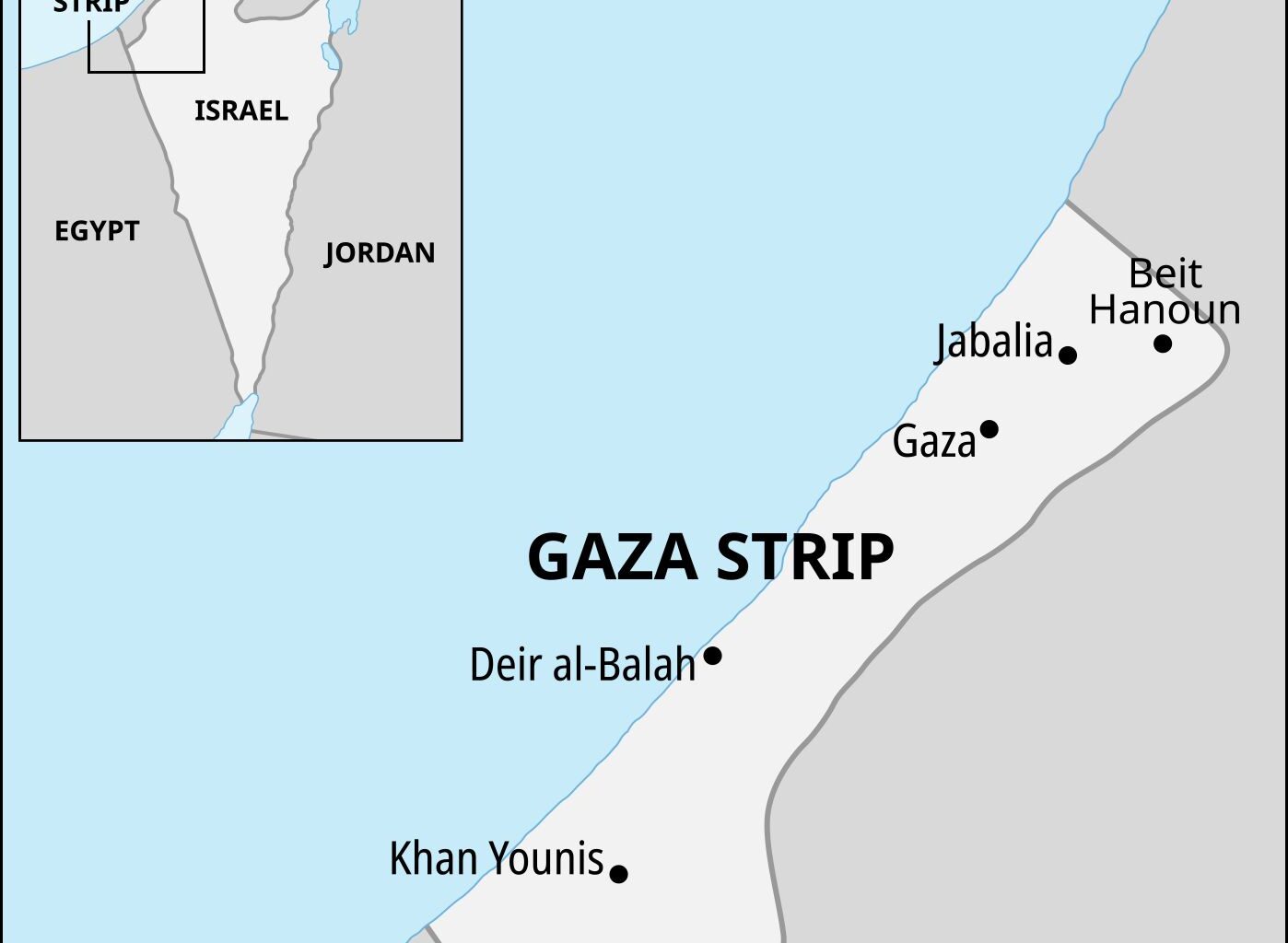
The first agreement to pause fighting occurred just six weeks into the war, when on November 22 Israel and Hamas agreed to a prisoner exchange mediated by Qatar and Egypt. During the pause, which lasted seven days, 110 of the hostages were freed in exchange for 240 Palestinian prisoners. In the days after fighting resumed, Israeli forces moved into the city of Khan Younis. A large number of civilians fled to Rafah, the last major urban center in the enclave for civilians to shelter from the ground invasion, and within weeks more than half of the Gaza Strip’s total population had crammed into the city along Egypt’s border.
By year’s end international support for Israel’s response to the October 7 attack began to wane amid the high number of civilian casualties and wide destruction in the Gaza Strip. In early January 2024, after nearly 23,000 Palestinians had been reported dead (a number that included mostly civilians but also Hamas fighters), Israel announced a change in strategy that resulted in a steep reduction in the average number of daily deaths to about one-third of what it had been in October. But the number was still more than three times that of the 2014 conflict, the deadliest in the Gaza Strip until 2023.
In late January Qatar, Egypt, and the United States proposed a framework for a ceasefire that would be conducted in three phases, which laid the groundwork for future agreements. The pause would include the release, in stages, of hostages held in the Gaza Strip and Palestinian prisoners taken by Israel since the start of the conflict. But the framework did not include guarantees that the hostage exchange would lead to a permanent ceasefire, a condition Hamas continued to insist on in future proposals.
February–June 2024: Invasion of Rafah looms Rafah as refuge in the Israel-Hamas WarFrom November 2023 to May 2024, Rafah provided refuge for the majority of the population of the entire Gaza Strip, who crowded into makeshift shelters in the last urban area to be affected by the Israeli invasion. Image from January 16, 2024.(more)
The concerns over the war’s high human cost reached a new level in February 2024 when Israeli officials announced their intent to extend the war into Rafah, the only remaining refuge for civilians. Despite the international outcry—which included an unusual rift between Israel and the United States—Netanyahu insisted that an invasion of Rafah had to proceed in order to root out “the last bastion” of Hamas battalions. Facing pressure from U.S. Pres. Joe Biden to implement a plan to protect civilians, the IDF said in mid-March that it would evacuate a portion of the civilians in Rafah to “humanitarian islands” that it would set up in the center of the Gaza Strip. On March 25, for the first time since the outbreak of the war, the United States refrained from vetoing a resolution by the United Nations (UN) Security Council that called for an immediate ceasefire.
Meanwhile, Israel faced increased scrutiny when an Israeli air strike hit vehicles carrying aid workers for chef José Andrés’s World Central Kitchen on April 1, the first of many incidents that raised worries over Israel harming international aid workers and journalists. That same month UNRWA, the United Nations agency that distributes the largest amount of international aid to the Gaza Strip, released the report of an investigation prompted by Israel’s allegations that some of its employees were members of Hamas and that about a dozen had taken part in the October 7, 2023, attack. The independent review suggested that the agency could do more to “assume more accountability for staff neutrality” but also concluded that it already had a “more developed approach than other similar UN or NGO entities” and that Israel had not expressed specific concerns about staff prior to the Israel-Hamas War.
Early that same month, Hamas rejected a ceasefire proposal that would require it to release 40 living hostages who were female, children, older people, or sick in the initial stages, saying it did not have 40 such hostages. At the end of April, as the IDF readied the Gaza Strip for an evacuation of Rafah, Hamas released videos showing proof of life of three hostages.
May–June 2024: Rafah invasion, Operation Arnon, and pressure for a ceasefire
The invasion of Rafah became imminent as negotiations, which had seemed to be progressing, broke down on May 5. Hours later, Hamas fired rockets at Israeli soldiers who were stationed near the Kerem Shalom border crossing, the main avenue for humanitarian aid. The attack killed four soldiers and prompted Israel to close the crossing to aid convoys. The next day, Israel ordered the evacuation of 100,000 Palestinians from Rafah. That evening, Hamas accepted a ceasefire proposal tendered by mediators that included efforts toward a “permanent cessation” of hostilities, but Israel reiterated its stance that it would reject any proposal that insists on an end to the war. Instead Israel’s war cabinet unanimously authorized the military to proceed with its plans for Rafah.
Soon after the authorization Israeli forces began moving to take control of the Rafah border crossing and the Philadelphi Corridor. On May 14 they entered the city. Within days the number of people who had fled Rafah since May 6 exceeded 800,000.
The areas the displaced Gazans fled to were deemed inadequate by international observers, while efforts to supply humanitarian relief went sour. A floating pier constructed by the United States to deliver aid received its first shipment on May 17, but the distribution of aid was repeatedly disrupted by safety concerns and weather damage in the weeks ahead. It was operational for a total of only 20 days before use of the pier was abandoned in mid-July. In that time, the total amount of aid delivered through the pier did not reach what was needed to sustain the Gaza Strip’s population for just one day.
Meanwhile, Israeli special forces undertook a covert operation on June 8 that rescued four Israeli hostages in central Gaza, some of the only hostages recovered by military force. The raid took place in two buildings in the Nuseirat refugee camp in the middle of the day. When the four Israelis were recovered alive and unharmed, the Israeli officers gave word to their commanders by radio: “Ha-yahalomim be-yedenu” (“The diamonds are on hand”). Heavy fighting took place as the special forces escaped with the rescued hostages, and more than 270 Palestinians in the vicinity were killed as air strikes aimed to shield the Israelis. The officer who led the mission, Arnon Zamora, was critically wounded and died shortly afterward; the operation was posthumously renamed Operation Arnon in his honor.
When the rescued hostages revealed that they knew in captivity that protesters were fighting for their release, demonstrators took to the streets in major cities across Israel that night to celebrate the rescue, call on the government to do more to bring the remaining 120 hostages home, and call for Netanyahu to be replaced as prime minister. The following day Benny Gantz, an opponent of Netanyahu who was also a key figure in his war cabinet, carried out a threat made weeks earlier to resign if Netanyahu had still not articulated a plan for the hostages to be released and end the war.
Pressure continued to mount for Netanyahu when the UN Security Council adopted Resolution 2735 on June 10. It called for an immediate ceasefire, a release of hostages, and the safe distribution of humanitarian aid, followed by a permanent end to hostilities in exchange for the release of remaining hostages and the withdrawal of Israeli forces from the Gaza Strip. The resolution, which was drafted by the United States and followed a ceasefire plan outlined by Biden weeks earlier, was passed with 14 votes in favor. Russia, which was at odds with the United States over Russia’s conduct in its war with Ukraine, was the sole abstaining vote.
July–September 2024: Ceasefire negotiations reach impasse
The dynamic of the negotiations shifted in July, making it tough to conclude a ceasefire agreement in the immediate future. Early that month Hamas dropped its demand for Israel to commit to a permanent end to hostilities. But a new obstacle arose when Netanyahu began insisting that Israel retain control of the Gaza Strip’s Philadelphi Corridor, a demand that Israel had not previously raised in its May 27 proposal. As talks continued, Israel intensified its operations in Gaza and on July 13 an Israeli strike in Khan Younis killed Mohammed Deif, Hamas’s top military commander. On July 31 Ismail Haniyeh, Hamas’s political chief abroad who was leading Hamas’s delegation in ceasefire negotiations, was killed in Tehran, leaving the negotiations in the hands of the more hard-line and inaccessible Yahya Sinwar.
Meanwhile, the war’s toll on public health was highlighted in July, after The Lancet published a study that indicated a conservative estimate of about four indirect deaths per one direct death during the war due to destroyed health care infrastructure and shortages of food, water, and safe shelter, bringing the total of direct and indirect deaths due to the war to 186,000, about 8 percent of Gaza’s prewar population. Later that month the IDF announced that it had found poliovirus in sewage and would offer vaccines to its soldiers. It also coordinated with international groups to assess the risk of polio among Gazans and administer vaccines. When the first confirmed case of polio was identified in a 10-month-old infant in mid-August, UN agencies requested a pause in fighting to allow health workers to vaccinate children in the Gaza Strip. On August 28 Netanyahu agreed under U.S. pressure to allow a vaccination campaign to take place in select areas.
On August 31 Israeli forces found the bodies of six hostages. Autopsies indicated that they were executed 1–2 days before they were found and nearly two months after Hamas had agreed to release three of them in a July ceasefire proposal. Protests erupted in fury across Israel as hundreds of thousands of Israelis took to the streets to demand Netanyahu reach a deal for the hostages to be released. Histadrut, Israel’s largest trade union, joined the protests on September 2 with a general strike (although a court found the strike illegal and ordered it to end that same afternoon). At a press conference that same day, Netanyahu doubled down on his demand to control the Philadelphi Corridor, which he characterized as “the oxygen of Hamas.”
Mid-September–mid-October 2024: The decapitation of Hezbollah and the killing of Yahya Sinwar
In mid-September Israeli forces focused on weakening Hezbollah in Lebanon—including killing its longtime leader, Hassan Nasrallah—while the humanitarian situation in the Gaza Strip continued to deteriorate from the unbroken bombardment of the territory and from restrictions on the entrance of humanitarian aid. The killing of Nasrallah induced Iran to send a barrage of missiles into Israel on October 1, an attack that nonetheless caused minimal damage and one casualty. The anniversary of the October 7 attack passed with bombardment from Hamas, Hezbollah, and Houthi forces, which likewise rendered little damage. On October 17 Israel announced that the IDF had killed Sinwar in an operation it had conducted the previous day in the Rafah area.
Mid-October–December 2024: Reopening dialogue and ICC issues warrant for Netanyahu
With Hezbollah weakened and the architect of the October 7 attack dead, the international community seized the chance to reopen ceasefire discussions about a week later, with Egyptian Pres. Abdel Fattah al-Sisi leading the latest proposal. Despite the reluctance of Hamas to engage after previous ceasefire negotiations fell apart in July, the group indicated an openness to the proposal. The Israeli delegation, although engaged in the negotiations in Qatar, awaited the results of the U.S. election on November 5 to determine how to proceed. Donald Trump won the election, and members of Israel’s right-wing government believed that his administration would align even more sympathetically with their cause than the Biden administration had. Meanwhile, on October 28, the Israeli Knesset overwhelmingly voted to ban and designate UNRWA as a terrorist organization.
As the negotiating teams prepared for a shifting U.S. role in mediation, new and far-reaching developments took place on the international stage. On November 21 the International Criminal Court (ICC) issued arrest warrants for Netanyahu and Yoav Gallant, who until November 5 had served as Israel’s defense minister. In a press release, the court noted reasonable grounds that Netanyahu and Gallant “intentionally and knowingly deprived the civilian population in Gaza of objects indispensable to their survival” and that “no clear military need or other justification under international humanitarian law could be identified” for those restrictions. The ICC also issued an arrest warrant that same day for Deif, whose death in July the court could not yet verify, for his role in commanding the October 7 attacks against civilian targets and his responsibility for his subordinates’ cruel treatment of and sexual violence against hostages. The court also intended to issue arrest warrants for Haniyeh and Sinwar before their deaths.
Quick Facts
Also called:
Israel-Gaza War or Gaza War
(Show more)
Date:
October 7, 2023 – present
(Show more)
Show More
Meanwhile, the incoming Trump administration began taking on mediation efforts in the hope of fulfilling Trump’s campaign promise to reach a hostage release deal before his inauguration. The renewed push, in which Secretary of State Antony Blinken of the outgoing Biden administration worked closely alongside Trump’s Middle East envoy, Steve Witkoff, was bolstered by a desire by the warring parties and the mediators Qatar and Egypt to enter a second Trump term on good footing with the incoming president. Trump’s ambiguous threat on Truth Social that “there will be ALL HELL TO PAY in the Middle East” without a deal by the time of his inauguration loomed over the negotiations, while Witkoff reportedly placed pressure on Netanyahu to accept some of the compromises of a deal.