
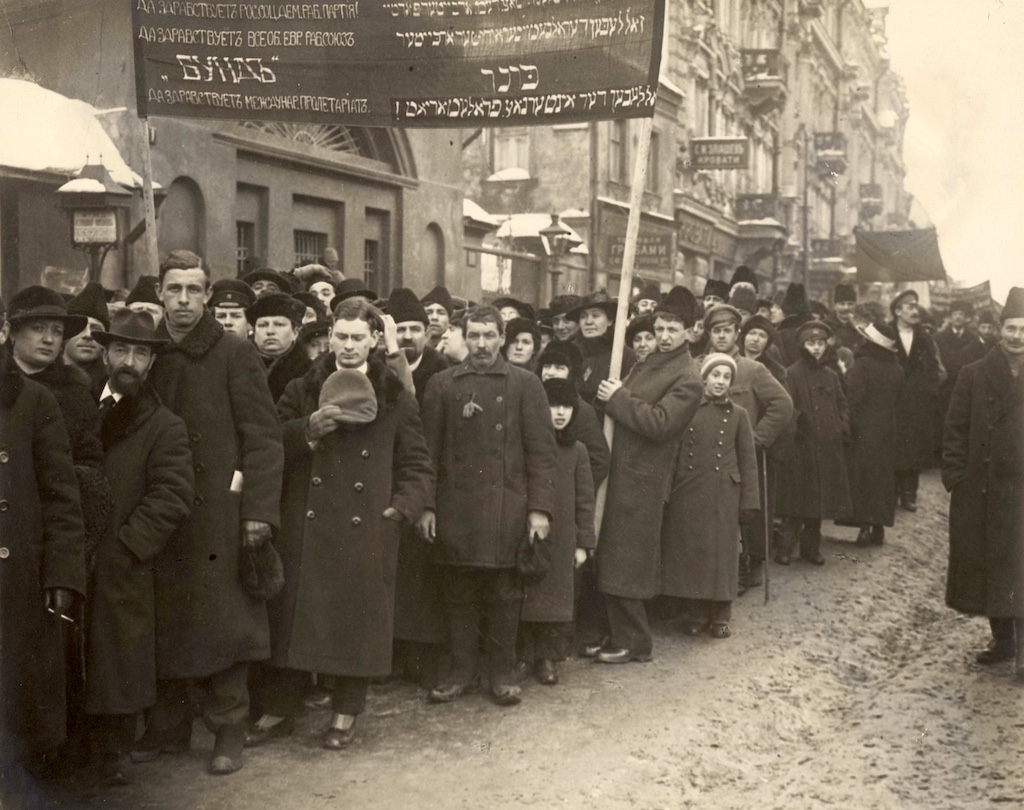
Since the end of World War II and the establishment of Israel, many have looked back on the Bund with contempt and criticism, labeling the movement naive, uncompromising, and weak. But while the Bund lost, it was not a failure. As Crabapple writes, “Failure is what happens to those overcome by their own faults and errors. To lose is to succumb to greater force.”
The Bund had faults and internal problems, just as any organization does. But fundamentally, it did not collapse because of brewing contradictions or internal dysfunction. It lost because it simply could not counteract the gargantuan force of European fascism. Fascism, like fire on dry brush, spread quickly and with great intensity through Europe. It killed everything in its way and launched a conflagration predicated on territorial annexation and ethnonationalist supremacy.
Six million Jews died in this fire, as did tens of millions of non-Jewish Eastern Europeans. The Bund didn’t fail because of a lack of strength or commitment or even strategy; it lost to a force of history that enveloped and decimated an entire continent.
The fact of that defeat does not render the Bund irrelevant. Instead, as Crabapple shows, old ideas are now being rejuvenated for a world in desperate need of them. The Bund’s predictions on Zionism and ethnonationalism have largely come true, and with disastrous consequences. Rather than decades of peace and reconciliation, Zionism within Israel has moved further right in response to insecurity and regional hostility. As Crabapple notes:
In 1938, [Bundist] Henryk Erlich wrote, “If a Jewish state should arise in Palestine, its spiritual climate will be: eternal fear of the external enemy (Arabs); and eternal struggle for every bit of ground with the internal enemy (Arabs). . . . Is this a climate in which freedom, democracy, and progress can grow? Indeed, is it not the climate in which reaction and chauvinism ordinarily flourish?”
This climate of perpetual reaction has resulted in millions of Palestinians being locked behind the walls of apartheid. In Gaza, most of the strip has been demolished through the hellish combination of artillery barrages, air munitions, and Israel Defense Forces (IDF) battalions. Over 70,000 Palestinians have been killed as a result, with most of the remaining survivors sent to refugee camps and tent cities. The strip is systematically depleted, with hospitals, schools, vital infrastructure, and energy sources being decimated. In the West Bank, Palestinians have been placed into local ghettos, with their freedom of movement and speech comprehensively restricted.
Roving paramilitary gangs of far-right settlers attack and intimidate Palestinian ghettos and face virtually no consequences. Illegal settlements are continuously allowed and retroactively legalized, with Palestinian autonomy being eroded brick by brick and farm by farm. Little stands in the way of further annexation, and with each new settlement, a Palestinian state becomes more difficult to imagine. Israeli society will not permit an autonomous Palestinian state nor will any subsequent Israeli government allow settlements to be dismantled. The project is fixed, the Palestinian issue is almost settled, and the only thing standing in the way of finalization is Palestinian resistance.
Liberal democracies failed to address material inequalities and cratered toward fascism, unleashing violence and racialized hate that devoured millions of lives and destroyed any possibility for class solidarity.
This is where the Bundists’ growing relevance lies. The Bundists criticized ethnonationalism and liberal accommodationism for their ability to marginalize entire populations and destroy class consciousness. The Bundists saw in Russia, Poland, and practically all of Europe what the failures of capitalism and nationalism could mutate into and unleash. Liberal democracies failed to address material inequalities and cratered toward fascism, unleashing spirals of violence and racialized hate that devoured millions of lives and destroyed any possibility for class solidarity.
Within Israel, the Bundists saw the same project unfolding. Ethnonationalist hatred was not reserved for Europe alone; it could emerge from any culture or society. The oppressed could become the oppressor, distant populations could be subjugated, and the same horrors of the past could again be repeated without any lesson being learned. Bundists didn’t oppose Israel because of its promise of Jewish cultural autonomy; they instead saw within its emerging DNA the same underpinnings that had ravaged Europe and much of Jewish culture. Their opposition to Zionism, if anything, was an effort to spare future populations the same kind of bloodshed they had experienced throughout their lives.
The world that gave rise to Bundism will never return. But a world that remembers its principles and carries them forward as a compass for left politics is indeed possible. Class-based calls for solidarity, universalism, and democracy have not lost their power. The project of maintaining cultural autonomy against assimilation while simultaneously opposing separatist ethnonationalism is as necessary as ever.
Our world, while not exactly similar to the interwar period, faces a multilayered crisis driven by inequality, economic panic, and the reassertion of flagrant imperial power on the global stage. Divisions over class, race, and religion are being stoked for political and military gain, and liberalism again finds itself facing the tranquilizing drug of accommodation and compromise. The structure of our world is different, but the principles and ideals that the Bund fought for, and the conditions that shaped them for generations, remain relevant.
Crabapple’s Here Where We Live Is Our Country is a worthy contribution to revolutionary history and well-timed illumination of the Bundist worldview for contemporary generations. At the heart of that worldview is the motto itself — a commitment to class solidarity against the forces of racial separation and cultural animus that threaten to drive us apart.