
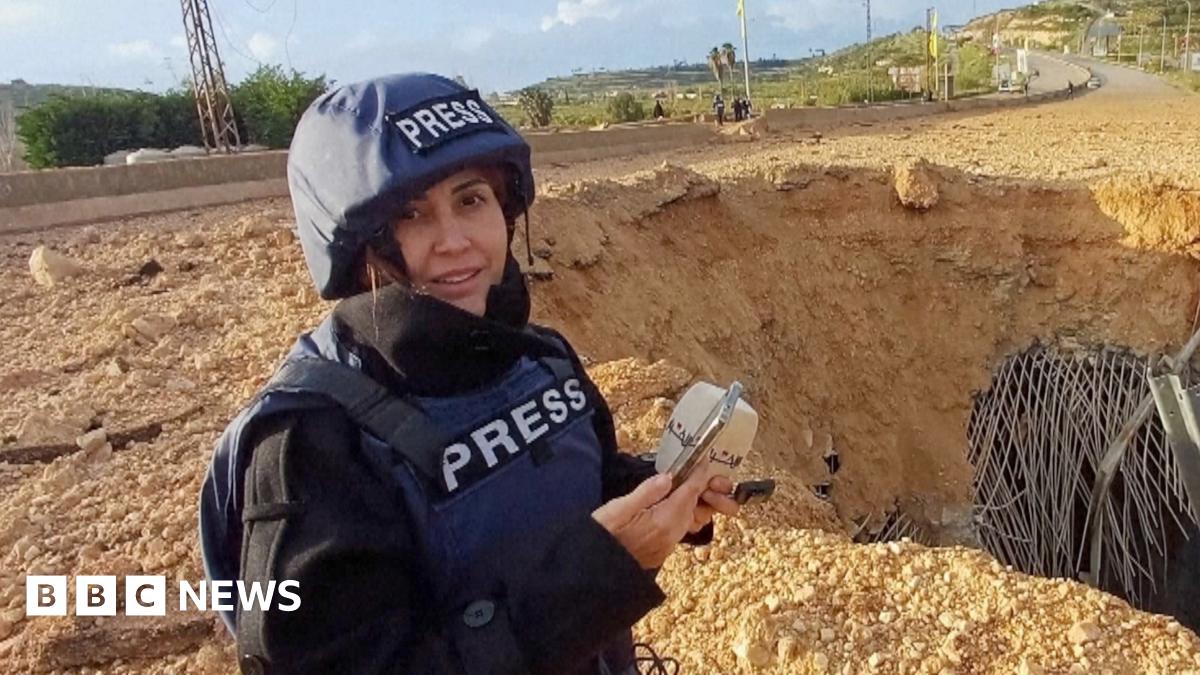
Journalists Khalil, 43, who worked for Lebanese newspaper Al-Akhbar, and Faraj, a freelance photographer, were travelling together. The two men who died have not been named by officials.
Lebanese Prime Minister Nawaf Salam said: “Targeting journalists, obstructing access to them by relief teams, and even targeting their locations again after these teams arrive constitutes described war crimes.”
He accused Israel of repeatedly targeting media workers in southern Lebanon in what he described as “an established approach”.
Salam offered condolences to Khalil’s family and said that Lebanon would “pursue the crimes before the competent international forums”.
In a statement, the IDF said it “does not target journalists and acts to mitigate harm to them while maintaining the safety and security of its troops”.
The IDF said it identified two vehicles that had “departed from a military structure used by Hezbollah”.
One of the vehicles had approached Israeli troops in a manner that was an “immediate threat” after crossing a “forward defence line”, violating a ceasefire, the statement said.
The IDF said the Israeli Air Force then struck one of the vehicles, and that the “structure from which the individuals had fled was also struck”.
The Lebanese health ministry said the IDF “pursued” Khalil and Faraj, “who had taken refuge from the first raid in a nearby house, targeting the house where they had sought shelter”.
When a Lebanese Red Cross ambulance arrived to treat the wounded, Israeli forces directed a stun grenade and gunfire toward it, preventing it from reaching them, the ministry said in a statement.
“This constitutes a blatant double violation: obstructing the rescue efforts of a citizen known for her civic media activism, and targeting an ambulance clearly marked with the Red Cross emblem,” the health ministry said.
Clayton Weimer, the executive director of Reporters Without Borders, said the IDF had received messages from the organisation, as well as journalists, asking that it allow ambulances to get to Khalil.
“The Red Cross signalled they were unable to get through because of ongoing Israeli bombardment. So that is callous disregard, on top of what appears to be a deliberate and targeted killing of a journalist.”
Faraj was eventually evacuated along with two of the dead, the statement added. Khalil’s body was later recovered by emergency teams, according to Lebanon’s civil defence agency.
Al-Akhbar said in an article on her death that Khalil “remained steadfast in her humanitarian and professional duty”.
The Guardian’s William Christou, who covers the Middle East for the paper, described her in a post on X as a “professional, kind and dedicated journalist, and always a pleasure to run into in the field”.
The IDF acknowledged reports that two journalists were injured as a result of the strikes, but insisted it was not preventing further rescue teams from reaching the area. It has not acknowledged Khalil’s death.
The US-based Committee to Protect Journalists (CPJ) said it was “outraged” by Khalil’s death.
“The repeated strikes on the same location, the targeting of an area where journalists were sheltering, and the obstruction of medical and humanitarian access constitute a grave breach of international humanitarian law,” said CPJ Regional Director Sara Qudah.