
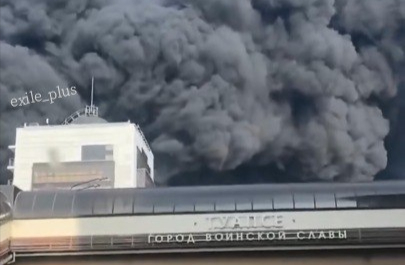
Two major oil refineries owned by Russian oil conglomerate Rosneft have halted operations following drone attacks in what appears to be a fresh blow to Russia’s energy sector amid escalating Ukrainian strikes.
According to Reuters, the Tuapse refinery on the Black Sea coast suspended operations after a Ukrainian drone attack on April 16, with further strikes reported on April 20.
JOIN US ON TELEGRAM
Follow our coverage of the war on the @Kyivpost_official.
The facility, which primarily exports its output, was forced to stop processing after damage to port infrastructure and a fire at oil storage facilities made shipments impossible, industry sources said.
The refinery, with a capacity of around 12 million metric tons per year (roughly 240,000 barrels per day), produces naphtha, diesel, fuel oil and vacuum gas oil.
Sources said it remains unclear when operations could resume. The company did not respond to requests for comment.
Ukraine’s General Staff said Kyiv forces carried out a coordinated overnight strike on April 20, confirming that the Tuapse oil refinery was hit again, with a strike on a storage tank area triggering a fire.
The refinery, integrated with a Black Sea port export terminal, was struck for the second time in less than a week. A fire at the site on April 16 burned for days and required more than 150 firefighters and emergency personnel to extinguish.
Independent Russian outlet Astra reported that a large fire broke out in the storage tank area following the latest attack.
Other Topics of Interest
Russia to Block Flow of Kazakh Oil to German Refinery, Berlin Says
The move comes amid Russia’s war against Ukraine and a global energy crisis linked to the US-Israeli war against Iran, which has caused major disruptions to global oil and gas markets.
Krasnodar governor Veniamin Kondratyev said the strike caused a fire at the seaport and widespread damage across the city due to falling debris. Windows were shattered at a school, kindergarten, church, museum, and an apartment building, while a gas pipeline was also damaged.
Ukrainian Telegram channels on Wednesday, April 22, published photos and videos indicating that fires following the attacks are still ongoing.
The Telegram channel Exilenova+ said a “man-made disaster” was unfolding in the city.
“It’s raining oil in Tuapse. We advise locals to put out barrels – finally, an oil and gas country is sharing oil with its people instead of sponsoring a war with it,” the report says in a sarcastic remark.
“We will not tire of repeating: These are the consequences of the war Russia unleashed. There is no talk of evacuating the population – slaves are enduring. A man-made disaster is unfolding in the city,” the channel added.
Earlier, the same channel reported that roads near the Tuapse oil refinery had begun to be covered with a layer of oil products.
Meanwhile, primary oil processing at the Novokuibyshevsk refinery has been halted since April 18 following another drone strike, according to two industry sources speaking to Reuters. Local authorities had earlier confirmed attacks on energy infrastructure in the region.
In 2024, the Novokuibyshevsk facility processed 5.74 million metric tons of crude oil, producing over 1 million tons of gasoline and significant volumes of diesel and fuel oil.
Reuters said the escalation coincides with a shift in US focus toward the Middle East, where supply concerns have already affected global oil markets. Washington has eased some sanctions on Russian oil in recent weeks to mitigate potential disruptions linked to tensions in the Gulf.
Kyiv’s escalating campaign on Russian oil
In recent months, Ukrainian drones have repeatedly targeted major export hubs, including the Baltic Sea ports of Ust-Luga and Primorsk, as well as the Novorossiysk oil terminal – all critical to Russia’s oil exports.
In March alone, Russia is estimated to have lost close to $1 billion within a week due to repeated strikes on its Baltic ports.
Kyiv said the campaign targeting Russian energy infrastructure aims to cut revenue from oil exports – a key source of funding for Moscow’s war effort.
Kyrylo Budanov, the Head of Ukraine’s Presidential Office, said strikes on Russian oil terminals are strengthening Ukraine’s position in ongoing negotiations. However, some allies have reportedly urged Kyiv to pause such attacks amid rising global energy prices.