
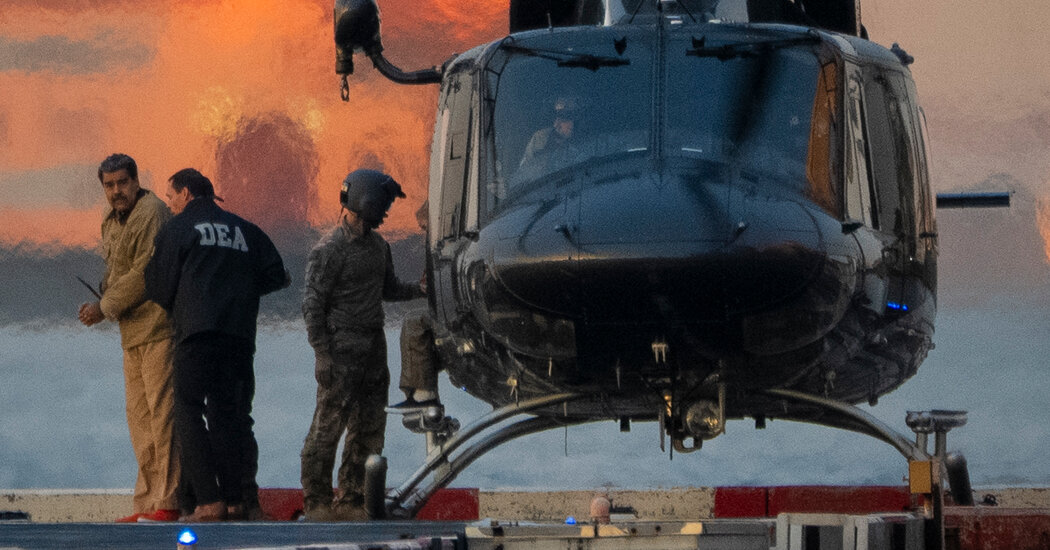
A U.S. Army special forces soldier who helped capture Nicolás Maduro of Venezuela has been charged with using classified information to bet on the mission on Polymarket, a prediction marketplace, federal authorities said on Thursday.
The soldier, Master Sgt. Gannon Ken Van Dyke, who was stationed at Fort Bragg in North Carolina, made more than $400,000 by betting on different outcomes related to Venezuela after learning of the operation, federal prosecutors and the F.B.I. said.
Sergeant Van Dyke tried to hide his use of classified information to make the money and to conceal his connections to the trading accounts, according to an indictment filed in Manhattan federal court.
Jay Clayton, the U.S. attorney for the Southern District of New York, said Sergeant Van Dyke used classified information related to the capture to “place bets on the timing and outcome of that very operation, all to turn a profit.”
The indictment represents one of the highest-profile episodes of a U.S. government employee using classified information to make money on prediction markets — a threat to national security that has led the White House to warn its staff to avoid such insider trading. The warning came amid a surge of suspicious trading related to the war with Iran.
Companies that run prediction markets have come under increased scrutiny in recent months. The Senate and House are considering legislation to limit government officials’ use of one popular site, Kalshi, and states are also considering stronger regulations.
Acting Attorney General Todd Blanche said, “Our men and women in uniform are trusted with classified information in order to accomplish their mission as safely and effectively as possible, and are prohibited from using this highly sensitive information for personal financial gain.”
President Trump, when asked on Thursday about government employees using prediction markets, said, “The whole world unfortunately has become somewhat of a casino.”
He added, “I was never much in favor of it. I don’t like it conceptually. It is what it is. I’m not happy with any of that stuff.”
Polymarket said in a statement Thursday that it had published new rules to tighten insider trading last month. It added that when it identified a user trading on classified government information, it referred the matter to the Justice Department and cooperated with its investigation.
In the hours before American troops captured Mr. Maduro on Jan. 3, it was reported that a Polymarket user placed a $32,000 bet that Mr. Maduro would be out of power by the end of January, and profited by more than $400,000. The Polymarket statement and the amounts specified in the indictment suggest the charges announced on Thursday related to that bet.
The indictment charges Sergeant Van Dyke, 38, with five counts: unlawful use of confidential government information for personal gain; theft of nonpublic government information; commodities fraud; wire fraud; and engaging in a monetary transaction in property derived from specified unlawful activity.
Sergeant Van Dyke has been an active-duty soldier since about 2008, the indictment said, adding that since 2023, he has been a master sergeant with U.S. Army Special Forces. Ten years into his service, he was given special access to classified information, signing a formal agreement in which he promised to never divulge the contents of that information. Last year, he signed a similar agreement related to military operations in the Western Hemisphere.
The question of how to regulate prediction markets has become more pressing for state officials in recent months, given a sudden boom in usage. The markets are regulated by the Commodity Futures Trading Commission, and bettors are often able to circumvent state-level restrictions on more traditional gambling because of the way the bets are classified legally.
Chris Cameron contributed reporting.