
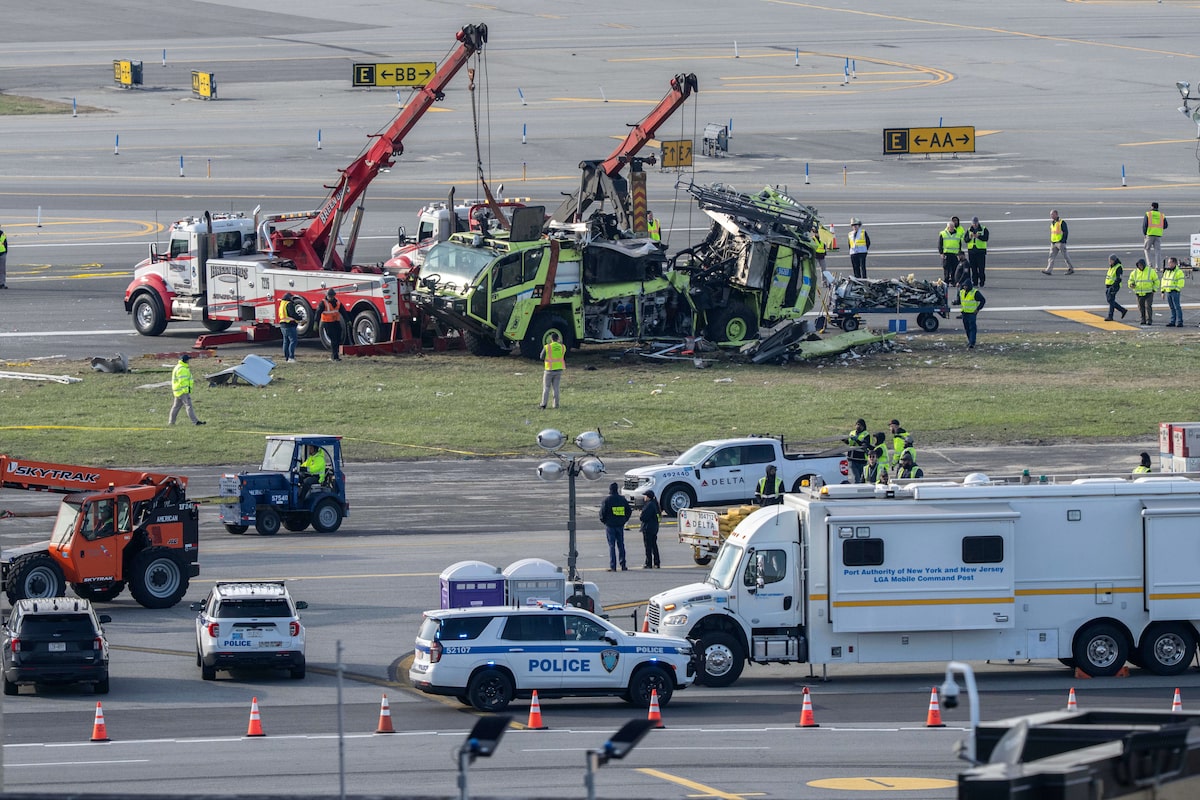
The wreckage of Port Authority fire truck is left on a tarmac after the wreckage of an Air Canada Express jet was moved from the runway, where they collided on March 22.Yuki Iwamura/The Associated Press
A firefighter in the truck that was hit by a landing Air Canada Express passenger jet at New York’s LaGuardia Airport last month heard a command to stop but did not know who it was for, the U.S. transportation safety investigator says in its preliminary report on the crash.
The plane’s two pilots, Antoine Forest of Coteau-du-Lac and Mackenzie Gunther of Ontario, both died in the March 22 collision. An air traffic controller had cleared the truck to cross the runway, then told it to halt moments later.
The report, issued Thursday by the U.S. National Transportation Safety Board, said the turret operator in the fire truck heard the command “stop, stop, stop” on the control tower radio, “but he did not know who that transmission was intended for.”
<!— Multimedia Carousel Float –>
<!— Multimedia Carousel Float –>
“He subsequently heard ‘Truck 1, stop, stop, stop’ and realized it was for them and subsequently noticed that they had entered the runway,” the NTSB report said. “He further recalled that as they turned left, he saw the airplane’s lights on the runway.”
The preliminary report offers the first look at how communications and other events that night might have factored into the tragedy. It also provides for the first time accounts of interviews with some members of the truck brigade.
It contains no findings of cause or contributing factors, and will be followed by a final study within about 18 months.
The nose of the plane was destroyed by the impact of the collision. Solange Tremblay, a flight attendant, was thrown far from the site of the crash while still secured to her seat and suffered multiple injuries. Thirty-nine people were taken to hospital, six with serious injuries.
Air Canada jet involved in near-miss at JFK Airport, U.S. agency says
The plane, a Mitsubishi CRJ900 operated by Halifax’s Jazz Aviation under contract to Air Canada, was carrying 72 passengers en route from Montreal. It had a last recorded ground speed of 104 miles an hour, the NTSB said.
The report said the plane was given clearance to land on Runway 4 at 11:35 p.m. At around the same time, seven emergency vehicles approached the runway on a taxiway, as they prepared to respond to an emergency involving a different plane across the airport.
An image from the preliminary report into the collision of an Air Canada jet and a firefighting truck at LaGuardia Airport. The green circle shows where the ground vehicles initially gathered, the yellow dash line their intended path and the red star indicates where the collision occurred.Supplied
At 11:36, the air traffic controller gave the trucks clearance to cross.
The air traffic controller then gave taxiing instructions to another aircraft, and immediately told the truck to stop.
At 11:37, the controller repeatedly told the lead truck to stop, but it accelerated as it approached the runway crossing.
The collision occurred two seconds after touchdown. The truck turned left just before the crash, while the plane’s rudder was turned to the left just before the end of the flight data recorder, the report said.
The fire trucks did not have transponders that would have made them appear on the tower control screens. The report says this meant the truck’s presence on or near the runway did not trigger a visual or audio alert.
Geraint Harvey, a professor at Western University and an expert in civil aviation, said most safety systems have overlapping safeguards to prevent such tragedies. However, in the LaGuardia crash, it appears several problems lined up to allow the accident to happen, including the first plane’s emergency, communications problems, and multiple trucks trying to cross an active runway.
“It’s awful,” Prof. Harvey said. “There’s really nothing the pilots could have done.”
Flight attendant injured in LaGuardia crash continues recovery as GoFundMe page raises over $188,000
John Cox, a pilot and chief executive officer of Washington-based aviation consultancy Safety Operating Systems, noted the LaGuardia runway was marked by red lights that signal the presence of a plane. The fire truck passed these red lights after receiving clearance.
“They’re red, but more importantly, they say there is an airplane on the runway or about to be,” he said.
Mr. Cox said it was not clear who the stop commands were issued to, given the air traffic controller had just talked to an aircraft before telling the truck to stop.
“There was ambiguity about who the ‘stop, stop, stop’ was for, and then the controller corrected it and said, ‘truck one, stop, stop, stop,’” he said.
The pilots were on the third and final flight of their shift, the NTSB said.
The first officer on board, Mr. Gunther, graduated in 2023 from Seneca College in Peterborough, Ont., with an Honours Bachelor of Aviation Technology. He was hired by Jazz in April, 2024, and had 718 flight hours.
The captain, Mr. Forest, began at Jazz in 2022 and had 3,560 flight hours.
There were two air traffic controllers in the tower that night, each with 18 or 19 years of experience.