
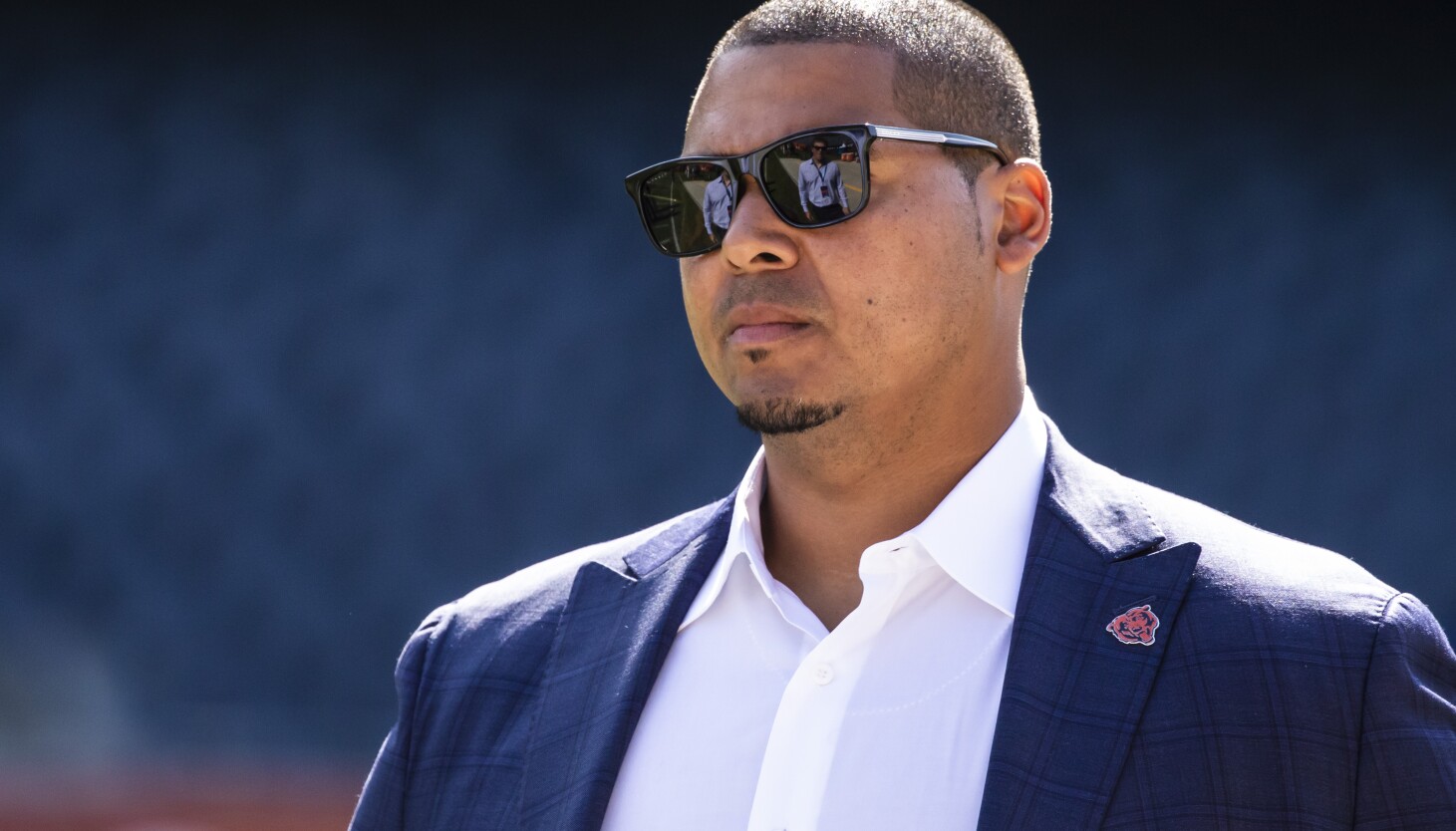
The Bears’ first three picks in the NFL Draft seemed to be geared more toward their future than their present. For a team aspiring to make the leap from good to great in the upcoming season, where general manager Ryan Poles’ urgency to address red flags at left tackle, defensive tackle and defensive end?
There’s nothing wrong or crazy about what they did with their first four selections, but they didn’t aggressively attack their three biggest needs.
The Bears went into the week with concerns at left tackle, defensive tackle and defensive end, and that’s still the case Friday night. They chose Iowa center Logan Jones on Friday in the second round at No. 57 overall, then took Stanford tight end Sam Roush at No. 69 overall in the third after trading out of the 60th pick to add a fifth-round pick at No. 144 overall. They capped the night by picking LSU receiver Zavion Thomas with the 89th pick.
In the first round Thursday, the Bears used the No. 25 pick on safety Dillion Thieneman.
That essentially means three problems remain status quo:
• There will be a wide-ranging open competition for the starting left tackle job, just like last summer.
• A pass rush that has ranked second-to-last in the NFL over the Poles era is still riding on Montez Sweat and several unproven candidates to be his running mate.
• One of the NFL’s worst run defenses from last season likely will have the same two starting defensive tackles in Gervon Dexter and Grady Jarrett.
Poles attributed some of the draft decisions to the fact that “life at the back of the round is different” than where the Bears usually have been picking. The options thin out, and while he was interested in making a play to get to the top of the second round, he couldn’t do so at a reasonable price trade-wise.
“We follow the board,” Poles said. “To go into a draft and start picking [for] your needs and hopping around the board and letting all the good guys go by just because of that, it doesn’t play out very well in the long haul. So we stuck to the board.”
Poles has said he believes some improvement will come from within, but that’s more on faith than on concrete evidence.
At defensive end, Sweat has been good, but made just one Pro Bowl in his first three seasons. The others, most notably Dayo Odeyingbo and Austin Booker, have never had more than eight sacks in a season. And the Bears haven’t seen enough from 2025 second-round pick Shemar Turner to know if he’ll be a force.
Similarly to Sweat, Dexter has been solid but not overwhelming, and Jarrett has dealt with injuries over the last few seasons and is approaching his 33rd birthday.
The starting left tackle is anybody’s guess.
Braxton Jones appears to be the leader at this stage, but he won the job at the end of training camp last year only to lose it by Week 4. Theo Benedet, also eventually benched, is another candidate. Kiran Amegadjie has played just six games since Poles drafted him No. 75 overall in 2024 and will have a tough road to make this roster. They signed Jedrick Wills, the former No. 10 overall pick, but he hasn’t played since November 2024.
Their fastest path to being a contender is to propel quarterback Caleb Williams forward. Sending him into the season without a good plan at left tackle isn’t helping.
After skipping those positions with the Nos. 25 and 57 overall picks, it was strange to bypass them again at No. 69. The Bears drafted tight end Colston Loveland 10th overall last year and still have veteran Cole Kmet under contract for two more seasons.
The Bears traded a 2027 fifth-round pick to the Patriots for Garrett Bradbury in March as Poles saw the market for centers surging ahead after Tyler Linderbaum got a three-year, $81 million deal from the Raiders. This is Bradbury’s third team in three seasons, though, and he is unlikely to be a long-term solution.
Bradbury will be an asset to Jones, who can take as long as he needs to acclimate and learn coach Ben Johnson’s offense. Bradbury likely will be the Bears’ Week 1 starter, providing Jones some margin. Poles said the Bears “feel really good about Garrett being the starting center.”
Jones, 24, actually began his collegiate career as a defensive tackle and switched to offense when Linderbaum left Iowa for the NFL.
“I haven’t even played my best football yet and I haven’t figured [center] out,” he said despite winning the Rimington Trophy as the best center in college football. “It’s been a journey, but the past two years, for sure, is when I realized that if I really wanted this, I’ve just got to go out there and take it.”
While the plan for Jones likely will be to develop behind Bradbury until he’s ready, it’s hard to see where exactly Roush fits.
Roush, 22, had his best season at Stanford last year with 49 catches for 545 yards and two touchdowns. With the Bears, though, Loveland figures to be a focal point, if not the centerpiece, of the passing attack, and the Bears just restructured Kmet’s contract to lower his salary-cap number for this season by kicking money into 2027.
“Nothing changes for Cole,” Poles said. “Our feelings haven’t changed.”
The first three players the Bears selected — Thieneman, Jones and Roush — are highly rated prospects who could turn out to be excellent pros. Thieneman in particular seems to have all the makings of a star.
But having a great safety, center and an extra tight end aren’t going to help the Bears as much as fortifying their pass rush, run defense and protection of Williams would have — especially if their expectations truly are to win now.

Oregon safety Thieneman can go a long way to help fill Bears’ needs in the secondary.
[month] [day], [year], [hour]:[minute][ampm] [timezone]
read

He had 41 catches for 488 yards last year, threatening opponents with exquisite speed.
[month] [day], [year], [hour]:[minute][ampm] [timezone]
read

The Titans moved up to No. 60.
[month] [day], [year], [hour]:[minute][ampm] [timezone]
read