
Freedom of navigation, nuclear weapons, missiles and proxies are not separate files. They are consequences of one deeper failure: Iran’s denial of self-determination.
By Benjamen Gussen
The current crisis in the Strait of Hormuz is usually described in the language of energy security, shipping insurance and naval power. That is understandable. When Reuters reports that only five ships passed through the Strait in twenty-four hours after Iranian seizures and a continuing American blockade of Iranian ports, the world immediately sees oil prices, supply chains and seafarers trapped in a war zone. But that framing is too narrow. Hormuz is not only a maritime crisis. It is a crisis of domination.
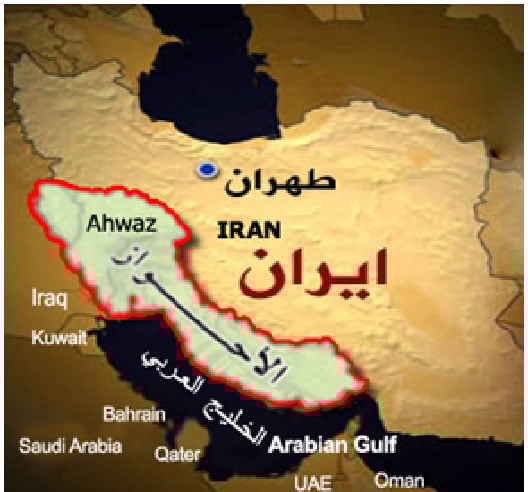
The basic question is this: may a state convert geography into coercion? May Iran use its coastline to threaten global passage? May it use the oil, ports and people of regions such as Khuzestan, or Al-Ahwaz to many of its Arab inhabitants, as instruments of a centralized revolutionary state? May it then invoke sovereignty as a shield while denying meaningful self-determination to the peoples within its borders?
If the answer is no, then the solution to the Iran crisis cannot begin with centrifuges. It must begin with self-determination.
The law of the sea gives us the first clue. The Strait of Hormuz is a strait used for international navigation. Under the United Nations Convention on the Law of the Sea, ships and aircraft enjoy the right of transit passage through such straits. Article 38 says that transit passage shall not be impeded. Article 44 says states bordering straits shall not hamper transit passage and that there shall be no suspension of it. Iran does not own Hormuz simply because geography placed it on one side of the waterway. Oman does not own it either. Coastal sovereignty exists, but it is limited by the world’s right of passage.
That principle is not a technicality. It is a moral rule dressed in legal form: geography is not a license to dominate.
The same principle applies on land. Article 1 of the UN Charter refers to “equal rights and self-determination of peoples” as one of the purposes of the United Nations. Article 1 of the International Covenant on Civil and Political Rights says that all peoples have the right of self-determination and may freely determine their political status and pursue their economic, social and cultural development. That is not decorative language. It is one of the basic promises of the postwar international order.
This is where the Ahwazi Arabs matter. Khuzestan is not merely a province on a map. It is a resource-rich, strategically vital region at the head of the Gulf, with a large Arab population that has long complained of discrimination, land dispossession, political repression and exclusion from the wealth extracted from its territory. Amnesty International and Human Rights Watch have documented arrests and crackdowns affecting Ahwazi Arab activists; Amnesty has also described land confiscation affecting Arab communities in Khuzestan. Whether one calls the region Khuzestan or Al-Ahwaz, the issue is a test of whether self-determination means anything when a state is powerful enough to ignore it.
This does not mean outsiders may simply redraw Iran by decree. Self-determination belongs to peoples, not to foreign strategists. The Ahwazi people, like Kurds, Baluch, Azeris and others in Iran, must be able to decide their own future through a genuine process. That future might be autonomy, federalism, confederation, independence, or continued union under enforceable guarantees. But it cannot be dictated permanently by Tehran, and it should not be pre-written by Washington, Jerusalem, Riyadh or anyone else.
The difficult question is force. Can force ever be justified by self-determination? The answer must be cautious but not evasive. Self-determination does not give outside powers a blank cheque to invade, partition or conquer. The UN Charter also prohibits the threat or use of force against the territorial integrity or political independence of states. But territorial integrity is strongest when a state represents all its peoples. The Friendly Relations formulation, later echoed in the Vienna Declaration, links territorial integrity to states conducting themselves in accordance with equal rights and self-determination and possessing a government representing the whole people without distinction.
That qualification matters. A state that suppresses a people, extracts its resources, crushes its cultural and political rights, and then uses those resources to menace neighbors weakens the moral force of its sovereignty claim. This should be a general rule, not an anti-Iran exception. Force may be justified only as a last resort, and only where it is necessary, proportionate and protective: to defend lawful passage through Hormuz; to protect civilians from mass atrocity; to rescue crews and ships under attack; or to create space for an internationally supervised self-determination process where peaceful remedies have been destroyed. Force is justified, if at all, to protect peoples and lawful rights from coercive violence.
This is the theme that should now shape negotiations with Tehran.
The mistake in much diplomacy is to treat Iran’s nuclear program, ballistic missiles, proxies and Hormuz leverage as separate files. They are not. They are expressions of one system: a centralized security state that treats geography and peoples as instruments. Khuzestan’s oil, Hormuz’s waterway, Lebanon’s sectarian fractures, Iraq’s militias and Yemen’s chaos are all used as levers. The symptoms differ. The disease is domination.
A serious Iran settlement should therefore contain a Self-Determination Chapter. It should require Iran to accept international monitoring of minority rights; release prisoners detained for peaceful cultural, linguistic or regional advocacy; recognize language and educational rights; create elected regional institutions with authority over local development, policing, water, environment and culture; establish transparent revenue-sharing for oil, gas and port income; and demilitarize internal repression by the IRGC in minority regions. If Tehran refuses meaningful internal self-determination, the next stage should be an internationally supervised process in which affected peoples can choose their political future.
This would not distract from the nuclear issue. It would attack the reason the nuclear issue exists. Iran’s nuclear program is not merely a collection of facilities and stockpiles. It is a shield for a regime that fears accountability at home and seeks leverage abroad. A state that must answer to its peoples is less able to let one ideological-security faction gamble national survival on nuclear brinkmanship. Communities that control their resources and bear the costs of sanctions will not easily consent to a nuclear posture that brings isolation, strikes and poverty. Verification by the IAEA, enrichment limits and removal of enriched material would still be necessary. But a nuclear deal that leaves Iran’s internal empire untouched only pauses the crisis.
The same is true of ballistic missiles. Missiles are the reach of a centralized state. They are funded by resources taken from regions whose people rarely have a real voice in the strategic decisions that invite retaliation. Give those regions political authority and control over local wealth, and the missile program becomes harder to justify and harder to finance. Ahwazi Arabs, Kurds, Baluch and others have every reason to ask why their land, oil, ports and sons should subsidize weapons that serve Tehran’s ideological wars. Arms control would still need range limits, production caps, inspection rights and bans on transfer to non-state actors.
The proxy issue is even clearer. Iran’s proxy network is the external version of its internal politics. At home, power flows through security structures that subordinate peoples. Abroad, power flows through armed clients that subordinate states: Hezbollah in Lebanon, militias in Iraq, the Houthis in Yemen and other aligned forces. A settlement based on self-determination would expose the contradiction. Iran cannot claim to defend oppressed peoples abroad while denying self-determination to peoples at home. Nor should it be permitted to use wealth extracted from minority regions to arm movements that deny the self-determination of Lebanese, Iraqis, Yemenis, Israelis or Gulf Arabs.
Hormuz then becomes part of the same logic. The world should create a treaty-backed international maritime shield to protect lawful transit through the Strait. Because the Security Council is paralyzed, the mission should be built through willing states, flag-state consent and coordination with the International Maritime Organization. It should authorize all lawful defensive measures: escorting merchant ships, clearing mines, rescuing crews, attributing attacks and defending vessels under threat. It should not be a war of conquest or a disguise for a blockade. It should be the maritime expression of the same principle: no state may turn geography into blackmail.
The negotiations with Iran should therefore be reframed. Do not ask only how many centrifuges Iran may spin. Ask whether Iran will recognize that peoples are not state property. Do not ask only how far its missiles may fly. Ask whether the regions paying for those missiles have any say in the matter. Do not ask only whether Tehran will restrain its proxies. Ask whether it accepts that Lebanese, Iraqis, Yemenis, Ahwazis, Kurds, Baluch and others have the same right not to be ruled by armed structures they did not choose.
This is not a call for reckless war or foreign-imposed partition. It is a call to stop treating sovereignty as sacred while self-determination is optional. If Iran wants its territorial integrity respected, it should govern in a way that gives all its peoples a reason to remain. If it refuses, the international community should not pretend that the map is more sacred than the people living on it.
The Strait of Hormuz has forced the issue into the open. The world can continue negotiating around symptoms: uranium, missiles, proxies and shipping lanes. Or it can finally address the first principle. Freedom of navigation and self-determination are not separate causes. Both say the same thing: neither seas nor peoples are the private property of states.