
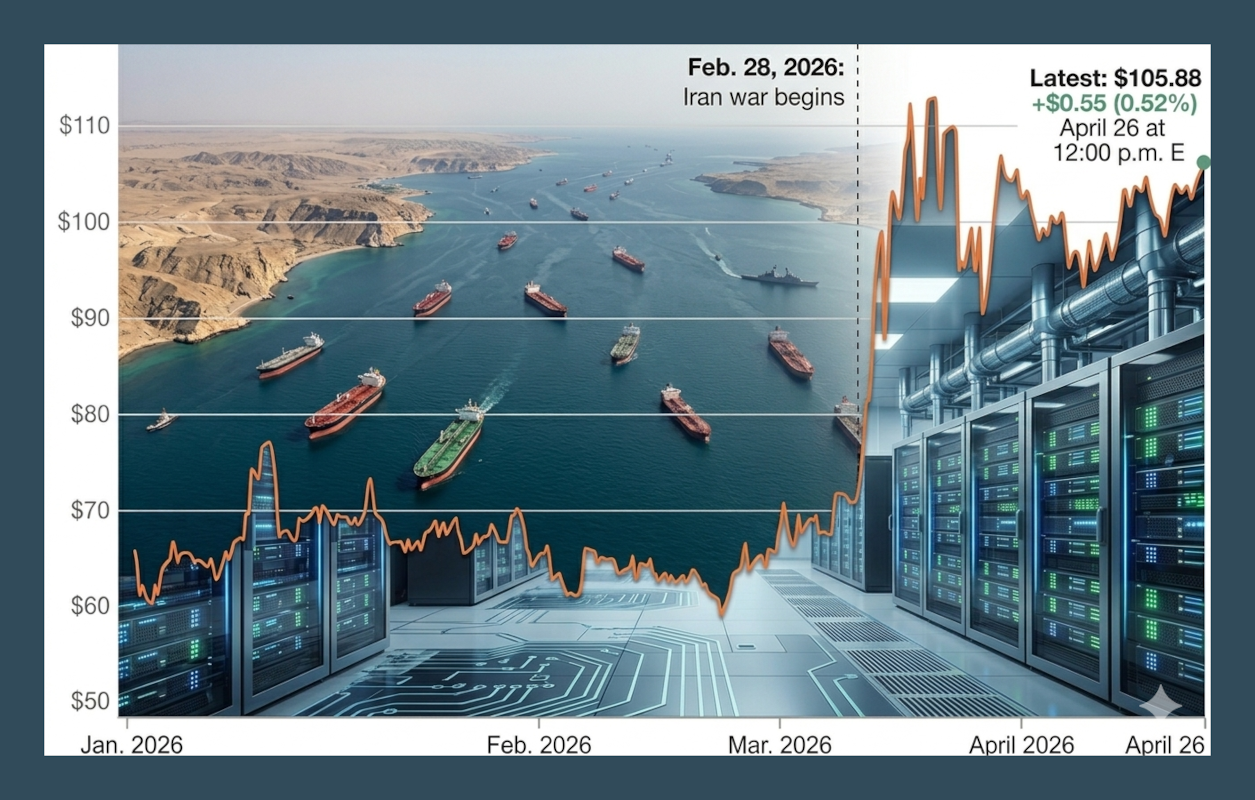
The future of AI will not be decided by who writes the best code, but by who can keep electrons flowing, copper moving, and molecules arriving through contested seas and fragile grids. The recent crisis in and around the Strait of Hormuz has made clear that the center of gravity of AI is not purely digital. It is physical.
Public debate has begun to recognize the infrastructure behind AI. Data centers have emerged as some of the most contested industrial projects in the West, challenged for their water consumption, land use, noise, diesel backup systems, and the strain they place on local power grids. These concerns are legitimate. They reflect a growing awareness that AI carries a visible and material footprint.
But these debates largely stop at the fence line. They focus on local externalities rather than the broader dependency chain that sustains AI systems. The deeper vulnerability lies further upstream — in LNG cargoes, copper supply, transformer manufacturing, industrial gases, and the maritime routes that connect them. What appears to be a digital ecosystem is, in reality, a tightly coupled physical system.
In a genuine energy shock — such as a prolonged disruption to shipping through the Strait of Hormuz — the hierarchy of needs becomes unavoidable. Grid operators prioritize residential demand, hospitals, and emergency services. Industrial and commercial users are the first to face curtailment. In many jurisdictions, large data centers already operate under interruptible load agreements. In a sustained crisis, those provisions would move from contractual formality to operational reality. When electricity becomes scarce, the question is no longer how efficiently AI systems run, but whether they can remain online at all.
Recent analysis by the World Economic Forum captures this shift, arguing that the next phase of the AI race “will not be won by code alone,” but by those who can reliably mobilize “electrons, copper and molecules” under conditions of geopolitical stress. The Hormuz crisis functions as a stress test of that proposition.
The dependencies are not abstract. LNG cargoes underpin power generation in economies central to the global semiconductor ecosystem, including Taiwan and South Korea. Industrial gases such as helium — with major supply originating from Qatar — are essential for semiconductor manufacturing. Specialty chemicals, including bromine produced in Israel, feed into chip fabrication processes. Copper, enabled in part by sulfur inputs from hydrocarbon production, constrains the expansion of power grids themselves. These are not peripheral inputs. They are foundational.
The geographic concentration of advanced semiconductor production reinforces the vulnerability. Taiwan Semiconductor Manufacturing Company alone accounts for a significant share of Taiwan’s electricity demand, operating within an energy system heavily dependent on imported LNG with limited buffer capacity. In South Korea, firms such as Samsung Electronics and SK Hynix anchor global memory supply chains while relying on energy imports that transit through contested maritime routes. The result is a layered dependency: the world’s most advanced compute capabilities rest on energy systems with limited redundancy.
The crisis has also clarified how AI infrastructure fits into the broader strategic landscape. Energy systems, shipping lanes, and hydrocarbon facilities remain the primary focus of military and economic pressure. But the expansion of data centers and cloud infrastructure ties digital capacity ever more closely to those same systems. As a result, AI infrastructure is not an isolated domain; it is embedded within a wider set of assets that are already exposed in any escalation. Even where not directly targeted, it operates within the same risk envelope.
Governments are responding by emphasizing AI sovereignty — domestic hosting, localized control, and national infrastructure buildout. But this response introduces its own tension. Concentrating critical AI workloads within national borders can reduce external dependencies while simultaneously increasing exposure to localized disruption, whether from physical attack, grid instability, or supply constraints. Efforts to secure AI capacity can, if pursued without redundancy, harden new points of failure into the system.
The emerging picture is increasingly clear. The next phase of the AI competition will be shaped less by advances in model architecture and more by the ability to sustain the physical systems that support them. Energy availability, grid resilience, industrial supply chains, and maritime security are no longer background conditions. They are decisive variables.
The crisis did not create this reality. It stress-tested a system that was already operating close to its limits—and, in doing so, made visible the physical choke points that will define the future of AI.
William Keenan is a retired Middle East Intelligence Analyst who served at NATO and the Pentagon. He lived and worked in the Middle East/North Africa for over 15 years. He is the author of ARABIA – Nine Years in the Kingdom.