
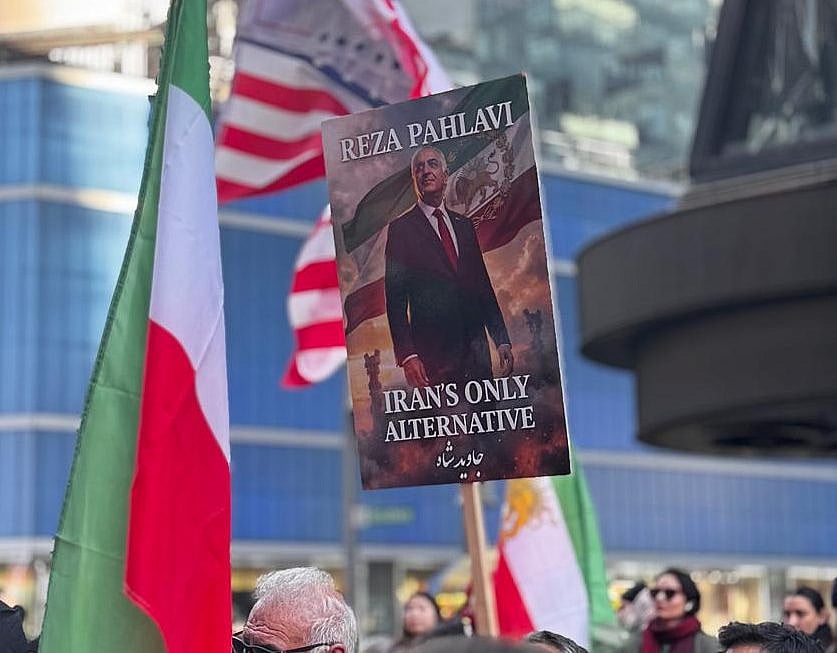
Following the elimination of Iran’s brutal dictator, Ali Khamenei, on February 28, 2026, the world witnessed a rare phenomenon: a nation partying over the death of its own leader. Videos quickly flooded social media showing thousands of Iranians dancing in the streets the moment news broke that his compound had been struck. But that jubilation wasn’t contained within Iran’s borders.
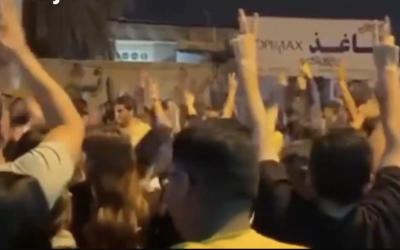
Iranians cheering and celebrating in Borazjan, Iran, following the death of Ali Khamenei. (Photo Credit: FOX Foreign News Desk, 2026)
The Iranian diaspora—many of whom have lived in exile since the 1979 Islamic Revolution—poured into the streets by the thousands in cities like Toronto, London, and Los Angeles. For a regime that murdered an estimated 40,000 civilians in recent months alone and systematically tortured women for the “crime” of showing their hair, Khamenei’s end was a long-delayed act of justice.
As a non-Iranian, I felt compelled to witness this history alongside those affected by it. I joined two separate rallies organized by Lion and Sun NY, a grassroots organization led by Iranian-American New Yorkers: the first in the busy streets of Times Square the morning after the strike, and the second a week later under the arch at Washington Square Park.
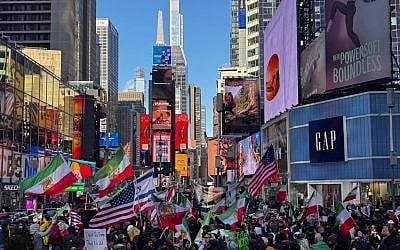
The rally in Times Square, March 1, 2026.
The atmosphere was unlike any public gathering I’ve ever seen. It didn’t feel like a typical political protest; it felt like a massive weight had been lifted. I watched as strangers took each other arm-in-arm, dancing and singing, while others took turns punching a rat resembling Ali Khamenei hung from a noose. Attendees, many with family members still actively resisting the government crackdown in Iran, waved American and Israeli flags in a show of gratitude for the military precision that had dismantled the regime’s leadership. The air was filled with roaring chants of “U.S.A!” and “Thank you, Trump!” as the crowd acknowledged the pivotal role of U.S. and Israeli involvement in their liberation.
But what struck me most—and what the mainstream media missed—was the sight of the Star of David of the Israeli flags flying side-by-side with the historic flag of Iran. Seeing that unity in person was a powerful reminder that the “Middle East conflict” isn’t always what the pundits say it is. When the common enemy is a genocidal tyrant, the bond between the two ancient civilizations becomes incredibly clear. In a world that often tries to paint Jews and Iranians as natural enemies, here they were dancing in the same circle. I saw Jewish New Yorkers and Persian exiles hugging and singing the same songs, celebrating a common victory over a regime that had spent decades trying to destroy both of them.
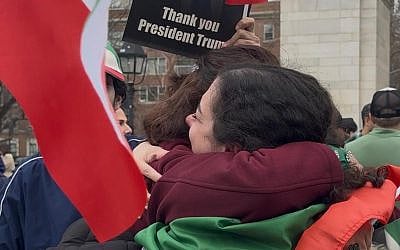
An emotional embrace between Iranians in Washington Square Park, March 8, 2026.
However, amidst the cheers, there was a profound sense of remembrance. People held signs with photos of the protesters killed in cold blood by the regime. I watched strangers collapse into each other’s arms, sobbing with a mixture of happiness and grief for the loved ones who didn’t live to see this day.
The political demand of the crowds was clear: the re-installation of the secular monarchy led by Crown Prince Reza Pahlavi. The air was heavy with the chant of “Javid Shah” (Long Live the Shah), calling for the Pahlavi leadership to return.
There was a beautiful, defiant energy in the way the diaspora reclaimed their culture. Between the emotional speeches, traditional Iranian music blasted through speakers, and Ghazal Mizrahi, a proud Iranian-Jewish singer, performed live. It was a reminder of the vibrant, sophisticated civilization that the Islamic Regime has been trying to suppress for nearly half a century.
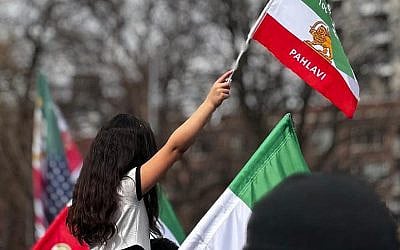
A young protester waving Iran’s pre-revolution Lion and Sun flag in Washington Square Park.
Standing in New York City, I learned the elimination of Iran’s dictator wasn’t just the end of a tyrant. It was about the rebirth of a people. For the first time in forty-seven years, the Iranian people aren’t just dreaming of freedom; they are standing on its doorstep, realizing that the very people they were told to hate were actually the ones standing right beside them.
Ezra Greenspan is a modern Orthodox American Jew with a strong interest in U.S.–Israel relations, Middle East politics, and Jewish identity with a focus on bridging perspectives between American and Israeli society. He is actively involved in political and pro-Israel advocacy and has experience engaging with policymakers and campaigns.