
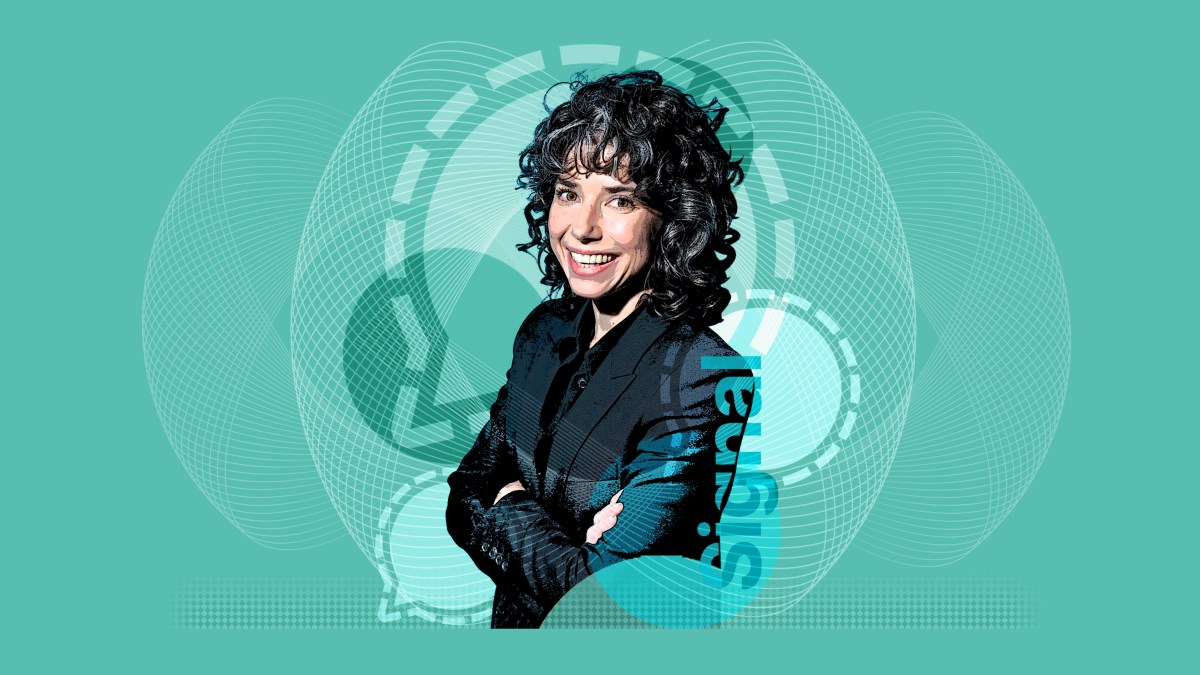
Studying a book in a café window on a cobbled Parisian street, Meredith Whittaker, curly haired, tattooed and dressed all in black, has the air of a scholarly punk.
When I ask what’s on her mind, the boss of Signal, WhatsApp’s privacy-obsessed messaging rival, stares deep into my eyes with a look that suggests the answer should be obvious: the rise of the “robot butler”.
In the tech world Whittaker inhabits, entrepreneurs and investors salivate over a not-too-distant future where average Joes will have their own low-cost, errand-running AI agents.
“It books a concert for you,” Whittaker recites. “It finds a time; what date would work for you and your friends. It messages your friends to co-ordinate, and then puts that in your calendar.”
For many, it’s a utopian vision. For Whittaker, it’s dystopian. “Of course, it’s really nice to have a robot butler that does everything for me, so I can sit in a hammock and bedrot all day,” she says. “But what does that entail? Access to your credit card. Access to your calendar. Access to your contact list. Access to your Signal to message your friends on your behalf.”
Such talk will alarm many users of Signal, which has become the go-to messaging app for privacy-conscious smartphone owners. Sensor Tower estimates Signal has 3 million active users in the UK.
WhatsApp, owned by Mark Zuckerberg’s social media behemoth Meta, promises end-to-end encryption, meaning the content of texts remains private, even from the host service itself. But many informed techies, politicians, activists and journalists prefer to entrust Signal with their deepest secrets. The app is used by the Ukrainian military, and by the upper echelons of Donald Trump’s US government.
• Smartphone apps’ data demands pose risk to privacy, experts warn
I’d assumed that Whittaker, who is working from Paris for the summer, had accepted my interview request so she could talk up Signal at a time when WhatsApp is poised to impose advertising on its three billion users. I ask her what she makes of her rival’s move.
“The sad inshitification of WhatsApp, their desperate self-own?” she asks, before adding: “We’re seeing people react to WhatsApp’s integration of a privacy-invasive and fairly useless AI system by moving over to Signal. We are seeing people react to advertising in WhatsApp by moving over to Signal.”
It quickly becomes apparent, however, that rather than talk about her rival, she sees this interview as an opportunity to vent her fears and frustrations about the UK.
First, there’s the UK’s Investigatory Powers Act, introduced in 2016, which she describes as “deeply authoritarian”. Earlier this year, The Washington Post reported that the Home Office had used a “technical capability notice” under the Act to demand Apple provide access to a user’s encrypted messages and data. The leaked story caused a furore in Washington. Apple has appealed, and the Home Office looks set to back down. But for some, the episode has cast a shadow over the UK.

Meredith Whittaker calls some of the repercussions of the UK’s Investigatory Powers Act “very, very disturbing”
SUZANNE CORDEIRO/AFP VIA GETTY IMAGES
“It’s a very, very disturbing power,” says Whittaker. If such a “back door” was opened, she says, it would create a technological weakness that could enable other governments and powers to infiltrate all users’ data. “There’s no one back door in an interconnected network,” she network,” she says, meaning that if you create one, more can be created. “If you implement that in the UK … it poisons the whole network. So that’s Ukraine. That’s Belarus. That is anywhere else.”
She says that one of the “most pernicious and alarming” problems is that if a company accepts a “technical capability notice”, it is prohibited from informing users. The upshot: “We don’t know [if any] other company has received one of those notices and responded by rolling over.” Whittaker says Signal has not received one, but that the company would sooner “leave” the UK than comply.
Then there’s the Online Safety Act, under which tech platforms such as Facebook and X are required to use age-verification tools and block posts in order to protect under-18 users from “harmful” content, such as pornography and self-harm videos. Whittaker describes this “technically incoherent” law as “a mess”, citing the removal of LGBTQ+ posts on some platforms and a surge in the use of virtual private networks (VPNs), with which people can hide their identity, location and age.
Whittaker thinks these two pieces of legislation are “deeply incoherent” with the UK’s stated desire to become an “AI champion”. “You get real boosterism on that side, which I think is in many cases ill-conceived.”
She adds: “There seem to be two wolves fighting under a blanket. One wants as much tech investment as possible, and the other is showing that many of those same people don’t understand the tech at all.”
• Online Safety Act threatens free speech, says Elon Musk’s X
Online safety minister Baroness Jones said in response: “The UK wants the internet to be a safe place for children while also ensuring they benefit from its incredible potential. It is simply wrong to say that you can’t do both.”
UK domestic matters covered, I set about trying to crack the Enigma code that is Whittaker, who Google DeepMind boss Sir Demis Hassabis describes as “a brilliant technologist and a fierce protector of privacy and security”. She may have established herself as one of the biggest names in tech, but it’s difficult to find anyone who truly knows her. She keeps her private life private, and no one seems to even know her age.
When I tell her I’ve worked out how old she is, a brief flicker of panic crosses her face. But when I cite a decades-old Los Angeles Times article that quoted her while she was working in a record store, she says coolly: “They were wrong.” She does, admittedly, look younger than 46.
Whittaker grew up in LA and went to an art school, where she studied theatre, dance and visual arts. From there, she went on to study English literature and rhetoric at the University of California, Berkeley, in San Francisco. Which sounds like an odd entry route into Google.
“Here’s a little secret about a degree in English literature and rhetoric: you get really good at reading,” says Whittaker, possibly irked by this suggestion. “I started at Google in 2006 and then I just read everything.”
Does she have a photographic memory? “I would say it is maybe a connectivist memory,” she says, by which I think she means an ability to store vast amounts of information. “But it’s very difficult to describe a mind palace,” she adds.
Whittaker successfully climbed the corporate ladder, and set up Google Open Research, a department that worked with academics to examine how tech tools might affect privacy and security. In 2018, Whittaker co-organised walkouts at Google, which saw thousands of staff protest against their employer’s handling of sexual misconduct complaints.
In retrospect, it seems obvious that Google’s business model — attracting billions of users to its search engine and other tools in order to sell advertising — does not align with Whittaker’s sensibilities. She says it was a “different” when she started. “I was inside the company during its formative years,” she says, adding that Google transformed from “a successful upstart … into a world-dominating surveillance monopoly”.
She went on to become a noisy opponent to Big Tech, through the AI Now Institute and through her work as a research professor at New York University. And in 2022, she was named president of the Signal Foundation, which was founded as a non-profit organisation in 2018. It was originally funded by a $105 million, no-interest loan from Brian Acton, a WhatsApp co-founder who became disillusioned after its acquisition by Meta.
Costs are covered by user donations, and Whittaker says Signal will soon launch some paid-for features, including encrypted storage. The app also relies on its user base of techies to keep an eye on its open-source codes to ensure it is running properly and securely.
“It’s kind of like fitting a massive company into a doll’s house,” says Whittaker of Signal’s non-profit model. “It’s very difficult and it’s not ideal. But we are in a particular industry where the profit model is diametrically opposed to the rights-preserving innovation that Signal is committed to.”
Signal, which has its headquarters in New York, does not reveal its user numbers, but Whittaker notes it has been downloaded “multiple hundreds of millions of times”. WhatsApp’s newly launched AI bot, and its stated advertising plans, have helped, as did “Signalgate”.
In March, the editor of The Atlantic magazine was accidentally added into a Signal group chat that included US vice-president JD Vance. The group shared details of an upcoming airstrike on Houthi rebels in Yemen. Whittaker says this incident, although “dicey”, proved that Signal is seen as “core infrastructure at the highest levels, and everyone uses it”.
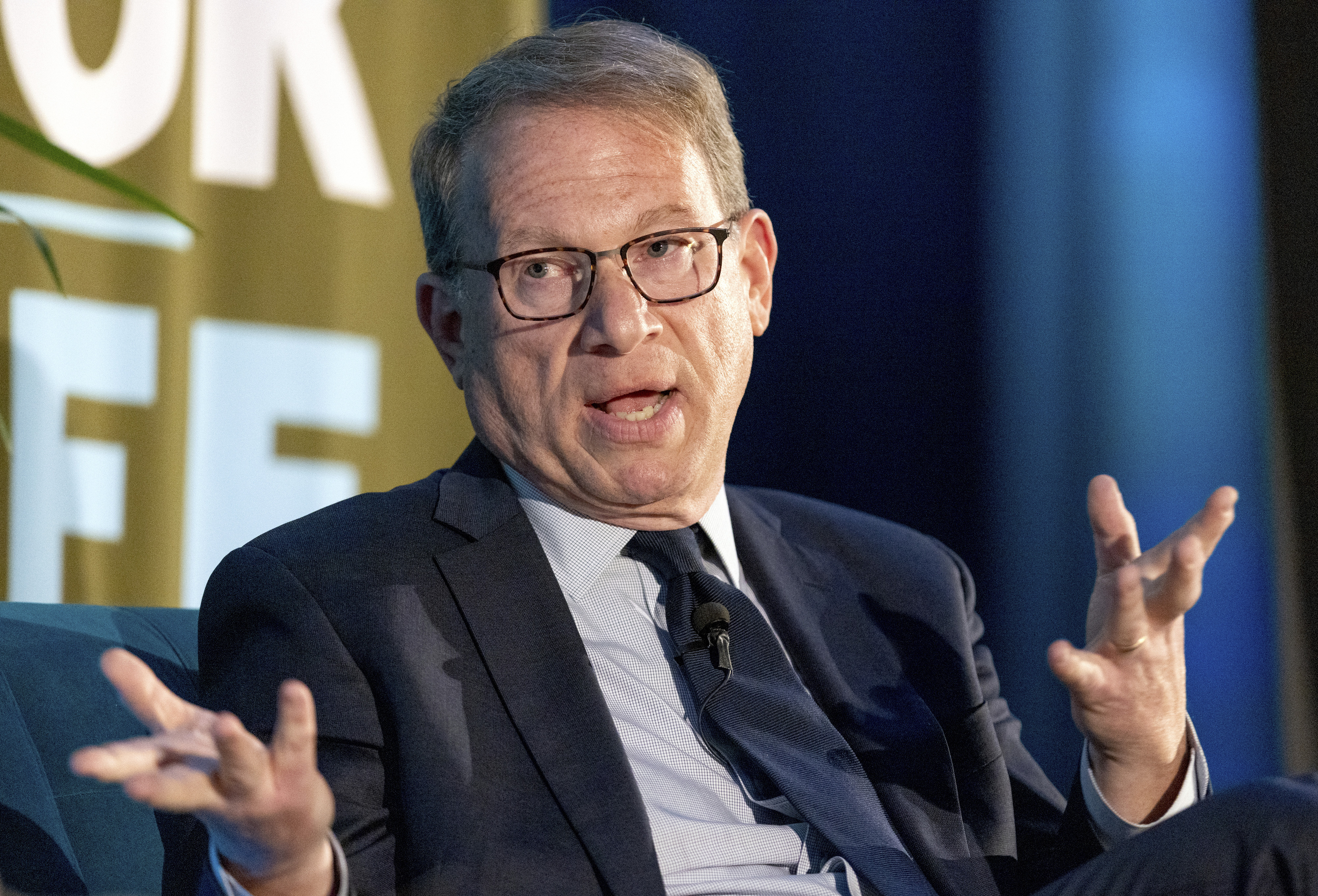
Jeffrey Goldberg, editor in chief of The Atlantic magazine, was accidentally added into a Signal group chat that included US vice-president JD Vance
BRETT DUKE/THE ADVOCATE VIA AP
After more than an hour with Whittaker, she’s proven herself lively company. But I still don’t feel I know much about her. I ask what she’d be doing if she hadn’t stumbled into Silicon Valley. “Oh, I’d be a poet.” Really? “Well, I am a poet. My emails are my poetry. I don’t know.”
While it’s clear that Signal is growing in popularity among the tech savvy, it remains a fraction of the size of WhatsApp. When I ask how long it will take for ordinary members of the public to start caring enough about their privacy to use Signal, Whittaker seems slightly affronted. “I really, really reject the framing that we’ve already given up all our privacy,” she says, adding that people are effectively “coerced” into using apps and websites that seem essential for modern life.
I suggest to Whittaker that some people reading this interview will think: I’m a law-abiding citizen, my private information is not very interesting, so why should I care?
At this, Whittaker’s eyes bore into mine once more. “I would invite anyone who gives that answer and — not in a mean way — to close their eyes. What data is on Meta’s servers? All your Facebook DMs, all your Instagram DMs, all the likes you put on those girls’ profiles, perhaps. Every interaction you’ve had there, all of your photos, all the edits of the photos, tons of ad-tracking data — really, really sensitive stuff.
“OK, you don’t care. You don’t care, you don’t care! OK, all that data’s online now. Mark [Zuckerberg] just dumped it online. Every single friend you have, everyone in the world, everyone in your college class, everyone in HR, everyone you work with, everyone at The Sunday Times. Your editor, my friend, just got sent a link to that database, and they just opened it … Do you still not care?”
Reminding her that I’m not talking about myself, I suggest to Whittaker that the hypothetical reader might respond: well, that could be embarrassing, but it’s probably not going to happen, is it?
“Why would you say that?” she asks, her tone accusatory, as if I’ve learnt nothing in the past 90 minutes. She goes on to lecture me on “ghost profiles”, advertising and the regularity with which individuals’ data is hacked. “Of course there’s a likelihood this will be breached,” she says impatiently. “Of course.” With that, Whittaker shoots me a smile. “That’s it,” she says. “Oxford Union gavel down.”

Helsinki was the venue for the Signal boss’s last holiday
GETTY IMAGES