
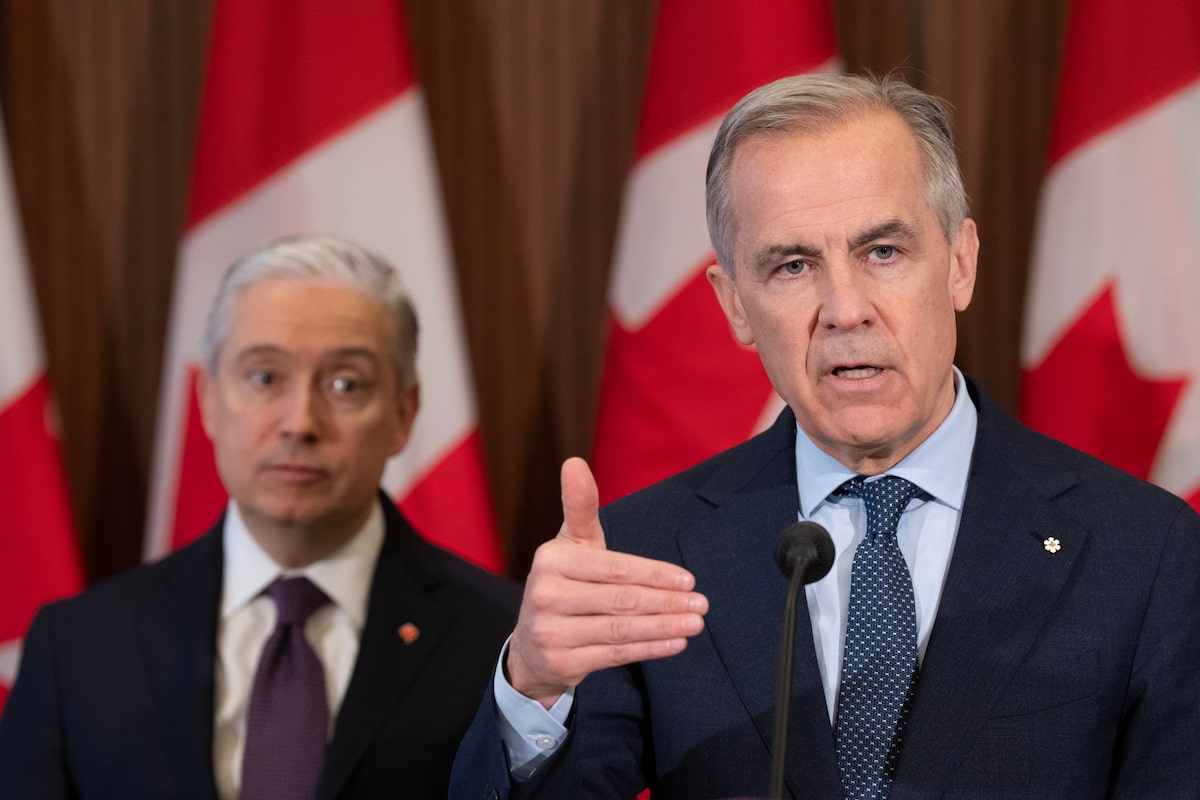
Finance and National Revenue Minister Francois-Philippe Champagne and Prime Minister Mark Carney during an announcement on Parliament Hill in Ottawa on April 14.Adrian Wyld/The Canadian Press
Prime Minister Mark Carney will announce plans to create a sovereign wealth fund Monday, a day ahead of the spring economic statement, according to a senior government official.
The fund will be used to invest alongside the private sector in major projects that the Carney government has committed to building over the coming years, and the government also plans to create a way for individual Canadians to contribute, the official said.
Mr. Carney will lay out the details of the fund at an event Monday in Ottawa, while Finance Minister François-Philippe Champagne will have a separate event in Montreal.
The Globe and Mail is not identifying the official as they were not authorized to publicly comment on the pending announcement.
A sovereign wealth fund is a state-owned investment account that is typically independently managed.
Opinion: Mark Carney, the banker for all seasons
International examples include Norway’s fund, colloquially known as the “oil fund,” which reinvests revenue from oil and gas resources.
At US$1.7-trillion in assets, Norway’s is the largest sovereign wealth fund.
The sector as a whole is worth an estimated US$13-trillion in assets under management.
Several Canadian provinces have versions of such funds, including the Alberta Heritage Savings Trust Fund and the Newfoundland and Labrador Future Fund.
Mr. Champagne’s office invited leaders of the country’s largest banks, pension plans and construction companies to the minister’s event, which was described to them as a prerelease of his spring economic statement, focused on infrastructure investment.
By late Sunday, the minister’s team and staff at the Prime Minister’s Office had yet to supply them with any details on the Finance Minister’s announcement.
Both the PMO and Mr. Champagne’s office declined to comment on Monday’s announcement when reached Sunday by The Globe.
The Globe is not identifying the business leaders who relayed details of the event, because they were not authorized to comment on the matter.
Mr. Carney has travelled abroad extensively to attract more foreign capital to Canada, including from sovereign wealth funds in regions such as the Middle East.
He’s also inviting more than 100 of the world’s largest investors to a summit in Toronto in September.
Canada to host September summit in Toronto to help draw billions in foreign investment, Carney says
That event is intended to amplify Canada’s attempts to position itself as a stable and predictable place to invest. The effort has caught the eye of major investors abroad.
Tuesday’s economic update will mark one year since the federal election, which saw Mr. Carney’s Liberals secure a minority government that recently became a majority after five opposition MPs crossed the floor to join the Liberal caucus and the government won three by-elections.
Mr. Champagne released a video statement Sunday that outlined the broad focus of Tuesday’s update. He said it would “build on” the plan outlined in his Nov. 4 budget.
“Our new government is doubling down on efforts to tackle long-term structural challenges, generational investment in infrastructure and productivity, strengthening Canada’s investment climate and making economic growth a clear priority,” he said.
“The spring economic update is our plan to keep that momentum going, all while making life more affordable for Canadians today and for years to come. Bringing down everyday costs is at the heart of that plan.”
Since the budget, Mr. Carney has announced consumer-focused policies with substantial price tags. In January, he unveiled a temporary increase to the GST credit, estimated to cost $12.4-billion over six years. Then, earlier this month, the Prime Minister announced a plan to shave off 10 cents in taxes per litre on regular gasoline – and four cents per litre on diesel fuel – until Labour Day at a fiscal cost of $2.4-billion.
But the senior government official said the federal government will show an improved bottom line in Tuesday’s spring economic statement, posting a lower projected deficit for the current fiscal year and future years.
Conservative Leader Pierre Poilievre and other critics of the government have sought to characterize Mr. Carney’s record to date as one of lofty promises but limited follow-through, particularly when it comes to launching big projects.
Mr. Poilievre released an open letter to Mr. Carney Sunday in which he urged the government to cap the deficit at $31-billion, present a plan to return to a balanced budget in the medium term and cut “bureaucracy, consultants, corporate welfare, foreign aid, handouts to fake refugees and tax havens.”
The government is clearly aiming to show evidence of progress as it enters its second year since the election.
On Friday, Energy and Natural Resources Minister Tim Hodgson told a business audience in Toronto that up to 10 new major natural-resources projects will be under way by this time next year.
The government announced last year that it would be changing the timing of its key financial reports. The annual budget was announced in the fall, instead of the spring, and the typical spring budget is being replaced by an economic statement, which is also called a fiscal update.
Opinion: The end of the ‘if only’ Prime Minister
Economic statements primarily focus on updating forecasts for revenue and expenses and their impact on Ottawa’s bottom line. They sometimes include new spending.
Mr. Champagne’s Nov. 4 budget projected a $78.3-billion deficit for 2025-26 and $65.4-billion for the current fiscal year that began April 1.
Several private-sector economists have recently reported that federal revenues are likely to be stronger than projected in the November budget. While this would allow Ottawa to show smaller projected deficits, the economists said they expected new spending announcements will use up most of that new fiscal room.
The economists said part of that improvement is because of statistical revisions to the gross domestic product that took place after the release of the Nov. 4 budget. Those statistical revisions are unrelated to any government policy decisions.
Signs of an improved bottom line were evident Friday, when the Finance Department released its monthly fiscal monitor report.
That report showed the federal deficit totalled $25.5-billion over the first 11 months of the fiscal year.
The government typically posts large one-month deficits in March, the final month of the fiscal year.
With a report from James Bradshaw in Toronto