
No flush of quarterbacks at the top of the first round. No stunning fall, like Shedeur Sanders a year ago. No vicious prank call, either (thankfully).
The 2026 NFL Draft is in the books, and though this year’s edition lacked the fireworks of the last few, teams spoke loudly with their decisions. For starters, a handful of clubs with needs at the most important position on the field — that’d be quarterback — resisted the urge to reach in a down year for the position, with most waiting until the later rounds to take a flier on a likely backup. And the one team that might have done the reaching, the Los Angeles Rams, happens to employ the best QB in the game, reigning MVP Matthew Stafford.
The New York Jets, Arizona Cardinals and Cleveland Browns, among others, may all be waiting until next year to pull the trigger on a QB. With the likes of Arch Manning (Texas), Dante Moore (Oregon), Julian Sayin (Ohio State) and LaNorris Sellers (South Carolina) expected to be available, there are rumblings the 2027 class could rival the 2024 edition that produced Caleb Williams, Jayden Daniels, Drake Maye and Bo Nix.
Instead, the 2026 draft saw a running back go third, a middle linebacker go seventh, and nine offensive linemen gone by the end of the first round. The Dallas Cowboys were giddy after having to trade up only one spot, from No. 12 to No. 11, to take Ohio State safety Caleb Downs, one of the cleanest prospects in the draft. And the Tampa Bay Buccaneers couldn’t believe one of the most talented edge rushers on their board, Miami’s Rueben Bain, Jr., fell to them at No. 15.
The Kansas City Chiefs, fresh off their first January at home in 11 years, were intent on rebuilding their defense. KC’s first four picks came on that side of the ball, including a trade up from No. 9 to No. 6 to grab LSU cornerback Mansoor Delane. The New York Giants, Carolina Panthers and New England Patriots all went offensive tackle in the first round, hoping to help their young quarterbacks. (Before grabbing Miami’s Francis Mauigoa at No. 10, the Giants swiped Ohio State’s Arvell Reese at No. 5, the start of an impressive haul for John Harbaugh and company.)
And Philadelphia Eagles general manager Howie Roseman went to work, per usual, stealing USC wideout Makai Lemon from the Pittsburgh Steelers in the first round — Lemon was already on the phone with Pittsburgh — before trading for Minnesota Vikings edge rusher Jonathan Greenard a day later, then possibly landing his tight end of the future in Vanderbilt’s Eli Stowers.
Here are a few storylines worth digging into:
Raiders seem intent on sitting top pick Fernando Mendoza
It’s among the hardest things to do in the NFL: draft a quarterback high, then have the patience and conviction to sit him as a rookie, even as the losses pile up and the fan base is clamoring for him to play. Many have pledged to do this. Few have actually carried through.
“(Teams) have this shiny new toy, and they can’t wait to unwrap it,” 2005 No. 1 pick Alex Smith said last summer. “And so often it’s the wrong decision.”
“The pressure to play the kid is real. It just is,” Colts GM Chris Ballard added, reflecting on the Anthony Richardson experience, which Indianapolis bungled in more ways than it can count.
If you believe first-year Raiders coach Klint Kubiak — and I tend to — Las Vegas will become the latest litmus test in one of the NFL’s most divisive debates: Throw a rookie quarterback into the fire, believing the early scars will harden him for the future, or keep him on the bench, allowing him to mature ahead of the moment he takes over? There is ample evidence both approaches can work, and context is essential: player makeup, coaching acumen, roster depth, leadership chops (see: impatient owners).
At the league meetings in Arizona a month ago, Kubiak tipped his hand, basically coming out and admitting his plan was to keep the presumptive No. 1 pick, Indiana’s Fernando Mendoza, on the bench to start, so long as the Raiders had a veteran quarterback — “a mature adult,” in Kubiak’s words — capable of running the show. A few days later, the Raiders signed 14-year veteran Kirk Cousins, who very much qualifies. Cousins isn’t getting paid $20 million, his guaranteed salary for 2026, to hold a clipboard and be a mentor. All indications are that he’ll be the Raiders’ starter Week 1 and beyond.
It doesn’t mean Las Vegas has any doubt about its prized pick. The Raiders were sold over a month ago; Mendoza was the future. Any teams calling GM John Spytek in recent weeks hoping to slide into the top spot — and there happened to be a few — were met with a blunt answer: “No.” The question now is when he’ll see the field.
“Ideally, you don’t want him starting from day one,” Kubiak said in late March. “You’d love him to be able to learn behind somebody. That’s in a perfect world.”
The Raiders have created that world and deserve credit for doing so. The easy thing would be to throw Mendoza out there, as the Tennessee Titans did with Cam Ward last season, as the Chicago Bears did with Williams the year before, as the Panthers did with Bryce Young the year before that. But Las Vegas is miles away from competing, especially in a loaded AFC West, and, despite some nice additions in free agency, will enter 2026 with major questions on the offensive line. Tossing out a rookie behind that unit — which allowed an NFL-worst 64 sacks last season — would be risky. More than one young passer has failed to come back from that kind of setup.
The interesting thing is that when Kubiak was addressing reporters in Arizona, he didn’t mean “learn behind somebody” for a few games. He meant well beyond that. Will the Raiders have the conviction to keep their shiny new toy on the sidelines all year? This is not an organization with an encouraging track record. But Kubiak seemed resolute in his belief, and he doesn’t seem like the coach willing to bend on it if his team starts 1-4.
Mendoza is sharp and seasoned. He started 36 games in college. He won the Heisman Trophy. He led one of the most unexpected title runs in the history of the sport, seizing every stage he saw. After going No. 1, he said, “I haven’t proven anything.” He celebrated by watching an entire season of Cousins’ film.
“There’s a humility to him and a self-awareness to him that he knows this is a really big jump,” Spytek said.
Mendoza is everything the Raiders have needed for a long time. His new coach might be right: For a different outcome, it’s time this team takes a different approach.
Do we believe Sean McVay?
You can typically tell what emotions are running through the minds of NFL decision-makers the first night of the draft — it’s the start of a long weekend and the end of a long process. They’re tired, relieved, often ecstatic (have you ever heard a GM admit the board didn’t fall his way?). In their minds, they’ve made their football team better.
In turn, most of these news conferences are lighthearted. Back-slaps with the boss. Jokes. A crack or two about a media member’s mock draft. Some uplifting stories about the prospect who sold them. Some football cliches on why he’ll fit their culture.
Which is why, when a head coach doesn’t smile once across the entirety of an 11-minute news conference after his team pulls a stunner and drafts a quarterback in the first round — and that coach happens to be one of the shrewdest offensive minds in the league — it raises some eyebrows. Stirs some theories, too, about said coach’s real feelings about the pick.
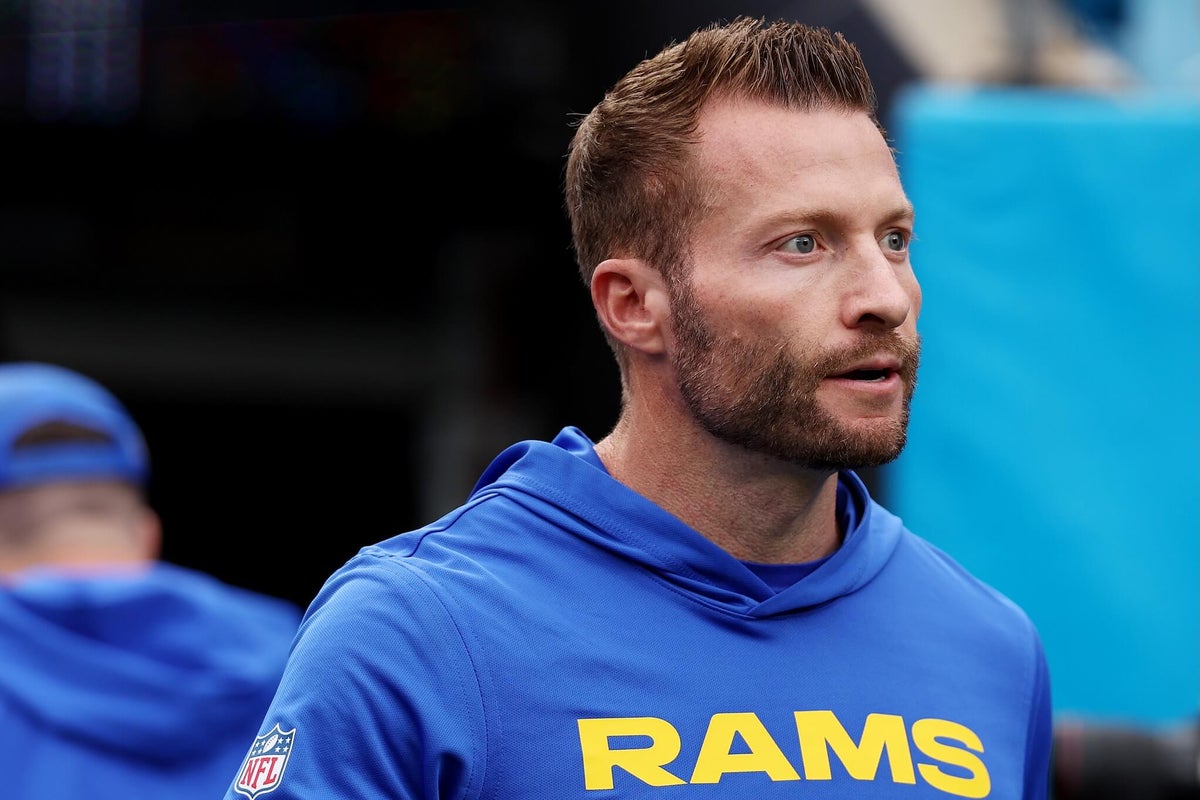
When Rams coach Sean McVay sat at the podium late Thursday night, shortly after his team drafted Alabama quarterback Ty Simpson 13th, he looked like he’d just lost a game. A big game.
What struck me was what The Athletic’s Rams beat writer, Nate Atkins, wrote later that night: “Across beats covering the Chicago Bears, Detroit Lions, Indianapolis Colts and now the Rams, this was the first time I’ve covered a first-round draft pick news conference where the regime showed so little excitement about the player selected.”
In a league too often sanitized by coachspeak, facial expressions might be our last great truth serum.
McVay tried to add context Friday and Saturday, acknowledging that “I can be a little grumpy” and that the cause of his late-evening grumpiness had nothing to do with a surprise pick at a position where the Rams are quite set. The coach was trying to downplay the idea of simmering frustrations with GM Les Snead about the selection, or the theory that he wasn’t on board with the choice in the first place. It’s not an ideal way to start Simpson’s career, with his coach — and future QB mentor — seemingly steaming a few minutes after the Rams made the pick.
Snead and McVay form one of the best leadership tandems in the NFL, and over the course of a decade, they’ve built the Rams into a model franchise. They’re also going to disagree from time to time. This is how scouting works. It’s how the NFL works. My gut tells me they disagreed on this one, and McVay’s face Thursday night revealed more of the story than his words in the days that followed.
The reality is Simpson is a luxury pick — and a reach, for that matter — by a team in Super Bowl contention, the kind of move a GM makes because he’s thinking long term. And that’s Snead’s job. Stafford is 38 and managing degenerative back issues. Nothing wrong with planning for what’s next. McVay’s opinion weighs heavily in everything the Rams do, as it should. But coaches are inherently wired to think differently: What can help us win this year? What can help us win Sunday?
Ty Simpson is not that answer for the 2026 Rams.
Another layer to McVay’s clarification was Stafford’s role in all of this. “The main thing was … I couldn’t be more excited about being able to add (Simpson), but also understanding how much I love Matthew Stafford, how respectful you want to always be to the way things are interpreted,” the coach said. “It is Matthew’s football team.”
In 2025, Stafford was the best quarterback in football. There’s no chance the drafting of Simpson was going to make him question his status or future with the team. Future Hall of Fame QBs are built to block out fear and bury doubt. It’s a requirement of the role. Second-guess yourself and you’ve already slipped. McVay selling the Simpson pick a little more on Thursday night wouldn’t have changed Stafford’s approach to the coming season one bit. These quarterbacks are miles apart.
Snead’s reasoning was fair — “I don’t want to sit here and say we draft one player and we go to the Super Bowl,” he said — but it doesn’t change the fact that the Rams wasted a rare opportunity to add an impact player who could help them in that pursuit. This pick, remember, came as part of a brilliant trade Snead made a year ago with Atlanta. It’s not often the Super Bowl favorite picks 13th in the first round.
It reminds me of another team with an aging quarterback and a narrowing championship window: As soon as Tom Brady landed in Tampa in 2020, the Bucs upended their team-building philosophy. It became, simply, win now. GM Jason Licht’s first pick was Tristan Wirfs, a hulking right tackle who kept Brady upright and became one of the best in the game. That pick was a win for the Bucs on two fronts: Wirfs started every game as a rookie, Brady suffered just 21 sacks, and the Bucs won the Super Bowl. He has since shifted to left tackle and remains one of the best in the sport.
The biggest winner in all of this? It’s Simpson. There’s no better landing spot for a young quarterback. He’ll get to work with McVay and sit behind Stafford — that is, if he’s able to beat out the incumbent, Stetson Bennett, for the backup role. For the Rams, it remains a puzzling decision to reach on a player who, in all likelihood, won’t see the field in 2026. They had other needs, if only a few.
McVay’s words said one thing. His face told the story.
‘Mike Tyson had short arms, too’
So little of the chatter regarding one of the most polarizing prospects in this year’s draft, Miami edge rusher Rueben Bain Jr., was about what he put on tape. In that regard, there was nothing to dispute.
A recent revelation, first reported by The Read Optional, threatened to cloud his draft status: Bain was involved in a fatal crash two years ago in which he was cited for careless and negligent driving. A 22-year-old woman later died. The best defensive player in the College Football Playoff was supposed to be a no-questions-asked top-10 pick. Would this cause him to fall?
The report wasn’t news to NFL teams, which routinely employ private investigators to dig into draft prospects and compile detailed reports on their backgrounds.
The rest of the conversation about Bain was about his arms — and how short they are.
Some context: Bain’s 30 7/8-inch arms placed him 45th of the 46 edge rushers included in The Athletic’s Dane Brugler’s 2026 edition of “The Beast.” (Ohio State’s Caden Curry was the only pass rusher with shorter arms.) There were more than 200 edge rushers with longer arms in the 2025 edition of “The Beast.” And in 2024, 38 of the 40 edge-rushing prospects had longer arms; the only ones to measure shorter were a pair of twins from UCLA — Gabriel and Grayson Murphy — neither of whom is on an NFL roster.
In summary, yes, Bain’s arms are historically short for a first-round defensive end. It’s a trait NFL evaluators covet, especially up front — you’ll hear scouts rave about arm length when it comes to linemen because reach is so important in the trenches and when you’re chasing a quarterback outside the pocket.
It seems a handful of teams bought into this theory, letting Bain slide out of the top 10 Thursday night, then keep sliding. The result: The Buccaneers landed a very, very good football player at No. 15. In time, he might prove the steal of the draft.
“Mike Tyson had short arms, too,” a beaming Licht said later.
The truth is the GM never thought Bain would be there. “We got our guy,” was how he started his news conference, acknowledging he’d never seen a draft room more excited. (Licht has been with the Bucs since 2014.) In all the variations the personnel staff played out before the first round, there were very, very few in which Bain fell to them. When he did, Licht was ready to turn in the card immediately. He actually had to convince himself to wait a minute.
“What are you doing the next five, 10 years?” the GM asked Bain over the phone.
“I’m gonna be a Buc,” Bain assured him.
From there, his reaction was telling. Bain walked purposefully, never slowing, never stopping — not even to size himself up in his new Bucs hat in the mirror — before striding onstage for a hug with the commissioner. He looked like he was marching out to the Super Bowl kickoff.
How much will Bain’s perceived limitation hurt him at the NFL level? He’ll be an interesting test case. No edge rusher has ever been drafted inside the Top 10 with shorter arms. Traits matter, but they aren’t everything. Bain excels in a few other areas that happen to be vital for those chasing QBs for a living. He has tremendous bend, a ruthless physicality and a relentless motor. Just ask the offensive linemen from Texas A&M, Ohio State, Ole Miss and Indiana, all of whom failed to slow him down in January’s playoff. Bain was a problem. He’ll likely be one in the NFC South, as well.
At first glance, Bain is a perfect fit for Todd Bowles’ defense; the coach will move him all over the line of scrimmage in hopes of getting him lanes to the passer. A limited reach in open space is less of a hindrance.
The episode reminded fans of the last time a talented defensive lineman from Miami fell into the Bucs’ lap. In 1995, Warren Sapp was a lock to go inside the top five. But character concerns pushed him down, and Tampa Bay grabbed him at No. 12. He’d start 130 games for the franchise, help it win a Super Bowl and end up in the Hall of Fame.