
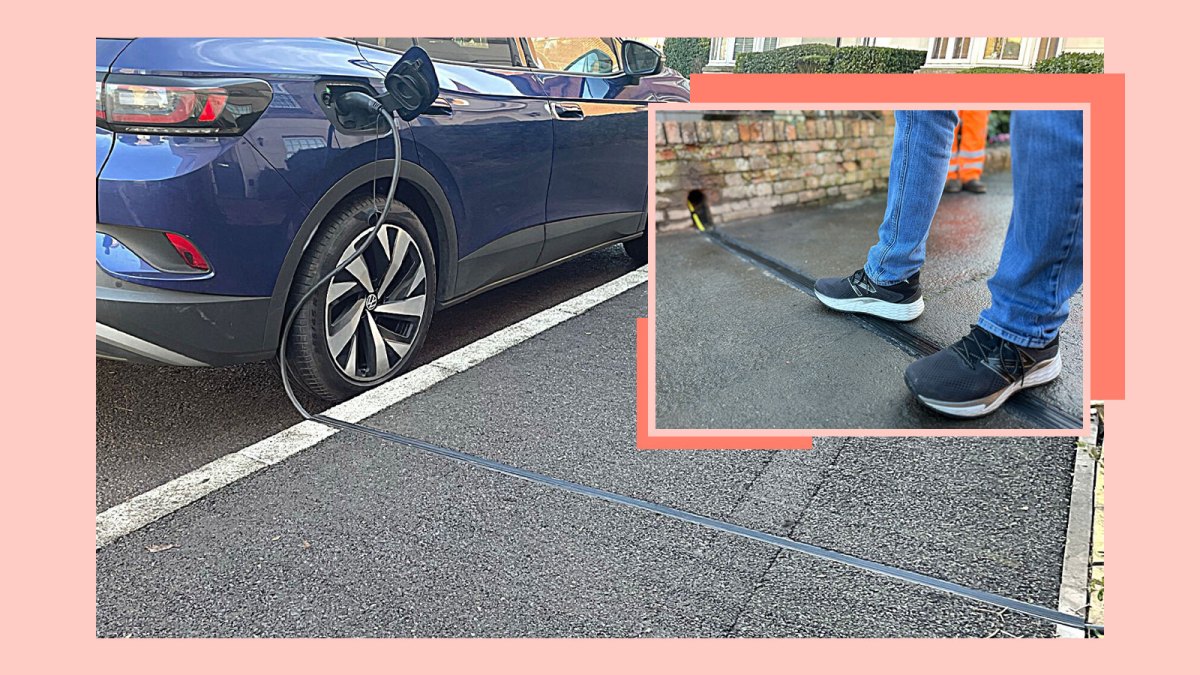
Some £25 million of taxpayer money is available to help those without driveways charge an electric vehicle from their home, but some local authorities are blocking funding requests on health and safety grounds over concerns that hidden charging cables are a trip hazard.
Being able to charge a vehicle at home can be make or break for drivers wanting to go electric. Home charging can cost as little as 6p per kilowatt-hour (kWh) — almost nine times less than public chargers, which cost about 52p/kWh on average.
Charging at home is easy if you have a driveway or garage. Those without would have to run a cable from their property to the street, which can obstruct the pavement — an offence under the Highways Act. A number of companies argue a better option is to dig shallow channels into the pavement to run the cable through, which is topped off with a flat lid that sits flush to the ground and typically costs about £1,000.
Residents first need planning permission and a street works licence from their local council, and sometimes have to pay an ongoing annual maintenance or licence fee to the council or company. Advocates argue that gullies are safer than loose hanging cables, which can obstruct the pavement.
About 35 per cent of households in the UK, and 56 per cent in London, do not have off-street parking according to the RAC Foundation, a think tank. These households must rely on expensive public chargers.
Fully charging a Renault Zoe with a 52kWh battery would cost £3.12 at home at 6p/kWh, and £27.04 on a public charger at 52p/kWh, according to ZapMap, a site that compiles information about public charging spots.
In a survey of 5,000 drivers by the energy supplier Eon Next, 59 per cent said the cost of going electric was the biggest barrier to making the switch, and 28 per cent cited the lack of public charging infrastructure.
Michael Goulden, the cofounder of Kerbo Charge, which has installed about 1,000 gullies across 30 council areas since January 2023, said: “People repeatedly tell us that home charging is the only way to make the numbers work. Electric cars are more expensive to lease, but they can make it work as the running cost is cheaper than petrol. But only if they can charge from home.”
• Can you still save money with an electric car?
Tied up by red tape
Drivers can apply for a £350 grant towards the cost of buying a home charger (which typically costs £800 to £1,200) if it is installed alongside some kind of “cross-pavement solution”. Last month the government also opened a £25 million fund for councils, incentivising them to allow cables “to run safely beneath pavements”.
Some councils including Bromley, Enfield, Lancashire and Suffolk have either trialled or fully approved cross-pavement charging. But other local authorities, despite touting their net-zero credentials, have rebuffed residents’ calls to trial them.
Lewisham borough council in southeast London told one resident who was keen on trialling a company called Charge Gully that it posed “an electric and tripping safety hazard”. The council also said in the email in December, seen by The Sunday Times, that gullies raised issues of liability for maintenance or in the case of an accident, and created “potential access issues for utility companies”.
Goulden said there were about 150 residents in Lewisham on his company’s waiting list, all unable to install a charging gully because of the council’s stance. He said the council had refused to meet the company.
He said: “In London nearly 60 per cent of households have no driveway, and it has the highest level of electric car adoption, so those two together make it the highest priority area to make cross-pavement charging available.”
Lewisham council said on its website that it was among the first local authorities to “declare a climate emergency” in 2019.
In its 2024 climate action plan it said its ambition was “to make Lewisham a place where low-carbon travel is the easy choice”.
• Fix our woeful rollout of EV charging to rescue our car industry
Lewisham council said there were still concerns about the long-term safety and practicality of cross-pavement charging, including risks to people with mobility challenges, and potential electric shock hazards. It added: “Even when installed correctly, these mechanisms can degrade over time or be misused, creating hazards homeowners or the council could be held responsible for.”
The Sunday Times understands at least 11 councils in London are blocking requests for cross-pavement chargers, as well as Birmingham city council and Oldham borough council in Greater Manchester.
Birmingham council, which said 30 per cent of its residential properties have no access to off-street parking, “does not licence or permit the use of trailing cables on the highway” because it deems them to be a tripping hazard.
Installers including Charge Gully and Kerbo Charge have insisted that the lids of their gullies fit flush to the pavement and require little maintenance.
• Read more money advice and tips on investing from our experts
Goulden said residents would also be liable for any accident involving a cable. “It’s no different to if someone’s using a lamppost charger where there’s a trailing cable, so there’s precedent for that.
“Most car insurers now include cable trip cover provided someone’s taken reasonable care. But the whole point of this is that it removes trip hazards. You can walk around a city and see people trailing free-hanging cables along the pavement. A gully would rectify that.”
‘It’s the only way I can afford to go electric’
Edward Baker lives in Greenwich, southeast London, and is keen to make the switch to electric. But he has no driveway and there is only one public charger within a 20-minute walk of his house, so the only feasible option for him to afford an electric car would be to install a cross-pavement charger.
Baker, 47, has spent almost two years trying to persuade Greenwich council to let him trial a pavement charging channel, installed by Charge Gully using a technique approved by other councils. Charge Gully promises not to compromise pedestrian access, but Baker’s efforts have been rebuffed.
• Can’t charge an electric car at home? Then petrol may be cheaper
He said: “About half of residents here live in terraced houses, so all of them are disadvantaged. It’s about five times more expensive to charge on public networks than at home. It feels like this would reduce pressure on government budgets because we would be paying for the gullies ourselves.”
The Royal Borough of Greenwich also declared a climate emergency in June 2019, and has “set an ambitious target to reach net-zero carbon emissions 20 years ahead of the national target of 2030”. It did not respond to a request for comment.
Ben Hopkinson from the Centre for Policy Studies, a right-leaning think tank, said: “Enabling easy access to home charging is one of the biggest barriers to the uptake of electric vehicles. Yet this is another example of the planning system making commonsense solutions more difficult.
“Councils that have made climate emergency pledges should be keen to approve these kerb installations instead of blocking them.”
This year the Department for Transport said it was looking at how installing cross-pavement chargers could be made easier. It said: “We are committed to delivering the charging infrastructure the country needs to drive the switch to electric vehicles.”
Has a council blocked your attempts to charge an electric car? Let us know in the comments