
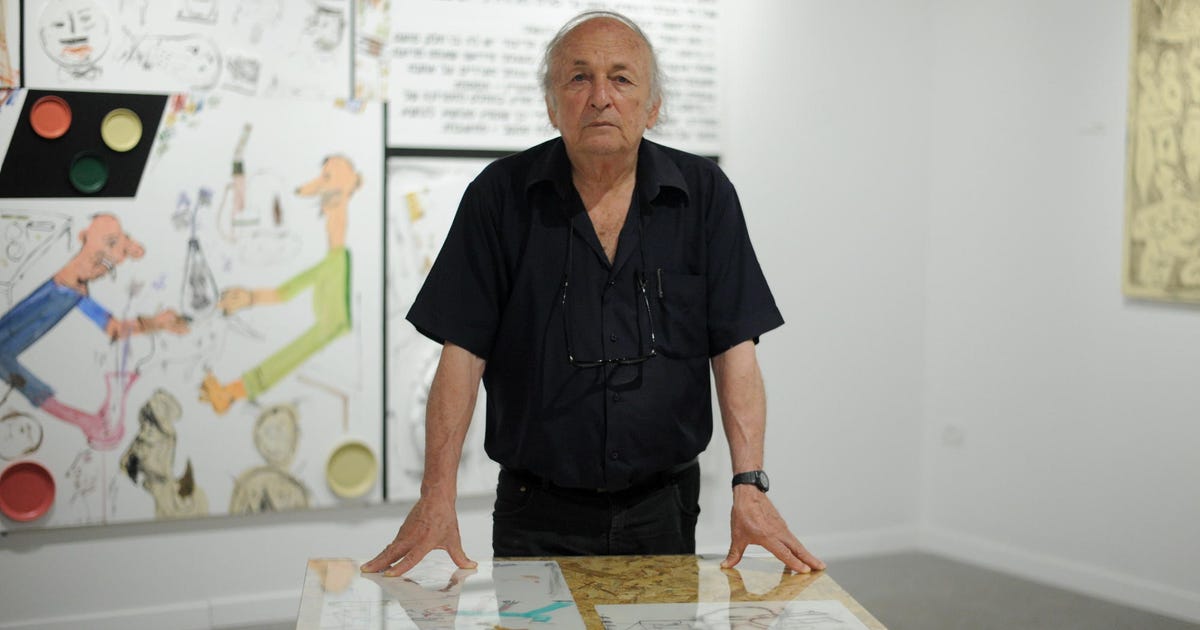
Yair Garbuz, an influential Israeli artist, writer and publicist, died on Wednesday at the age of 80 following a rapid deterioration due to cancer. A recipient of the Sokolov Prize, Garbuz exhibited dozens of shows in Israel and around the world and published numerous books spanning satire, memoir, poetry and essays.
Garbuz was born in 1945 in Givatayim to parents who immigrated from Poland. He studied painting under Raffi Lavie and at the Avni Institute, and held his first solo exhibition in 1967. His early works from the mid-1960s incorporated techniques such as photographic collage and scribbles, often depicting expressive figures and grotesque nudes.
From the mid-1970s through the mid-1980s, his work evolved to include ironic reinterpretations of figures from institutional Zionist propaganda, frequently embedding text into the composition. Rather than returning to traditional painting, Garbuz developed a hybrid visual language combining painting, collage, text, and references to Israeli art history. Among his notable works are “If Not a Selfish Giant, then at Least in His Garden” (1979), a mixed-media collage, and later paintings such as “Israeli Art (Ichud Israeli Art Meuchad).”
 Close
Close
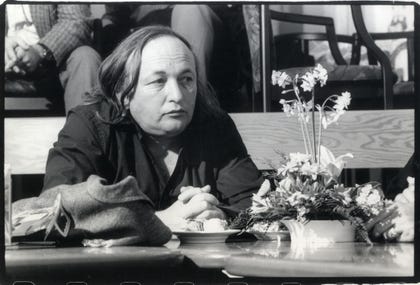
Garbuz in 1990. He argued that the Israeli art world is disconnected from its historical context. Credit: Tali Shani
Garbuz in 1990. He argued that the Israeli art world is disconnected from its historical context. Credit: Tali Shani
Alongside his visual art, Garbuz was an active cultural commentator. He wrote for the satirical supplement Davar Aher in the newspaper Davar, sometimes under the pseudonym Y. Polani, work that earned him the Sokolov Prize in 1993. He also hosted a satirical television program on Channel 2 and appeared as a panelist on cultural programs on Channel 8.
In 1989, he published “Always Polish,” a collection of satirical essays adapted from his columns. He later authored several additional books, including “A House in the Galilee” (2014), a reflective autobiographical narrative; “Expected Changes in My Distant Past” (2020), a poetry collection; and “Terribly Beautiful” (2025), a collection of essays on art and politics.
Garbuz also held significant academic and institutional roles. For approximately 14 years, until 2011, he served as head of the HaMidrasha Art School at Beit Berl College. He later joined The Basis for Art & Culture in Herzliya, where he led the school’s cultural activities.
His artistic achievements were widely recognized. In 2004, he received the EMET Prize for Art, Science and Culture, with judges praising him as “a creative and influential artist, and one of the greatest visual troubadours of Israeli art.” In 2015, he was awarded the Rappaport Prize for an Established Israeli Artist by the Tel Aviv Museum of Art, where he later presented the exhibition “I am Painters” in 2017.
Related Articles
For many years, Garbuz was an active voice in Israeli public discourse, commenting on political, cultural and artistic issues. However, this changed after a controversial speech he delivered at a rally in Tel Aviv 10 days before the 2015 national elections. In the speech, he questioned how “amulet-kissers, idol-worshippers and people who prostrate themselves at the graves of saints” were controlling the State of Israel. The remarks sparked sharp criticism across the political spectrum, from both right and left.
In a 2018 interview, Garbuz said his words had been deliberately distorted and insisted he had not been referring to Mizrahim (Jews of Middle Eastern descent): “Very few people can say ‘I was lynched.’ And I was. But I managed – because I knew that if my words really did include anything against Mizrahi ethnic groups, I’m the first who would have apologized for that.”
In later years, he spoke about the lasting impact of the controversy on his public role. In a 2024 interview, he described his relative silence since the speech, particularly in the context of the war in Gaza and protests against the government:
“I am for the protest and I participate in it, but I also don’t entirely find myself… Textually, I suffer quite a bit… In terms of slogans, I suffer quite a bit… These are slogans that make you feel good. I’m not invited to speak… It seems to me they’re afraid that my words will be taken and distorted… ‘It’s fine that you’re with us, just don’t get on stage again.'”
 Close
Close
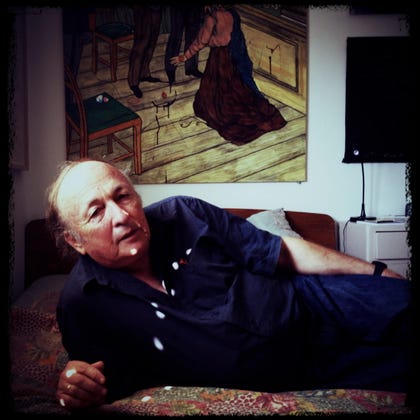
Garbuz in 2021. His controversial “amulet-kissers” speech in 2015 had a lasting effect on his public role. Credit: Ilya Melnikov
Garbuz in 2021. His controversial “amulet-kissers” speech in 2015 had a lasting effect on his public role. Credit: Ilya Melnikov
Garbuz was also critical of the way Israeli art history is presented and preserved. In a 2014 interview with Haaretz, he expressed frustration with what he saw as a lack of continuity and historical accountability in Israeli museums:
“It cannot be that the state was built incorrectly and the museums were built correctly… When I enter a museum in Paris, I can at any given moment learn the entire history of French painting… You come to Israel, say the name of an artist whom the museum even honors and exhibited, and they’ll tell you there was an exhibition five years ago, what do you want?
“What they call an Israeli art collection here looks like an exhibition… it has nothing to do with how history is written, with a person being able to come and look and say, I see what happened here, I see the 1960s and the 1970s … The state was built the same way… if the government changes, history changes. So a museum director changes, and suddenly the painters change.”