
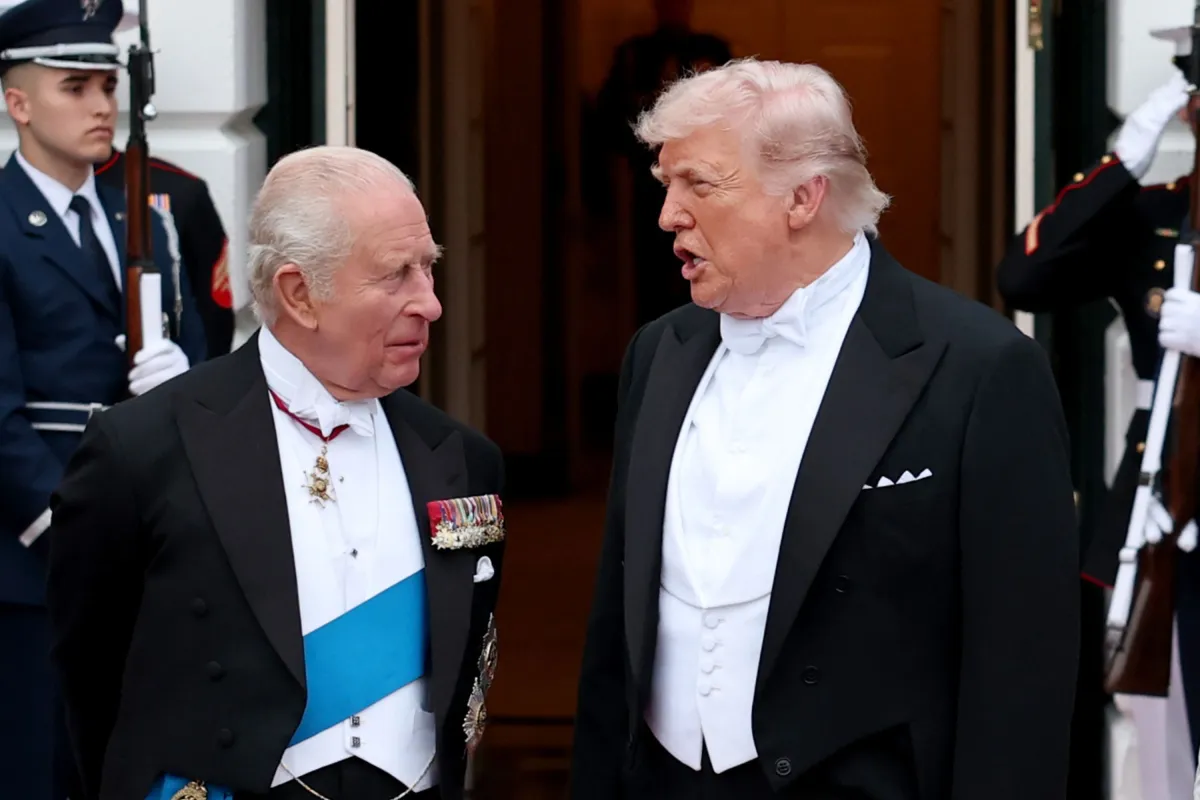
Donald Trump said that King Charles III “would have probably helped us with Iran” in comments that risked jeopardizing the fiercely defended impartiality of the British Monarchy.
The U.S. President said in the Oval Office that he was “very disappointed” with NATO a day after the king defended the alliance in a landmark speech to a joint session of Congress. He added: “The King is fantastic. We spent a lot of time together. We talked a lot. We talked about this also. He loves his country, and he’s a great King. And he’s a great friend.
“I think if he were doing that, if that were up to him, he would have probably helped us with Iran.”
This comes after Charles III’s aides moved to downplay the fallout over Trump’s suggestion that the monarch “agrees with me” on Iran’s nuclear ambitions during a speech at a White House state dinner. Charles’ office issued an exceptionally rare clarification on Tuesday about the king’s position on the war in Iran, which has led to a downgrade in Britain’s growth forecast.
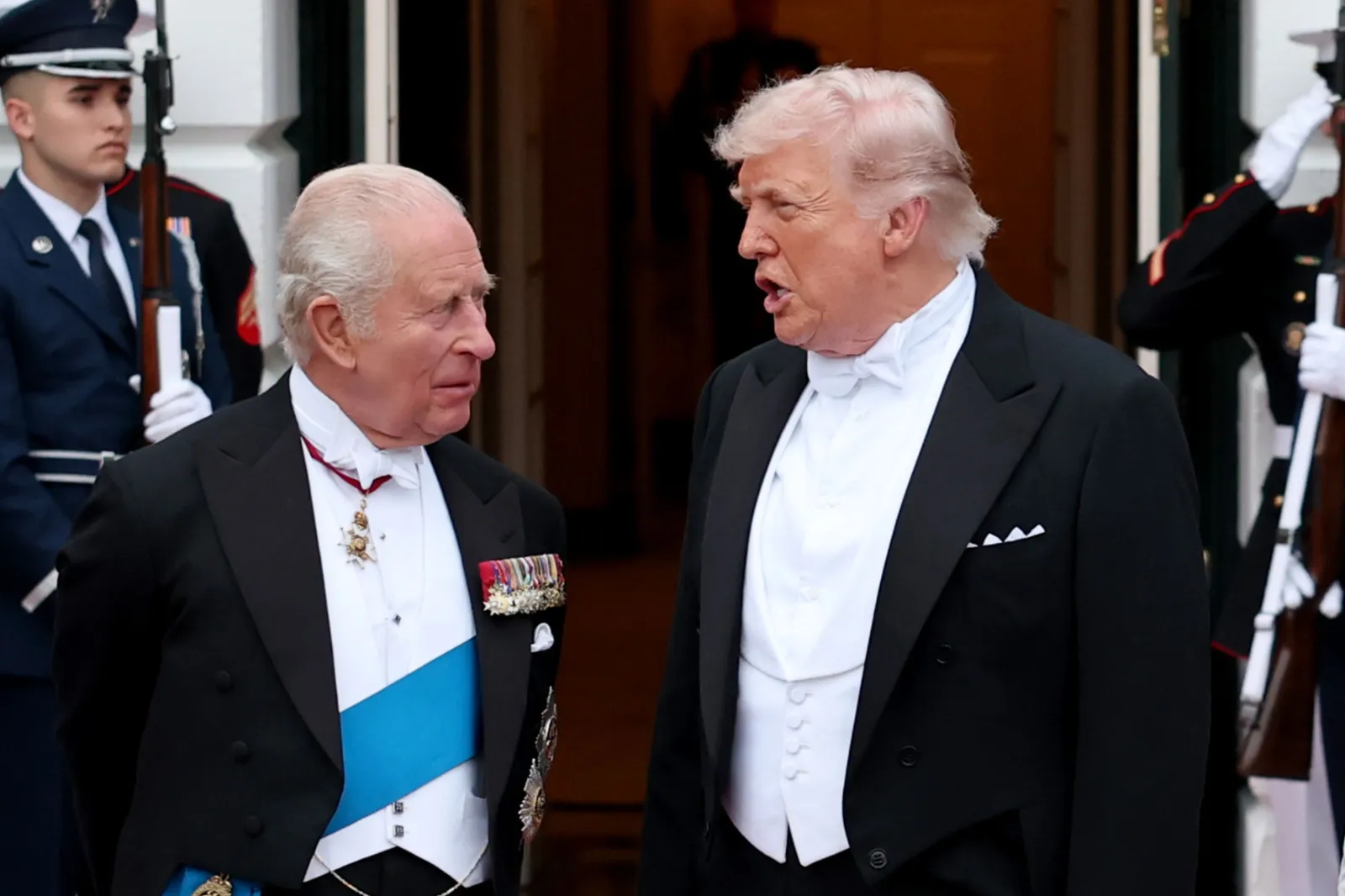
The president said in his speech in front of the king: “We’re doing a little Middle East work right now…and we’re doing very well. We have militarily defeated that particular opponent, and we’re never going to let that opponent ever, Charles agrees with me even more than I do, we’re never going to let that opponent have a nuclear weapon. They know that, and they’ve known it right now, very powerfully.”
A Buckingham Palace spokesperson told Newsweek and others: “The King is naturally mindful of his Government’s long-standing and well-known position on the prevention of nuclear proliferation.”
Why It Matters
British royals—and particularly the Monarch—are required to stay out of politics, but crucially they also must not oppose the Government or Prime Minister, who is in charge of actually running the country. Trump’s remarks add to comments he made on Tuesday at a State Dinner at the White House in which he said, in front of the king, that “Charles agrees with me” on stopping Iran from having a nuclear weapon.
Long-standing palace policy is to never clarify comments the royals are reported to have made during public engagements, even when they are inaccurate. However, Trump’s phrasing was ambiguous about whether the king simply opposed Iran becoming a nuclear power or whether he agreed that the prospect was imminent enough to justify America going to war.
The King’s Gambit in His D.C. Speeches
In particular, the spokesperson stopped short of disclosing the king’s opinion, saying simply that Charles was aware of his government’s position on the subject. That demonstrates just how sensitive the issue of the king’s opinion actually is to Britain.
With that in mind, Trump’s comment could have caused significant tension, particularly if it had been read as support for the war.
However, Charles also helped to defuse the issue in his own speech, with a jokey aside about the Suez Crisis of 1956, in which Britain, France and Israel invaded Egypt to secure the Suez Canal, a vital shipping route, without telling America first.
“And yes, we have had our moments of difficulty even in more recent history,” Charles said. “When my mother visited in 1957, not the least of her tasks was to help put the ‘Special’ back into our Relationship after a crisis in the Middle East. Nearly 70 years on, it is hard to imagine anything like that happening today….”
The king got a healthy laugh from those gathered in the White House, but keen students of international relations may note that Charles’ comment itself was risky. That’s because there is an implicit comparison between the Suez Crisis and the ongoing war in Iran, however vague and subtle, and Suez destroyed the career and legacy of then-British Prime Minister Anthony Eden, who will always be remembered primarily for one of the biggest missteps in the history of modern British foreign policy. Eden, in fact, had to resign in part because of the crisis.
Henry Brandon, a former Washington correspondent for British newspaper The Sunday Times, at one stage noted: “Sir Eden‘s whole proud career had been scarred by a decision which misfired for lack of American cooperation.”
Trump will presumably be hoping to fare a little better than Eden did.
Political Reactions to King Charles’ Speech
Tuesday was, though, a day in which the king repeatedly gambled by challenging Trump’s worldview on NATO, Ukraine, Europe, the rule of law, and judicial independence, among other issues.
And he did it all—in the speech to Congress and at the White House state dinner—to rapturous applause from some of the biggest figures in politics and business in America.
Trump told Charles before the speech that he would watch it and wanted to attend in person, but was told that it would be too much. And even before entering the dinner, as they posed for photos outside, he told Charles how much he loved the speech.
“He made a great speech,” the president said. “I was very jealous.” And Trump elaborated during his own speech on where that jealousy came from.
“I want to congratulate Charles on having made a fantastic speech today at Congress,” Trump said. “He got the Democrats to stand. I’ve never been able to do that. I couldn’t believe it.
“They liked him more than they’ve ever liked any Republican…or Democrat actually. So, I just want to thank you, and congratulations. It’s not an easy thing to do. That’s a tough place.”
King Charles Marks 25 Years Since 9/11 in New York
For the king and Queen Camilla, the main leg of their U.S. visit is over, and they arrived in New York on Wednesday to visit the memorial to the September 11, 2001, terror attacks.
They laid a wreath and took in the scale of the tragedy, which killed almost 3,000 people when the World Trade Center’s twin towers collapsed after being hit by planes. An extensive police cordon was set up around the memorials, leaving New Yorkers gathering in crowds, straining to see the royals from a distance.
Jack Meicels, 25, a data analyst, told Newsweek how he was a baby when the towers were attacked and said he appreciated the king’s effort to mark the tragedy.
“That’s beautiful,” he said. “I love seeing that as someone who was around New York my whole life, it’s a day that will never be forgotten and it’s something the whole world should never forget either.”
He was just as positive about the king’s State Visit, saying that “it’s a great relationship, England and the United States,” as well as about Charles’ speeches: “He was pretty funny.”
“I was 1 year old, and my dad was heading into the city,” he said. “I’m from Connecticut, but he was born and raised in the Upper East Side. And yeah, so he knew to go home directly, and it was just chaos. And you know, I have…family friends that were firefighters, my mom’s roommate, she’s married to one that was a fire chief then, and it was just tragic.”
Retired photographer Jeffrey Kay, 73, told Newsweek that he felt there was some “political maneuvering for tears” reflected in the decision to mark the 25th anniversary of 9/11 before September.
“In front of my building where I had two young children was the staging area for all of the debris that came down, often still burning, in front of our house,” he said. “That’s why we had to leave because of the fumes. So in terms of bringing that up, I probably had mixed feelings on that.
“In some ways, it feels like it is an international event, but it also feels somehow put into publicity to make it a little bit more something. It’s not September, so it’s not the anniversary now.”
Kay said he and his family are part of the 9/11 Health Watch program as a result of their proximity and added: “My son, his professor committed suicide two weeks after 9/11 because his friends were part of the people who died in one of the towers. So yeah, we were affected.”
He was more positive, though, about Charles’ speech: “It feels positive. If England is our mother country and if there is any connection to being allies, this talk is very important because our talk is terrible. So if anyone, any other friend leader can point us to the North Star being a little bit more moral, that would positive.”
Later on Wednesday, the king will join a reception celebrating the King’s Trust, one of his most important charities, in its 50th year.
Charles, though, will have arrived in New York, no doubt feeling like the most delicate phase of the most high-profile State Visit he will likely ever complete had been a success.
And now he can focus on the heartbreaking stories of 9/11 survivors and their families, knowing that he kept the American political elite on his side even as he told some hard truths about how Britain sees the international world order under Trump.
Updated with additional information 4/29/2026 3:14 p.m.