
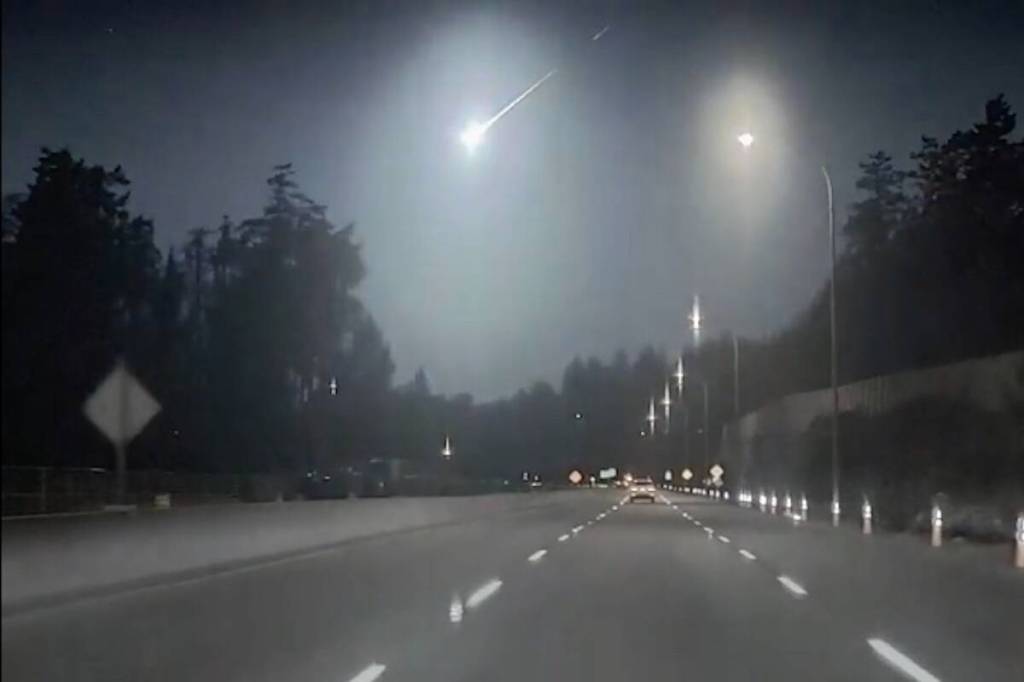
Fireball lights up night sky across Greater Victoria
Published 9:53 am Wednesday, April 29, 2026
A bright flash had all eyes turning to the sky across Greater Victoria.
At 12:12 a.m., Wednesday (April 29), a bolide-meteor was seen streaking across the sky.
The phenomenon was witnessed across B.C., Washington and Oregon, with reports coming from as far north as 100 Mile House, down to Boring, Ore.
Reddit user ceedaizy caught sight of the fireball while driving on the Trans-Canada Highway in Victoria, near Helmcken Road.
“Saw this while driving, so cool,” they said.
Anthony Rudge witnessed the bolide in Shawnigan Lake, a home security camera also documenting the moment.
“Just after getting out of my car, I saw this white streak light up the whole sky with crazy red streaks following it,” said Rudge.
A second meteor was also caught on Rudge’s camera around 1:30 a.m.
Victoria astronomer Dave Balam, principal investigator for Space Guard Canada, estimates the first meteor was the size of a football helmet or smaller, classified as a bolide because of its brightness.
“I would say it’s as bright or brighter than the full moon,” he said.
While most meteors burn bright and fast as they enter the Earth’s atmosphere, Balam said he would not be surprised if this bolide has “dropped a couple of meteorite stones” in Oregon.
“There’s something called the terminal point, when velocity is equal to the atmospheric pressure, and you have a little explosive event there,” he explains. “The meteor loses all its velocity, and whatever is left drops onto the ground into what we call a strewn field.”
He suspects the hunt is already well underway to find what’s left.
“It’s a well developed practice that goes on, so I would imagine that there are meteorite hunters out already looking for it,” he said.
For those disappointed they missed the phenomenon, Balam has good news – it’s not unusual to see bolides in the sky.
”We get about a half a dozen of these a year,” he says. “And do bear in mind that the planet is bombarded by about 100 to 200 tons of meteoric material every 24 hours.”
More common are the smaller meteors, the size of a grain of sand, which shower the sky during the summer, typically in August.
“They’re just tiny little things,” said Balam. “But they’re tiny little things crossing Earth’s nearest orbit at 48 kilometres per second … when they hit the top of the atmosphere, they light up and make nice plasma streamers through the atmosphere.”
Based at the National Research Council Canada, on West Saanich Road, Balam has been tracking large meteors passing through the Earth-moon system for around 50 years with the Near-Earth Object Observations Program.
“The ones that we normally track are 50, 100, 200 metres in diameter,” he said. “The smallest I’ve seen from here in Victoria with the telescope was probably about the size of an SUV, and that was back in ’86.”
READ MORE: Finding Bigfoot: Greater Victoria research trio tracks Sasquatch on Island.
Sleeping beauty marmot Roger yet to wake from slumber at Victoria hotel.
Death on the Strait: Sooke sea otter exposed as ‘Salish Sea serial killer’.