
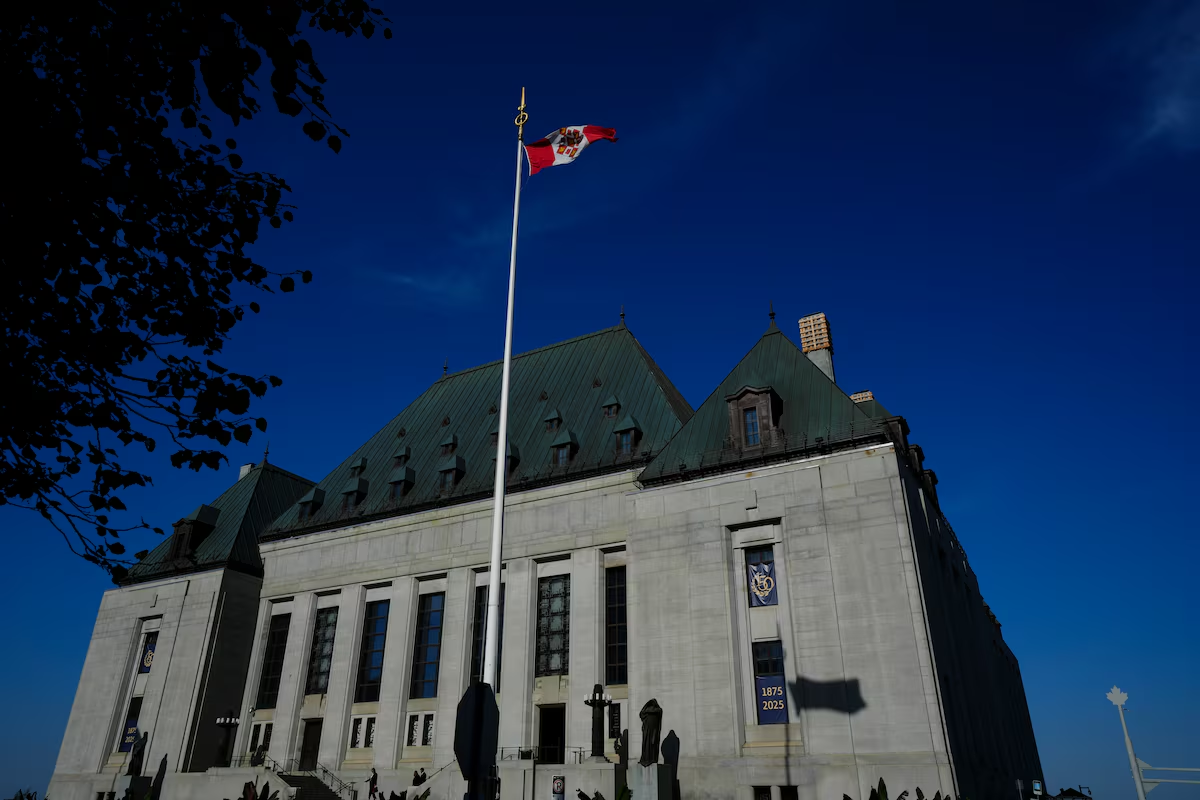
The Supreme Court of Canada ruled on Friday that a prime minister with a majority government in Parliament can curtail the free speech of MPs and senators in narrow circumstances.
The 8-1 decision focused on a constitutional challenge launched eight years ago in the lower courts by one Lakehead University law professor.
How one law professor challenged the limits of a prime minister’s power at the Supreme Court
In 2017, the federal government created a special committee of Parliamentarians with top-secret clearance to review national security and intelligence operations. It reports to the prime minister. But it included a compromise: committee members cannot reveal what they learned to their colleagues in Parliament unless they are authorized by the prime minister.
This was an abrogation of the centuries-old right of MPs and senators to speak freely in Parliament, without fear of any legal consequences. That right is a fundamental pillar of Canada’s democracy. But the security committee law meant that revealing secrets in Parliament – even those in the obvious public interest – could lead to the arrest and jailing of MPs or senators.
Prof. Ryan Alford at Lakehead in Thunder Bay, Ont., took the federal government to court in 2018. He argued there is an absolute right of free speech in Parliament imbued in the Constitution. He won at the Ontario Superior Court of Justice in 2022 but lost in 2024 at the Ontario Court of Appeal.
Law Professor Ryan Alford makes his case in a one-man constitutional challenge against the federal government at the Supreme Court of Canada, presenting arguments in Ottawa at a hearing on Nov. 5, 2025.Supreme Court of Canada
On Friday, Justice Malcolm Rowe, writing on behalf of the 8-1 majority that included Chief Justice Richard Wagner, stated that the Constitution allows Parliament and provincial legislatures to define their privileges. This includes imposing some limits on free speech in arenas such as the House of Commons. This means a prime minister with a majority government can set the rules.
But Justice Rowe made clear that a prime minister “cannot fundamentally alter or undermine Parliament’s role within Canada’s constitutional order.”
In the case at hand, the Supreme Court determined that the restriction on parliamentary free speech in 2017’s National Security and Intelligence Committee of Parliamentarians Act was “a narrow limitation of parliamentary privilege.”
“It does not affect free speech in Parliament more broadly,” Justice Rowe wrote.
In a dissent, Justice Suzanne Côté said the limitations in the security committee law were too broad. She said the federal government overstepped its constitutional authority.
“This is not a carefully tailored limit on parliamentary free speech,” she wrote and declared: “It is unprecedented in Canadian history.”