
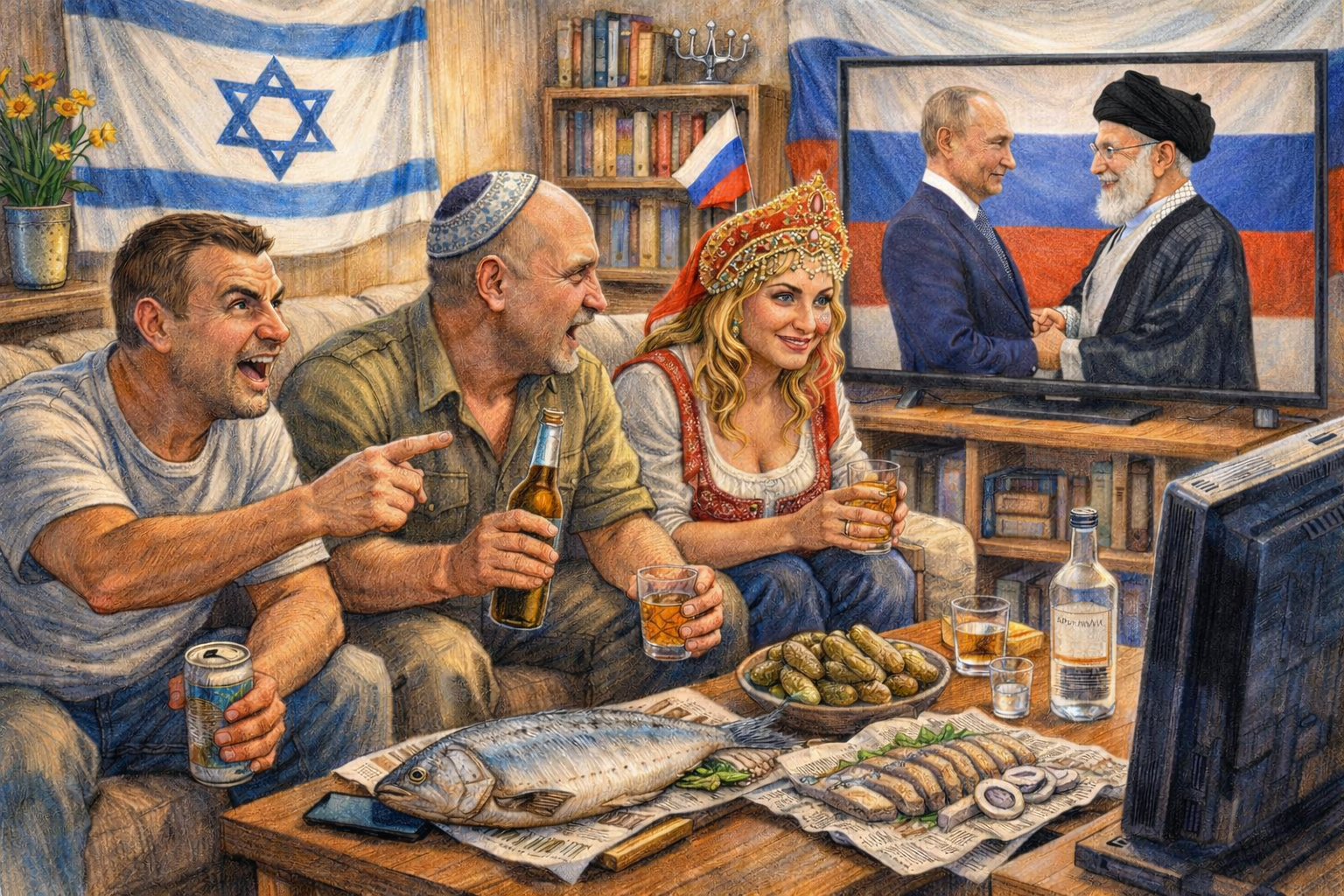
In Israeli political and public life, there is a phenomenon that has existed for years and is often described as the “Russian street.” In everyday Hebrew, Russian-speaking repatriates and their descendants are often casually called “רוסים” — “Russians.” But this word can be misleading.
This article is not about all “רוסים” in Israel.
It is not about everyone who speaks Russian at home, reads Russian-language media, made aliyah from the former Soviet Union, or belongs to the broader Russian-speaking Israeli community. Many Russian-speaking Israelis are loyal citizens of Israel. Many support Ukraine, understand the danger of russian imperialism, serve in the IDF, volunteer, help Israeli society and clearly stand against dictatorship and aggression.
The problem is different.
This article is about a specific political and mental group inside that environment: admirers of Moscow, defenders of Putin, and people who continue to justify Russia even when its alliances, technologies and geopolitical interests collide directly with the security of Israel.
For many of them, any conversation about Ukraine immediately turns into a reflexive search for someone to blame in Kyiv, while Moscow is excused, softened, or hidden behind the old familiar phrase: “but our boys are there.”
For Israel, this is no longer somebody else’s war.
It is a question of national security.
Not “רוסים” as a Community, but Admirers of Moscow
This distinction is essential for an Israeli audience.
In Israel, the Hebrew word “רוסים” is often used broadly and imprecisely. It may refer to Jewish repatriates from Russia, Ukraine, Belarus, Moldova, the Baltic states, the Caucasus, Central Asia and other parts of the former Soviet Union. It may refer to people who made aliyah in the 1990s, to their children who grew up in Israel, or simply to Israelis who speak Russian.
But this article is not about them as a whole.
To put all Russian-speaking Israelis into one political box would be unfair and false. Russian-speaking Israel includes soldiers, doctors, engineers, teachers, entrepreneurs, artists, volunteers, activists, bereaved families, reservists and citizens who are fully part of Israeli society. Some were born in Ukraine. Some fled Russian imperialism. Some lost relatives to Soviet repression. Some have been among the clearest voices in Israel against Putin’s war.
The problem begins where language turns into loyalty to the Kremlin.
It begins when a person living in Israel continues to repeat Russian propaganda, justify the invasion of Ukraine, mock Ukrainian suffering, or treat Putin’s regime as a natural center of political and cultural loyalty.
That is not the Russian-speaking Israeli community.
That is the pro-Moscow camp inside it.
And it should be named precisely.
Why the Pro-Moscow Camp Has Become a Problem for Israel
This environment is not made up only of online radicals or people who have spent too many years inside the closed world of Russian television propaganda. The more dangerous part is that, alongside them, one can often find representatives of the so-called Russian intelligentsia.
They may speak beautifully about freedom, democracy, human rights and European values. But the moment Ukraine enters the conversation, the mask often slips.
Again and again, the same old historical pattern appears: Russian liberalism too often ends exactly where the Ukrainian question begins.
For an Israeli audience, this should not be treated as an abstract intellectual debate. If a person lives in Israel, enjoys the protection of the Jewish state, raises children here, does business here, votes here and uses the freedoms of this country, but at the same time continues to emotionally, politically or informationally support Russia in its war against Ukraine, that person is not only acting against Ukraine.
He is also acting against the interests of Israel itself.
Because today’s Russia is not a nostalgic memory of childhood, language, literature or culture. It is a state that maintains deep and dangerous connections with forces hostile to Israel. It is a country whose military technologies, instructors, mercenaries and allies increasingly appear near those who fire at Israeli soldiers and civilians.
When Propaganda Becomes Stronger Than the Instinct for Survival
The tragedy is that some people still refuse to see the direct connection between Russia’s war against Ukraine and the threats facing Israel.
For them, it is still “not our war.” It is “complicated geopolitics.” It is “better not to quarrel with Moscow.”
But reality has already changed.
Israel is now facing a new kind of war — a war of drones, hybrid alliances, battlefield technologies and the exchange of combat experience between authoritarian regimes and terrorist organizations.
In that reality, Ukraine has been standing for years on the front line of the same technological war for which Israel, painfully, was not as prepared as it should have been.
The Drone War: What Israel Failed to Understand in Time
After years of full-scale war in Ukraine and after Israel’s own bloody years of shock, pain and mobilization, the country is still trying to catch up with the new military reality.
Drones. Fiber-optic UAVs. Systems resistant to traditional electronic warfare. Real-time battlefield reconnaissance. Strikes on military positions from unexpected directions.
This is no longer theory.
This has already reached Israel’s northern front.
When technologies actively developed and tested in the war against Ukraine begin to appear near Israeli positions, the question stops being diplomatic. It becomes practical: who learned from whom? Which systems are being transferred? Who shares experience with Hezbollah? Who benefits when the IDF faces the same challenges that Ukraine has been facing every day?
The answer is uncomfortable, but increasingly clear: Russian military experience, Russian contacts and Russian technological know-how are appearing closer and closer to Israel’s enemies.
Russia, Wagner, Hezbollah and the Shared Market of War
Today it is no longer possible to look at Hezbollah, Iranian structures, Russian military networks and related mercenary formations as completely separate worlds.
They exchange experience. They test tactics. They study the weaknesses of their enemies. They turn every war into a laboratory.
For Israel, this means one simple thing: support for Russia is no longer merely a “personal opinion” or an innocent form of nostalgia.
It is a political position with real security consequences.
If Russian technologies, military methods or training experience help forces fighting against Israel, then sympathy for Moscow inside Israel is no longer just a cultural issue. It becomes a moral and political failure.
This is why NAnews – Nikk.Agency Israel News treats this topic not as a quarrel between Ukrainians and Russians, and certainly not as an accusation against all “רוסים” in Israel. It is a question of Israeli national security, Jewish responsibility and the ability of society to recognize a threat before it hits its cities.
Stolen Ukrainian Grain and Israel’s Dangerous Moral Blindness
Against this background, the scandal around the purchase of Russian grain — grain that may be connected to occupied Ukrainian territories — looks especially painful.
This is not only about trade, logistics or market prices.
The problem is much deeper.
When Israeli businesses buy grain from Russia, they are sending money into the economy of an aggressor state. That economy then supports a military machine, strengthens ties with Iran, maintains contacts with anti-Western and anti-Israeli forces, and helps sustain technological chains that may later return to Israel in the form of drones, missiles and training for its enemies.
The picture becomes absurd.
Israel may save money or make a profit from trade with a state that, directly or indirectly, strengthens those who threaten Israel.
That is not pragmatism.
That is dangerous shortsightedness.
Why the Ukrainian Street in Israel Took to the Streets
That is why protests by the Ukrainian community and its supporters in Israel should not be dismissed as diaspora emotion.
This is not only a Ukrainian issue.
It is an attempt to stop trade with an aggressor that destroys Ukrainian cities while remaining part of a wider anti-Western, anti-Ukrainian and anti-Israeli axis.
The Ukrainian street in Israel is saying something very simple: a country cannot buy stolen goods and pretend that this has nothing to do with the security of the Jewish state.
It cannot close its eyes to the fact that money, technologies, grain deals and political loyalties are far more connected in today’s world than many people would like to admit.
For Russian-speaking Israelis — including those casually called “רוסים” in everyday Hebrew — this is an especially important test.
One can continue living inside the old myth of “our boys,” or one can finally recognize that these “boys” are often standing on the side of those who help Israel’s enemies.
The Main Question for Israel
Israel cannot afford the luxury of political blindness.
It is too small a country. The price of mistakes is too high. Its enemies study every weakness too carefully.
If part of Israeli society continues to justify Russia, ignore Ukraine’s experience and refuse to see the connection between Moscow, Tehran, Hezbollah and the new technologies of war, this is no longer just a worldview problem.
It is a security problem.
The real choice today is not between the Russian language and a Ukrainian position. It is not between an old homeland and a new country. It is not even between the sympathies of different communities.
The real dividing line is different: between citizens who understand that Israel’s security comes first, and those who still look at the world through Moscow’s imperial lens.
Either Israel learns to see who is really strengthening its enemies, or it will once again wake up after the next attack and ask why it was not prevented.