
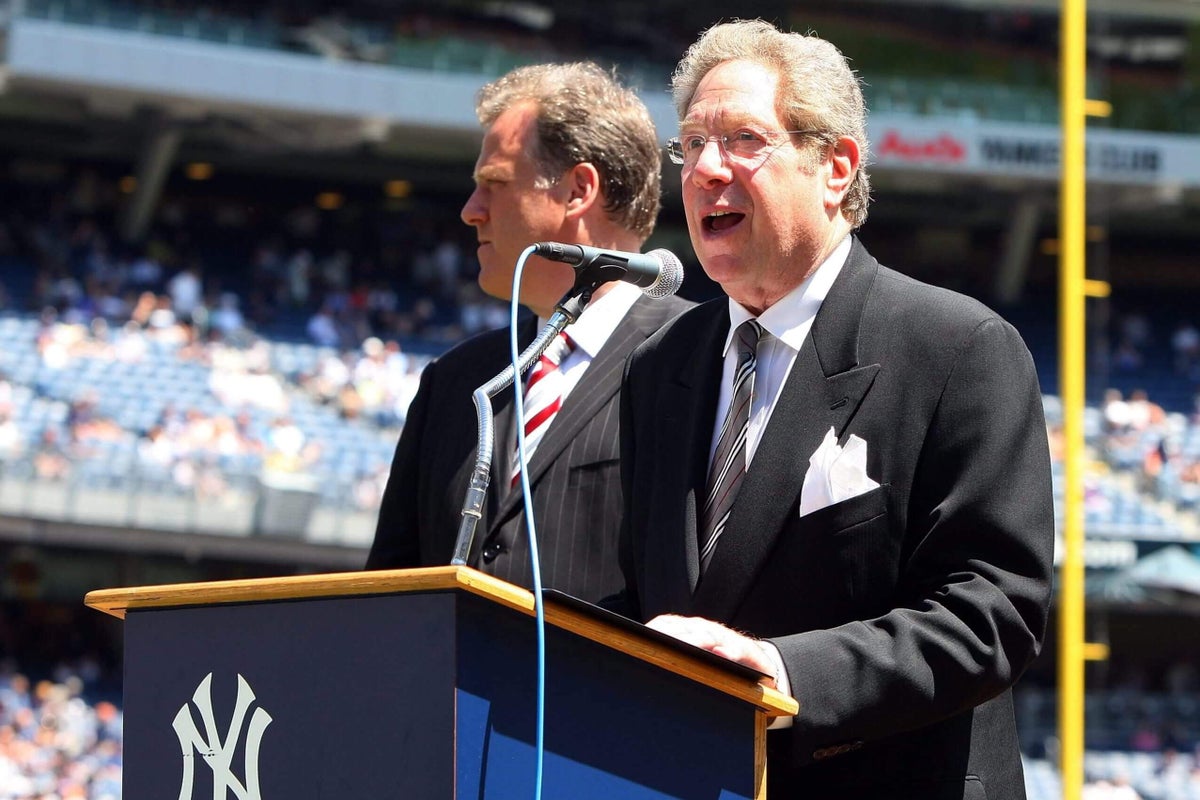
When you called John Sterling’s cell phone and it went to his voicemail, he would greet you with a message that said, “Congratulations, you have reached …,” then he proceeded to give his number.
It demonstrated Sterling’s sly personality, putting his unique imprint on something mundane, and it made you laugh. He prided himself on being a bit different and was unabashedly himself.
Sterling passed away at 87, a legend and a unique figure in New York Yankees broadcasting history. He cemented his place in the Bronx during the dawn of the internet, calling 5,060 games in a row at one point from 1989 to 2024.
He, though, was from another time: He read physical newspapers and books, didn’t own a smartphone, and, even though on the radio, he would wear a tailored suit, tie and dress shoes to each and every game.
His style, both off but especially on the air, created a great passion with Yankees fans. The bond baseball broadcasters have with listeners is usually tight, because the people in the booths are companions on a journey that begins in February during spring training and, for two lucky teams, ends in either October or November. Sterling was the voice of the Derek Jeter Yankees dynasty and called eight World Series — five of which ended with Sterling’s signature “Thuuuuuuuuuh Yankees win! … Thuuuuuuuuuuh Yankees win!”
Sterling will forever be associated with Jeter, Mariano Rivera, Andy Pettitte, Jorge Posada, Bernie Williams and the glory of those years. He was the soundtrack of the championships, with the last one in 2009, led by CC Sabathia and Alex Rodriguez.
From his signature sayings like, “Bern! Baby! Bern!” for a Williams long ball to calling Jeter, “El Capitan,” to his trademark home run lines, “It is high! … It is far! … It is gone!”
He was far from perfect. If you were listening on the radio and wanted to know if the ball was, in fact, actually high or far or even gone, you might have been out of luck. This aspect became fodder for critics, from fans to writers to even on The FAN, the home of Yankees baseball in Sterling’s latter years, where hosts would goof on replays of missed calls.
He remained a lovable uncle for Yankees fans, because he was part of their family. He had two partners who stood out as a tandem.
First was Michael Kay, who was the newspaperman turned broadcaster with designs on bigger mountains.
As Sterling’s No. 2, Kay joined Sterling as his partner in 1992. Sterling had a voice that sounded as if it were designed by Guglielmo Marconi, while Kay brought the information as he was fresh off the beat with the New York Post and Daily News. It made for a strong tandem of sound and insight.
After Kay moved on to become the lead television voice of the Yankees when the YES Network began in 2002, Sterling would team with Charley Steiner, who had the same classic sound. It didn’t work, as there was only one No. 1 chair in Sterling’s Yankees booth. Soon after, in walked Suzyn Waldman.
Waldman is a pioneering woman in sports media who worked the Yankees beat on WFAN for more than a decade. John and Suzyn were work husband and wife who created a unique New York sound. And John got to call all nine innings of play-by-play.
The duo was rooting for the home team, no doubt, but if things weren’t going right or if the team was playing improperly or if a game was taking a little too long, the kvetching on the air would make the doldrums bearable.
With all their years around the game, they had nearly seen everything, which made a Sterling catch phrase irresistible: “You can’t predict baseball, Suzyn.”
You also can’t leave baseball when it is in your blood. Sterling never wanted to retire from calling games, but the wear and tear of his Lou Gehrig-like broadcasting streak gave out. He started the 2024 season, but quickly realized he could not go on, even if he still had his same skills in the booth.
His voice never gave out, which was a medical marvel. Even at the end of his run in the booth, it did not thin out, like other play-by-players. His voice boomed on the air until his retirement a few weeks into the 2024 season.
While it is usually unwise to say there will never be another like someone, in this case, it is likely true. While radio play-by-play remains a purer art for baseball broadcasters, the bigger money is on TV. That’s where the best ones generally end up.
With Howie Rose retiring across town with the Mets, the next time New York baseball has a classic, old-time radio voice is likely decades and decades into the future. There is no way there can be another Sterling.
Eight years ago, when the Yankees acquired Giancarlo Stanton, there was the usual parlor game of what Sterling’s home run call would be for the hulking slugger.
When Stanton sent one high, far and gone, Sterling belted out, “Non si può de stoparlo!” Not many people knew what it meant. There was an uproar.
It means, “You can’t be stopped!” in Italian. Stanton is not of Italian descent. I caught up with Sterling about it shortly into the season.
“It’s different,” Sterling said. “I’m a bit different.”
He was a bit different, especially in these modern times. From all his years of travel, he developed techniques, including one on how to handle flights. While most everyone was on their phones, Sterling would put his nose in a book from the team bus to the charter plane and then to the hotel.
Around 2008, the Yankees were on a team flight to Minnesota. The turbulence had the Yankees bouncing around in the air to the point that the oxygen masks fell from overhead. Kay said everyone was freaking out and getting nervous.
When the masks fell, Sterling belted out a laugh and shoved it away. Years later, he told me nonchalantly that it was bothering him, so he brushed it aside and read his book.
He was a bit different. In all the best ways. He will be missed.