
For Ranjit Menon, there is no escaping Ridgeway Plaza.
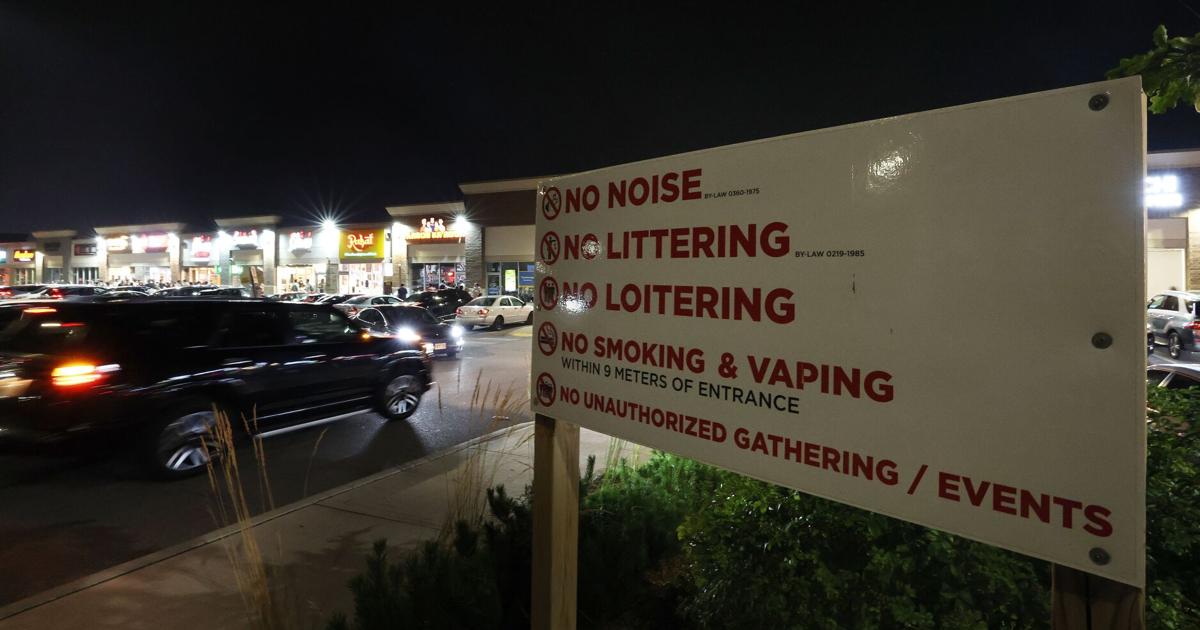
On some summer nights, the sounds of horns from the late-night car traffic at Mississauga’s best-known mall can be heard in his master bedroom, with the screeching tires often waking him up.
Not a day goes by that he doesn’t find garbage strewn all over his lawn and driveway from the plaza across the street, he says.
“The three houses next to us are all for sale,” said Menon, adding that on several evenings he walks around inside his home wearing headphones to block out the noise.
“Our issue isn’t with the plaza. Our issue is with the city … which has been saying for a year and half they will have a solution, but nothing permanent has happened,” said Menon, who says he also enjoys the diverse cuisine next door from time to time. He says that he and his neighbours have pushed for a meeting with the local councillor, to no avail.
Menon has lived in the area for nearly two decades — long before the shopping centre at Ridgeway Drive and Eglinton Avenue West opened in 2022. His house is one of four on the end of a once-quiet cul-de-sac that directly overlooks some 120 unique ethnic restaurants and cafes — a few open all night — that serve up such multicultural fare as Moroccan, Yemeni and Turkish dishes, turning the otherwise unexceptional strip mall into a popular destination for foodies.

The variety of food served in the 120 ethnic restaurants at Ridgeway has turned it into a popular place for foodies.
Steve Russell Toronto Star
On any given day you can see families eating Iraqi street food, or large groups of elderly women enjoying lunch at an Iraqi restaurant, while younger people filled Yemeni cafes serving trendy coffee drinks. Interspersed are numerous ethnic grocery stores, small businesses and bakeries.
A plaza-turned-food market wasn’t the original vision for the area, but it has transformed the quiet, car-centric suburban neighbourhood of Churchill Meadows into an unexpected tourist destination, bringing visitors from all across North America. That popularity has meant large crowds, impromptu rallies, littering and excessive noise, which the Star detailed last year. Neighbours also say the adjacent streets see several accidents a month.
Since then, the city says it has issued dozens of tickets and fines to the plaza’s owners for bylaw infractions such as littering, fire code violations, licensing for restaurants. It was fined $24,000 for two nuisance gatherings last year, and faces two more charges this year.
Peel Regional Police said that so far in 2025 more than 150 provincial offences notices have been issued, and they have responded to more than 300 calls for service in the area, with most of those charges laid for traffic offences inside and around Ridgeway Plaza. And since January 2024, police have responded to more than 35 nuisance gatherings — predominately evenings lasting into the early morning
‘Band-Aid, temporary solutions’
Yet nearby residents and local politicians say despite those efforts, the problems persist. They say their concerns and suggested improvements — a large fence around the plaza to block debris, dividers on the two-way street to prevent illegal left turns and even speed cameras — have been mostly ignored.
“What we’ve seen thus far are responses from council/police to individual issues, resulting in Band-Aid, temporary solutions,” said local resident Irene Puddicombe. “The community as a whole is not being informed of the efforts the city may be making and everything seems to be ad hoc.”
The amount of traffic has meant road safety is a key focus of enforcement by police.
Steve Russell Toronto Star
As an example, Menon pointed to the recent installation of temporary bollards on Ridgeway Drive, intended to stop drivers making illegal left turns out of the plaza onto a busy street that has resulted in several accidents. Just a few days after they were installed, some were knocked down.
“Why didn’t they extend this barrier all the way down the road, or put in something permanent?” said Menon, who shared video of cars completing the illegal u-turn by going around the fallen bollards. “This won’t even last a few days.”
A source of stress
Coun. Matt Mahoney, who’s also deputy mayor, said Ridgeway takes up much of his time — and causes much of his stress.
“It really concerns me when I’m waking up on a Sunday morning and I’m afraid to look on my phone and get the update from Ridgeway Plaza,” he said. “Things like that and safety (issues here) are the only thing that keep me up at night.”
Mahoney said the city is currently working on a comprehensive transportation plan for the roads around the area, and will soon be putting in more bollards and more speed bumps on nearby streets. Council’s interim control bylaw is also still in place, which limits new businesses in the plaza until city staff can do a complete review, he said.
But those measures in the works will do little to solve what Mahoney said is the biggest issue:
“It’s the number of cars there that creates an issue,” he said.
That comes as no surprise to Peel police, who said they recognize “that issues within and outside of Ridgeway Plaza are not related to the various businesses,” said Sgt. Tyler Bell-Morena, who works in public affairs.
“While we work tirelessly to ensure public safety, we also work to ensure that we are not over-policing the plaza in a way that negatively affects businesses by focusing on road safety concerns impacting the safety of all those attending Ridgeway Plaza,” Bell-Morena added.
But Mahoney said the plaza owners also need to “work with us to make it a safe and friendly place” by paying for such measures as dividers between parking spots, no trespassing signs, security cameras — and bringing in paid-duty police officers.
“It’s a money situation and that’s why we will keep putting the biggest fines we can on these owners and hope that they work with us,” he said. If not, Mahoney, added, the city will continue to fine them.
Mississauga Deputy Mayor Matt Mahoney is unhappy about the situation at Ridgeway Plaza, where traffic and parking infrastructure can’t keep up with the demand, despite new traffic calming measures.
Richard Lautens Toronto Star
Mahoney added that it’s the role of the private property owner to pay for changes to the site, not the city. He also said the police and bylaw officers meet regularly to discuss their enforcement plans for the plaza.
“We are doing everything we can as a city within our bylaws, in fact adding bylaws and strengthening bylaws to make the plaza safer … but at some point the responsibility has to be put on those attending,” he said, adding that he’s had unanimous support from council on his recommendations.
A burden for plaza businesses
Ameer Hamzah, head of the condo board that represents the owners of the 300 units in the plaza, says they have already brought in several improvements, such as speed bumps, additional stop signs and increased private security on the weekends.
“We all want to make it successful,” said Hamzah.
But he said any additional asks on the small family businesses that operate in the plaza are onerous. “How much burden can you place on them?”
He said many business owners feel as though they are being penalized for their success and for the city’s own mistakes in granting approval to so many restaurants in one spot.
“The city created the problem, passed it on to us, and now expect us to fix it? How do we fix it?” he said.
Hamzah gave the example of how the city didn’t plan for proper garbage receptacles or waste disposal for hot oil often used in cooking before approving the development — a requirement in other municipalities — and now often penalizes the businesses for their ad hoc solutions.
Mahoney previously told the Star that a strip mall was always planned for the area and zoned for employment. He says the real estate agent at the time decided to promote it as a food market, even though approval and licences for the restaurants on the site is a municipal responsibility.
Mahoney said the city doesn’t have the authority to stop a business from opening as long as it meets the zoning requirements, but city staff are now reviewing the practice.
Hamzah said the board is supportive of many of the city’s suggestions, including increased enforcement, and a control bylaw to limit businesses and even the addition of road signs on exterior streets.
But Hamzah also says the condo board has had limited communication with the city since a testy meeting last year, so there has been little co-ordination on the enforcement measures planned by the city and police, and more development is expected nearby.
“We all need to be at the same table and talk as partners,” said Hamzah. “We can’t just keep blaming each other.”
Mahoney says it’s up to the plaza board to make visiting the site a pleasant experience.
“If the plaza owners wanted to, they could help to make it a positive place … but it’s not that. Even negative is not strong enough of a word for what it is,” he said. “This is not something that I think any community wants.”
Some fixes for design flaws
But Shauna Brail, an urban planner at the University of Toronto – Mississauga said despite what Mahoney thinks — and despite flaws in the design of the plaza, it has still managed to become a community space.
“The design is abominable, but that doesn’t mean you can’t fix,” she said.
“Beautifying the space — retrofitting to make the public space better — would make an enormous impact on how people who don’t use the plaza see the plaza, and make a meaningful impact on those who do,” said Brail.
In many ways, Ridgeway is an example of a car-centric development where little thought has been given to pedestrians.
Steve Russell Toronto Star
She said like many suburban spaces, the entire plaza has been designed for cars, with no thought given to pedestrian or cyclists.
She said redesigning the parking by merging some spaces, and allowing other spaces to be converted to outdoor sitting areas could improve the traffic flow. “This would actually make it safer,” by clearly designating pedestrian and car areas, she said.
She said that beyond a transportation plan, the city needs a “public life plan” to see how the plaza is being used by everyone. This could give the municipality the ability to create a permitting system where people could apply for gatherings or special events instead of holding spontaneous ones, which often become problematic.
She also believes the challenges the plaza is facing are part of Mississauga’s growing pains, as it moves from a suburb to becoming a city.
“I understand there have been challenges around congestion and noise and sometimes rowdy behaviour, but I think there’s huge potential,” she said. “I think you should be celebrating that there’s this really cool place that serves food … where there’s a sense of community and culture and a sense of being together.
“Isn’t that what makes a place, a place?”