
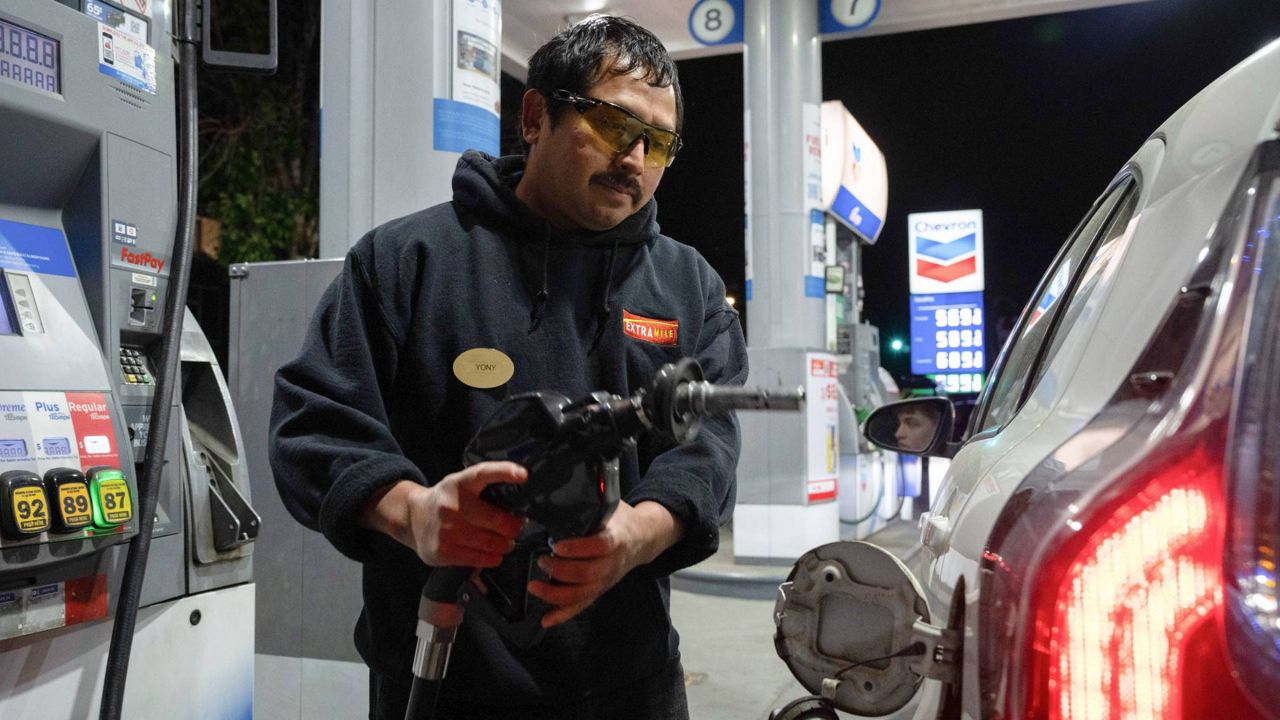
President Donald Trump said Monday he plans to suspend the federal gasoline tax to help Americans as fuel prices continue to soar amid the United States’ war with Iran.
What You Need To Know
President Donald Trump said Monday he plans to suspend the federal gasoline tax to help Americans as fuel prices continue to soar amid the United States’ war with Iran
“We’re going to take off the gas tax for a period of time, and when gas goes down, we’ll let it phase back in,” Trump said in an interview with CBS News
However, suspending the federal gas tax would require an act of Congress
Shortly after the interview went public, Sen. Josh Hawley, R-Mo., announced he will introduce legislation Monday to pause the tax; Democrats in the Senate and House had previously proposed similar bills
“I think it’s a great idea,” Trump said in an interview with CBS News. “Yup, we’re going to take off the gas tax for a period of time, and when gas goes down, we’ll let it phase back in.”
However, suspending the federal gas tax would require an act of Congress. Shortly after the interview went public, Sen. Josh Hawley, R-Mo., announced he will introduce legislation Monday to pause the tax. Democrats in the Senate and House had previously proposed bills to suspend the tax through Oct. 1.
The average price of a gallon of regular gas in the U.S. as of Monday was $4.52, up 41 cents over the past two weeks. Prices are 50% higher than they were before the start of the war.
The federal gas tax is 18.4 cents per gallon of gasoline and 24.4 cents per gallon of diesel.
The tax goes into a Highway Trust Fund that is mostly used to help construct and repair highways. It raises about $30 billion annually, according to the Institute on Taxation and Economic Policy.
Trump’s comments came as concerns were growing that the ceasefire between the U.S. and Iran could soon collapse, reigniting their war and further stymying oil shipments. The U.S. president has rejected Tehran’s offer and on Monday said the truce between the two countries was “on massive life support.”
In peacetime, about one-fifth of the world’s oil travels through the Strait of Hormuz, the narrow passage between the Persian Gulf and Arabian Sea. Traffic through the strait has been obstructed for weeks by competing blockades by Iran and the U.S.