
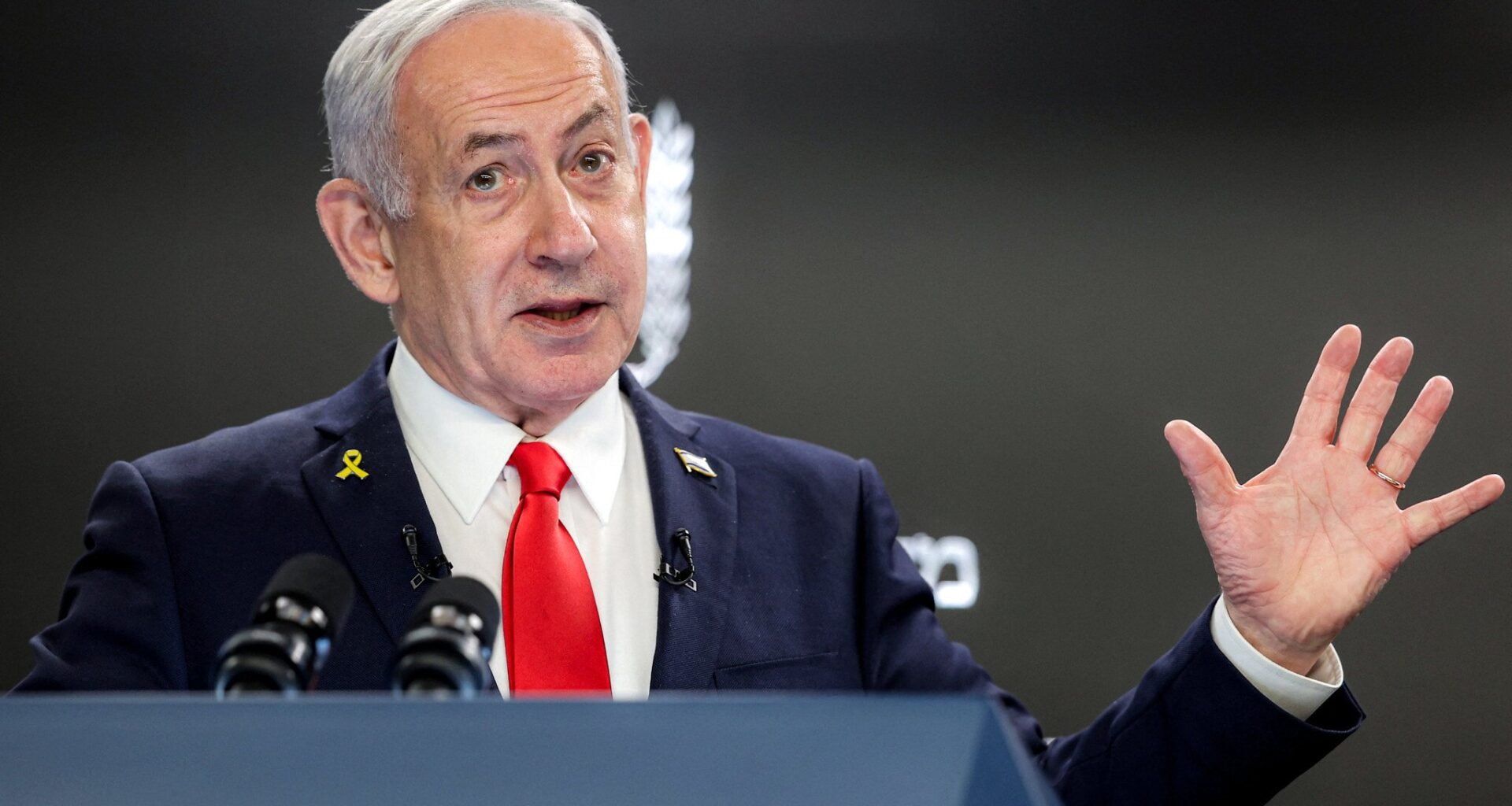
Prime Minister Benjamin Netanyahu rejected the accusation that Israel is committing genocide in Gaza, telling Israeli reporters on Sunday night, “If we had wanted to commit genocide, it would have taken exactly one afternoon.”
Netanyahu made the remark near the end of back-to-back press conferences he held with foreign and Israeli journalists, respectively, in which he also denied again that Israel has pursued a policy of starvation in the enclave.
Speaking to Israeli media, he falsely claimed that Israel had never halted all humanitarian aid to Gaza, even though his government had enacted that policy earlier this year.
Netanyahu made the two comments while defending his government’s recent decision to launch a major offensive in Gaza City. He said the plan will lead to Hamas’s defeat, but it has come under a tidal wave of domestic and international backlash.
Israel also faced global censure recently for widespread reports of starvation and deaths from malnutrition in the Strip. Netanyahu has repeatedly denied that Gaza is undergoing starvation or that Israel is seeking to create a humanitarian crisis there. Israel has also consistently and vehemently denied the charge — made by pro-Palestinian activists, some left-wing Israeli organizations and a number of countries — that it is committing genocide in Gaza, saying it makes efforts to avoid killing civilians whom Hamas puts in harm’s way.
Get The Times of Israel’s Daily Edition
by email and never miss our top stories
By signing up, you agree to the terms
“There is no starvation. There hasn’t been starvation. There was a shortage. And certainly, there was no policy of starvation,” Netanyahu said at the press conference. “If we had wanted starvation, if that had been our policy, 2 million Gazans wouldn’t be living today after 20 months.”
He continued, “It’s the same with genocide — if we had wanted to commit genocide, it would have taken exactly one afternoon.”
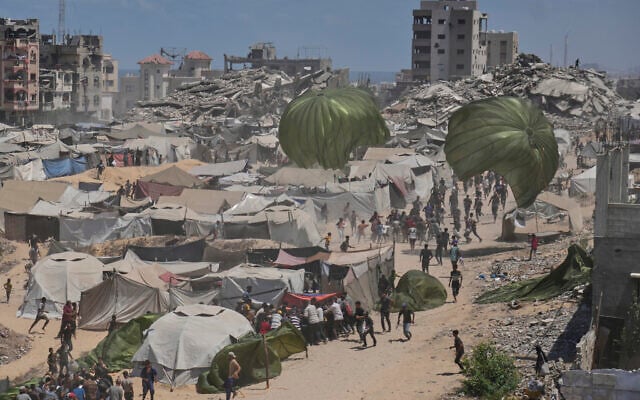
Palestinians rush to collect humanitarian aid airdropped by parachutes into Gaza City, northern Gaza Strip, August 7, 2025. (AP Photo/Jehad Alshrafi)
Earlier in the press conference, Netanyahu defended Israel’s approach to humanitarian aid in the Strip, which he said is now being overhauled. In recent weeks, Hamas-run local officials, in addition to international agencies and aid groups, have documented a rising number of deaths from starvation in Gaza.
Israel has disputed such claims, and blames Hamas for stealing aid and the United Nations for failing to distribute it. But facing international condemnation, Israel has put several measures in place to increase the flow of supplies.
At the press conference, Netanyahu was asked whether his decision earlier this year to halt humanitarian aid was a failed strategy to defeat Hamas.
“First of all, we need to understand what actually happened,” he answered. “We never said we were stopping all entry of humanitarian aid. What we said was that, alongside halting the trucks that Hamas was seizing — taking the vast majority of their contents for itself, then selling the leftovers at extortionate prices to the Palestinian population… we would stop this.”
In fact, on March 2, the premier’s office announced, “Prime Minister Netanyahu has decided that, as of this morning, all entry of goods and supplies into the Gaza Strip will cease.” He portrayed it as a way to stanch a source of Hamas profits and pressure the terror group into concessions.
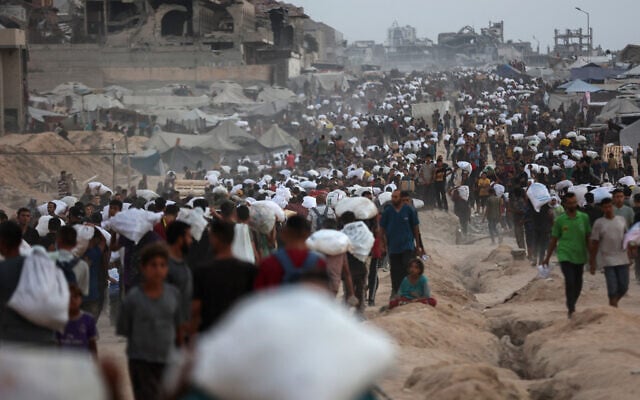
Palestinians bring back aid parcels they managed to procure as they walk on a coastal path west of Beit Lahia on July 29, 2025, after aid trucks entered the Gaza Strip from the northern Zikim border crossing. (Omar AL-QATTAA / AFP)
He reversed the policy 11 weeks later, after heavy pressure from international allies, and backed the Gaza Humanitarian Foundation, an American-led initiative to give aid directly to civilians from four distribution points while bypassing Hamas and the UN. But the GHF drew harsh criticism because of near-daily killings near its aid sites and the difficulty people faced in accessing them.
On Sunday, Netanyahu said that approach had failed and “we didn’t have to get into this situation.”
“We didn’t want to create starvation here — on the contrary, we wanted to bypass Hamas’s looting and theft,” he said of the GHF. “Only it didn’t work as we wanted, it didn’t succeed because there weren’t enough points, etc., so we learned our lesson. We stopped it.”
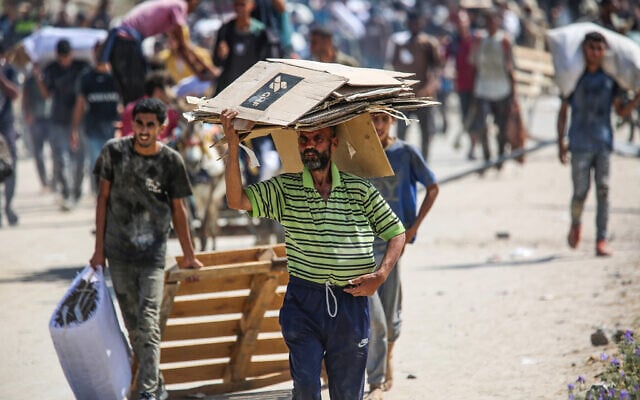
Displaced Palestinians carry food parcels and supplies from a Gaza Humanitarian Foundation aid distribution point along the Netzarim Corridor in the central Gaza Strip, August 4, 2025. (Ali Hassan/Flash90)
He added, “Now, we’re acting differently. Aid is entering, we’re doing all we can so most of it won’t fall into Hamas’s hands, and in parallel, we’re really increasing the number of distribution points, the secure corridors, and the airdrops, airdrops that generally don’t reach Hamas.”
The international airdrops of aid have faced criticism for endangering people as they fall to the ground. Aid groups have said more supplies are needed to end widespread malnutrition in the Strip. Netanyahu has said aid would increase as part of the Gaza City takeover plan.
Is The Times of Israel important to you?
If so, we have a request.
Every day, even during war, our journalists keep you abreast of the most important developments that merit your attention. Millions of people rely on ToI for fast, fair and free coverage of Israel and the Jewish world.
We care about Israel – and we know you do too. So today, we have an ask: show your appreciation for our work by joining The Times of Israel Community, an exclusive group for readers like you who appreciate and financially support our work.
Already a member? Sign in to stop seeing this
You appreciate our journalism

You clearly find our careful reporting valuable, in a time when facts are often distorted and news coverage often lacks context.
Your support is essential to continue our work. We want to continue delivering the professional journalism you value, even as the demands on our newsroom have grown dramatically since October 7.
So today, please consider joining our reader support group, The Times of Israel Community. For as little as $6 a month you’ll become our partners while enjoying The Times of Israel AD-FREE, as well as accessing exclusive content available only to Times of Israel Community members.
Thank you,
David Horovitz, Founding Editor of The Times of Israel