
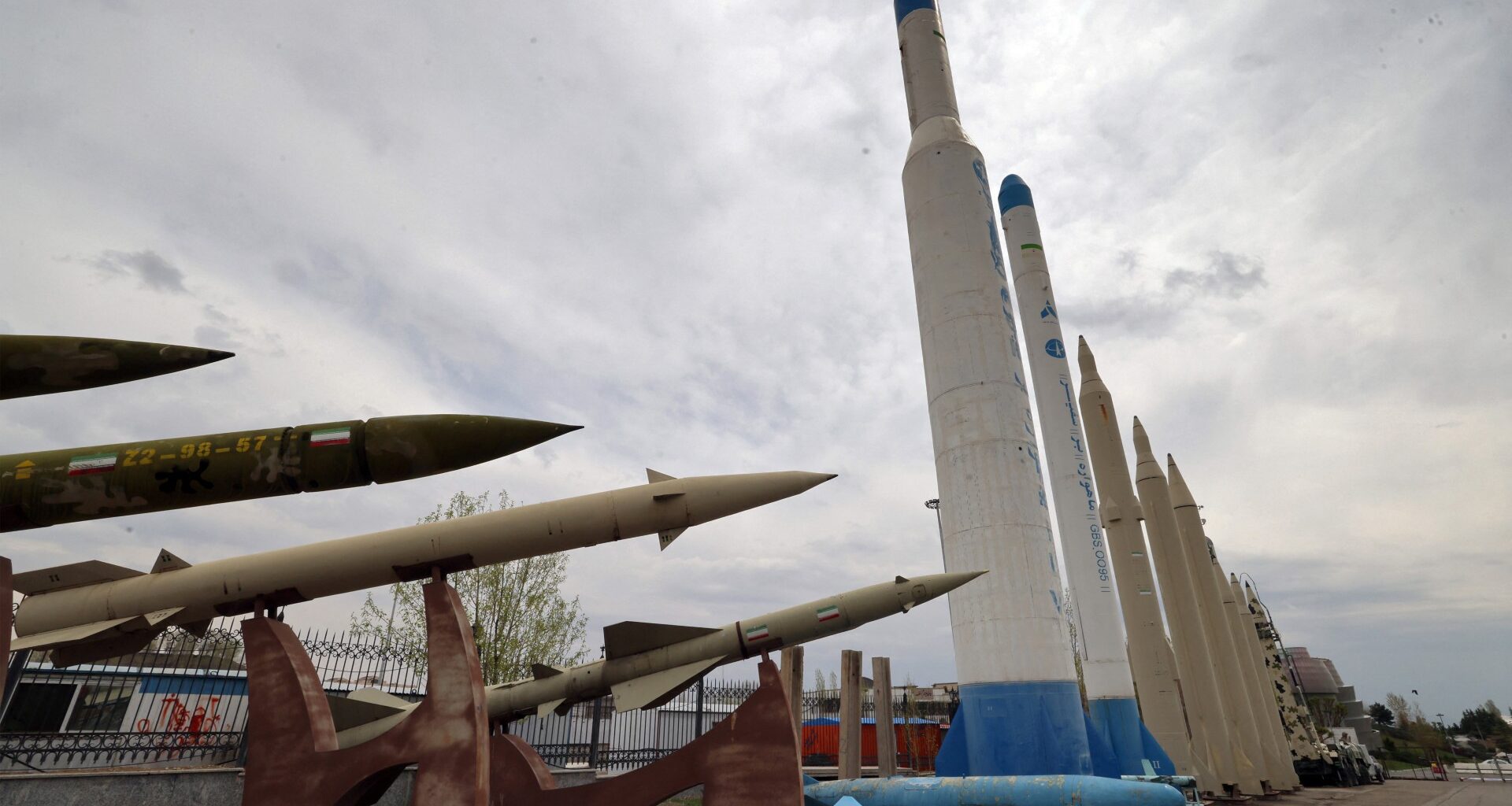
US intelligence agencies are telling policymakers that Iran has regained access to most of its missile sites, launchers and underground facilities, contrary to Washington’s rhetoric about decimating Iran, according to a report by The New York Times (NYT).
The report, published on Tuesday, cited classified assessments from earlier this month.
It included evidence that Iran had restored operational access to 30 of 33 missile sites along the Strait of Hormuz, meaning that it can threaten international shipping and US warships along the key waterway.
Sources with knowledge of the assessment said that Tehran can use mobile launchers inside some sites to move missiles to other locations, and, in some cases, launch missiles directly from launchpads at the facilities.
The document found that Iran still fields 70 percent of its mobile launchers across the country and has retained around 70 percent of its missile stockpile from before the war.
New MEE newsletter: Jerusalem Dispatch
Sign up to get the latest insights and analysis on
Israel-Palestine, alongside Turkey Unpacked and other MEE newsletters
Using satellite imagery and other surveillance tools, military intelligence agencies have also assessed that Iran has regained access to around 90 percent of its underground missile storage and launch facilities, which are either “partially or fully operational”.
All of this paints a rather different picture from statements from US President Donald Trump and other senior government figures claiming to have “decimated” Iran’s capabilities.
The US and Israel launched the war on 28 February with a barrage of strikes on Iran. Tehran has responded by striking Israel and Gulf countries, as well as by closing the Strait of Hormuz, through which a fifth of the world’s oil and liquefied natural gas passes.

Gulf turns to Turkey for air defence systems amid Iran threats
A White House spokesperson responded to the NYT report by reiterating that Iran had been “crushed”, adding that anyone who “thinks Iran has reconstituted its military is either delusional or a mouthpiece” for Iran’s Islamic Revolutionary Guards Corps.
Joel Valdez, the acting Pentagon press secretary, added: “It is so disgraceful that The New York Times and others are acting as public relations agents for the Iranian regime in order to paint Operation Epic Fury as anything other than a historic accomplishment.”
The Washington Post also last week reported, citing US intelligence assessments, that Iran retained about 75 percent of its mobile missile launchers and roughly 70 percent of its pre-war missile stockpile.
The NYT has previously reported that the US military has already depleted its stockpiles of several key munitions, including Tomahawk cruise missiles, Patriot interceptor missiles, and Precision Strike and MGM-140 ground-based missiles.
Trump and US officials have denied that munitions supplies have fallen to critically low levels.
Dan Caine, the chairman of the Joint Chiefs of Staff, told a House appropriations subcommittee on Tuesday: “We have sufficient munitions for what we’re tasked to do right now.”
The NYT reported that when the US struck Iranian missile facilities, it opted to seal off entrances rather than destroy entire sites – partly due to limited stocks of bunker buster munitions.
Some bunker busters were dropped on underground facilities, but officials said military planners needed to be cautious and retain supplies for potential wars with North Korea and China.
The NYT reported previously that the US has used 1,100 long-range stealth cruise missiles during the war, which is around the total remaining supply in the US stockpile.
It has also used 1,300 Patriot interceptor missiles, accounting for over two years of production at 2025 rates.