

 Close
Close
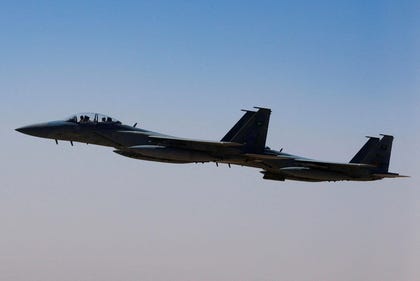
A Saudi fighter jet in 2025. Credit: Brian Snyder/ REUTERS
A Saudi fighter jet in 2025. Credit: Brian Snyder/ REUTERS
Saudi fighter jets bombed targets linked to powerful Tehran-backed Shi’ite militias in Iraq during the Iran war, while retaliatory strikes were also launched from Kuwait into Iraq, multiple sources familiar with the matter said.
The strikes are part of a broader pattern of military responses around the Gulf that remained largely hidden during a conflict that has drawn in the wider Middle East since joint Israeli-U.S. strikes on Iran on February 28. Those attacks triggered Iranian strikes on Gulf states and Israel that have rattled the global economy and shut the Strait of Hormuz, through which a fifth of global oil and liquefied natural gas flows.
The sources for the strikes from Saudi Arabia and Kuwait include three Iraqi security and military officials, a Western official, and two people briefed on the matter, one of them in the United States.
The Saudi strikes were carried out by Saudi air force fighter jets on Iran-linked militia targets near the kingdom’s northern border with Iraq, one Western official and the person briefed on the matter said. The Western official said some strikes took place around the time of the April 7 U.S.-Iran ceasefire.
They targeted sites from which drone and missile attacks were launched at Saudi Arabia and other Gulf states, the sources said.
Citing military assessments, the Iraqi sources said rocket attacks were launched on at least two occasions from Kuwaiti territory on Iraq. One set of strikes hit militia positions in southern Iraq in April, killing several fighters and destroying a facility used by Iran-backed militia Kataib Hezbollah for communications and drone operations, they said.
Reuters could not determine whether the rockets from Kuwait were fired by the Kuwaiti armed forces or the U.S. military, which has a large presence there. The U.S. military declined to comment. The Kuwaiti information ministry and the Iraqi government did not immediately respond to requests for comment.