
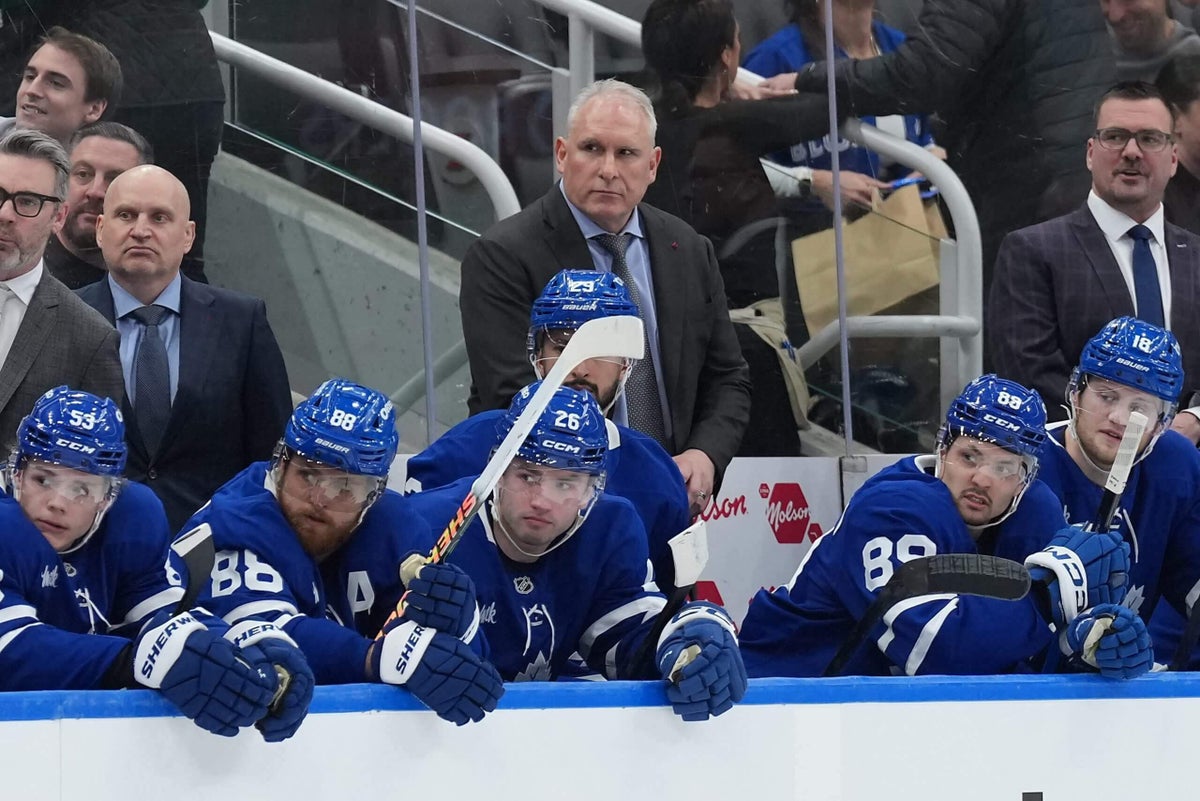
The Toronto Maple Leafs were on pace for 78 points and holding the second-worst record in the Eastern Conference in the middle of November when then-general manager Brad Treliving backed Craig Berube as coach.
“I believe in Craig and his messaging,” Treliving said. “Craig didn’t become a bad coach overnight.”
The Leafs were in the same place in the standings just over a month later, two days before Christmas, when Treliving defended Berube again in the wake of Marc Savard’s dismissal from the coaching staff.
“I want to make it clear,” Treliving said. “I support Craig fully.”
Moving on from Berube at either point might have changed the Leafs’ fate. It might have spurred a turnaround that kept the NHL’s longest playoff streak alive or, at the very least, avoided the kind of spectacular flameout that, among other things, has captain Auston Matthews wondering if he wants to stick around for the final two seasons of his contract.
It might have saved Treliving’s job.
The Leafs will never know — though waiting did come with the unexpected and unlikely bonus of winning the draft lottery and the right to pick first at the draft.
But in firing Berube now, two years (almost to the day) from when he was hired as Sheldon Keefe’s replacement, in John Chayka’s first big move as GM, the Leafs have a clearer path to figuring out who they really are.
Was the nightmarish season that just passed the definite end to an era, or just a one-year setback spurred in part by the failings of their coach?
Berube’s job performance last season was arguably more damaging than even that of the fired GM.
Start with the fact the Leafs allowed 295 goals, the most by any Leafs team in 35 years.
It wasn’t primarily a goaltending problem, either.
Though the crease wasn’t exactly elite, as it was in Berube’s Atlantic Division-winning first season behind the bench, it wasn’t bad. The Leafs ranked 17th in the NHL in team save percentage, just behind the Montreal Canadiens. And they actually had the NHL’s best save percentage on the penalty kill.
The real problems were within Berube’s control: The Leafs defended poorly and didn’t have the puck enough.
How bad was it?
The Leafs gave up a league-high 2,633 shots — 206 more than the second-worst team, Chicago, and 701(!) more than the very best in Carolina.
That would explain why the busiest goalie in the league (on a per-60-minute basis) was the Leafs’ Joseph Woll. The second busiest? The Leafs’ Dennis Hildeby. Sixth-busiest? Anthony Stolarz, also a Leaf.
All that time in the defensive zone, coupled with curious deployment decisions, meant Matthews was suddenly spending much less time on offence than in previous seasons.
Consider that during the 2021-22 season, when Keefe was still the Leafs coach, Matthews lounged in the offensive zone almost 46 percent of his time at even strength. That mark placed him in the NHL’s 98th percentile — better than anyone essentially.
That all changed dramatically under Berube.
Matthews’ time on defence went way up, to the point that he was actually spending a slightly bigger chunk of his time in the defensive zone (41.5 percent) than the offensive zone (40.1) last season.
Under Berube, the Leafs didn’t deploy Matthews, a former Hart Trophy winner, like the Oilers did Connor McDavid or the Avalanche with Nathan MacKinnon. The Leafs captain’s deployment was more akin, oddly enough, to the Lightning’s Selke Trophy candidate, Anthony Cirelli.
More like a shutdown centre, that is.
Five-on-five deployment
PlayerDZ Faceoffs/60OZ Faceoff %
14.6
65.7
11.4
64.0
19.2
53.6
17.5
53.1
Perhaps it wasn’t surprising then that, coupled with injuries and Mitch Marner’s exit, the captain’s five-on-five point production per 60 minutes plummeted to the lowest level of his NHL career.
The team’s insistence on point shots and resistance to fast breaks and easy offence under Berube certainly didn’t help. Nor did the coach’s decision to play Max Domi by Matthews’ side more than any other winger this past season, even though Domi was the weakest defender in the forward group and an increasingly marginal force on offence.
Berube’s lineup choices could be strange and hard to explain that way.
When Scott Laughton broke his foot at the end of training camp, Berube opted to overhaul his entire lineup rather than simply slotting David Kämpf into Laughton’s fourth-line centre position.
Berube would scratch promising rookie Easton Cowan to begin the season and again — for Calle Järnkrok — with the Leafs’ season hanging in the balance coming out of the Olympic break. He sent Matias Maccelli to the press box for weeks in late November and early December and never could find a solution for the power play in the first half, which cost Savard his job.
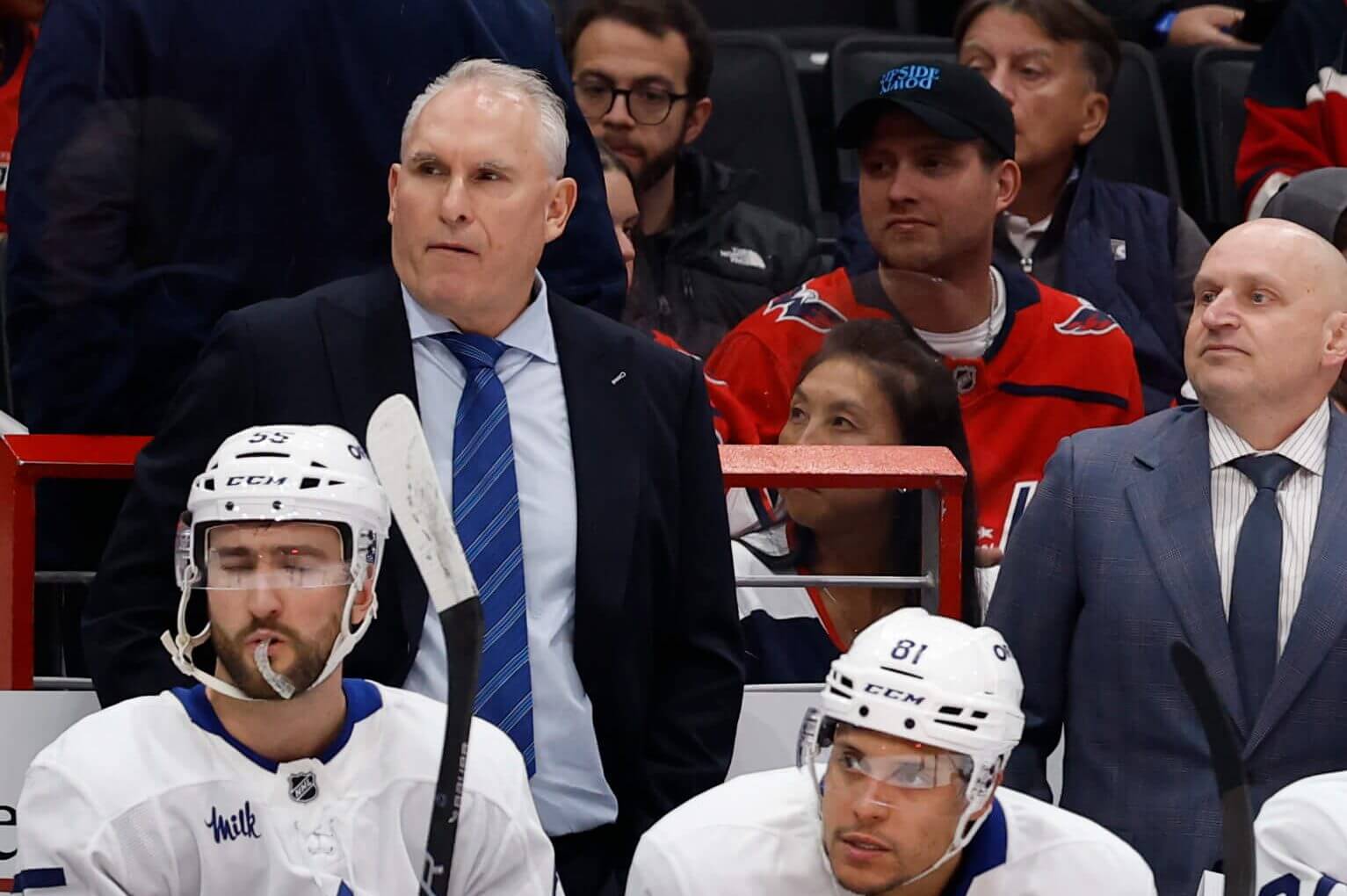
Craig Berube’s lineup choices could be strange and hard to explain. (Geoff Burke / Imagn Images)
Of course, the roster he had was far from perfect.
The Leafs lacked strong, or at times even adequate, puck-movers on the back end, which led to a whole whack of missed passes to forwards, which led to counterattacks and icings and more time defending.
Treliving never did replace Marner in any way, shape or form, which proved to be a major drain on the team’s offence, defence and power play. Losing Chris Tanev to injury for all but 11 games left the now former Leafs coach without his best defender. Nor did the Leafs boast a litany of quality defenders up front (though banishing one in Kämpf didn’t help).
Every coach is going to deal with something, though. No roster is foolproof. It was Berube’s job to get the most out of the one he had.
He failed to do so.
A team that was supposed to compete for the Stanley Cup instead missed the playoffs for the first time in a decade, and by a lot.
It often felt as if Berube was coaching the team he wanted instead of the one he had.
The tough guy who was supposed to bring accountability to the Leafs never materialized, either, especially last season. Berube was unable to get his team to play hard, even as the losses piled up when hope for the playoffs remained. He was unwilling, with rare exceptions, to cut opportunities for struggling players or criticize them publicly.
The one player who drew his frequent ire — William Nylander — led the team in scoring.
It’s hard to pick out even one player who improved under Berube’s watch. Many, such as Matthews, Domi, Matthew Knies, Morgan Rielly, Nick Robertson and even Nylander, regressed in one way or another.
Even his first season in charge now looks clearly like a house of cards that was doomed to collapse, with top-notch goaltending and an elite power play masking clear structural issues that were exposed in Round 2 by the Florida Panthers.
The players deserved (and got) plenty of blame for what went down in Games 5 and 7 in that series, but so did Berube — for the system that allowed the Panthers to produce 166 shot attempts in those two devastating losses, but also for not unlocking more from a talented but perennially underachieving group as he was hired to do.
Berube’s tenure will go down as one of the strangest and most disappointing in team history, and the shortest by a full-time coach in nearly 20 years.
He was ultimately the wrong coach for this team, a misguided overcorrection to Keefe.
Firing him was a necessary first step for Chayka and adviser Mats Sundin toward uncovering how much is salvageable here — whether there is still a Stanley Cup contender, or even a playoff team, lurking beneath the ruins of last season.
All the more so with a premium young talent about to join the organization.
Can a new coach get the Leafs to control the puck more? Defend better? Find more opportunities to utilize the awesome talent of Matthews and Nylander? Spur growth from Knies (if he isn’t traded) and Cowan? Make better use of Rielly (if he isn’t traded)?
Can that coach squeeze more out of a roster that’s probably become a little underrated after being overrated a year earlier? What benefit can a new coach play in the development of the player the team picks first at the draft (and how much did that factor into the Berube firing)?
The Leafs shouldn’t willingly blow things up without trying to explore the degree to which an upgrade behind the bench can change their fortunes.
Again and again in the NHL, we’ve seen teams that were thought to be one thing transform into something different, something better, with a new voice and perspective behind the bench. Just this past season, the examples included Joel Quenneville in Anaheim, Dan Muse in Pittsburgh, Marco Sturm in Boston and Rick Tocchet in Philadelphia.
Getting this hire right will be among the biggest priorities for Chayka and Sundin this offseason.
With the right coach, the Leafs can determine whether their Stanley Cup contention days really are over or whether there’s life again after Berube.
— Stats and research courtesy of Natural Stat Trick, Hockey Reference and NHL EDGE