
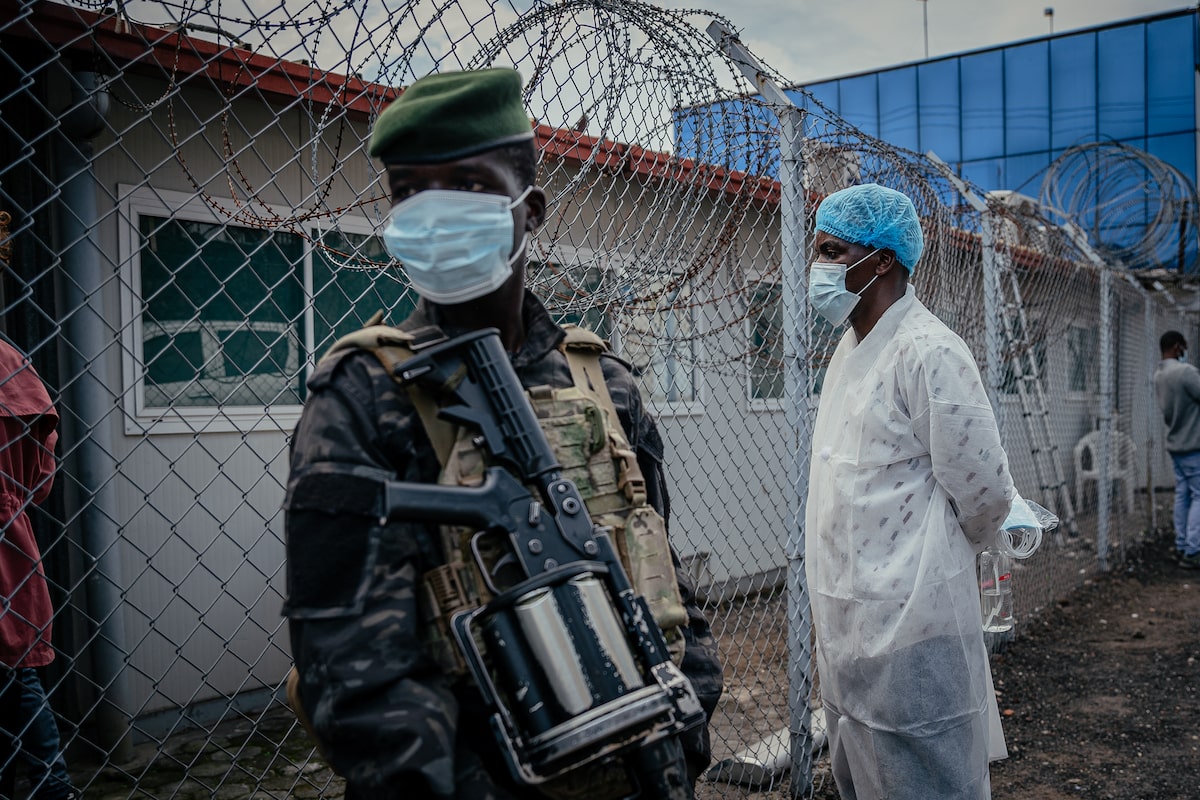
A soldier guards the Rodolphe Mérieux Laboratory, National Biomedical Research Institute in Goma, Democratic Republic of the Congo, on Tuesday. The lab is responsible for analyzing suspected Ebola cases.JOSPIN MWISHA/AFP/Getty Images
Canada has no immediate plans to follow the Trump administration’s ban on travellers from three African countries considered at risk from the Ebola virus, a federal health official says.
A rare strain of Ebola, without any approved treatment or vaccine, has been spreading rapidly across the eastern region of the Democratic Republic of the Congo, with two cases reaching across the border into Uganda.
More than 130 suspected deaths and more than 500 suspected cases are now recorded, a sharp increase in the past three days, authorities said on Tuesday. The virus is believed to have been spreading for several weeks without detection because of a lack of adequate testing labs in the region.
The U.S. travel ban prevents entry by anyone from Uganda, the DRC and South Sudan, except U.S. citizens or permanent residents. Health experts worry that border restrictions will create stigma and encourage people to evade screening.
While there are currently no travel-related health measures for Ebola at Canada’s borders, the Public Health Agency of Canada will assess any emerging evidence as it considers possible interventions, Health Canada spokesman Mark Johnson told The Globe and Mail.
“There has never been an imported case of Ebola disease into Canada and there are currently no cases of Ebola disease in North America,” Mr. Johnson said in an e-mail.
At least six Americans in eastern Congo have been exposed to the Ebola virus, and one who tested positive has been flown to Germany for treatment, U.S. officials say.
The administration of U.S. President Donald Trump announced the travel ban on Monday, restricting any non-American travellers who have been in Congo, Uganda and South Sudan in the past 21 days. No Ebola cases have been reported in South Sudan, but its southern borders are close to the epicentre of the outbreak.
The U.S. ban has provoked concern. “Africa needs solidarity, not stigma,” the Africa Centres for Disease Control and Prevention said in a statement on Tuesday.
An Ebola outbreak in the Democratic Republic of Congo and Uganda has been declared a public health emergency of international concern by the World Health Organization.
Reuters
Africa CDC said it is calling on all countries, in the continent and globally, to “refrain from imposing unnecessary travel or trade restrictions” in response to the latest Ebola outbreak.
It did not mention specific examples. But in addition to the U.S. ban, Rwanda has closed its normally busy border crossings with the DRC.
“The world must avoid repeating the mistakes of previous health emergencies, where fear-driven measures caused major economic damage without delivering proportionate public health benefits,” Africa CDC said.
The latest Ebola outbreak, centred in the Ituri province of eastern Congo, is caused by the Bundibugyo strain of Ebola, which has an estimated death rate of 30 to 50 per cent. There have been only two previous recorded outbreaks of this virus.
The virus was first identified nearly 20 years ago, yet there are still no licensed treatments or vaccines for it. This highlights a “deeper structural injustice” in the global health system, Africa CDC said in its statement.
“Africa CDC believes that if this disease had predominantly threatened wealthier regions of the world, medical countermeasures would likely already be available,” it said.
A mother helps her children wash their hands, an Ebola prevention measure, before entering Kyeshero Hospital in Goma on Monday.AFP Contributor#AFP/AFP/Getty Images
Tedros Adhanom Ghebreyesus, director-general of the World Health Organization, said he is “deeply concerned about the scale and speed” of the latest Ebola outbreak.
The outbreak began in a mining zone with “high levels of population movement that increase the risk of further spread,” Dr. Tedros said in a speech to the World Health Assembly on Tuesday.
Cases have been reported in major cities, including Kampala in Uganda and Goma in eastern Congo, he noted. And there is armed conflict in Ituri province, with escalating fighting in recent months.
“Over 100,000 people have been newly displaced, and in Ebola outbreaks, you know what displacement means,” he said.
The WHO and the Congolese health ministry have sent 12 tonnes of protective equipment and medical supplies into the Ebola epicentre, and a further six tonnes were expected to arrive on Tuesday to help increase efforts on testing, surveillance and contact tracing.
The head of the World Health Organization on Tuesday expressed concern at the speed and scale of the Ebola epidemic in the Democratic Republic of Congo and Uganda.
Reuters