
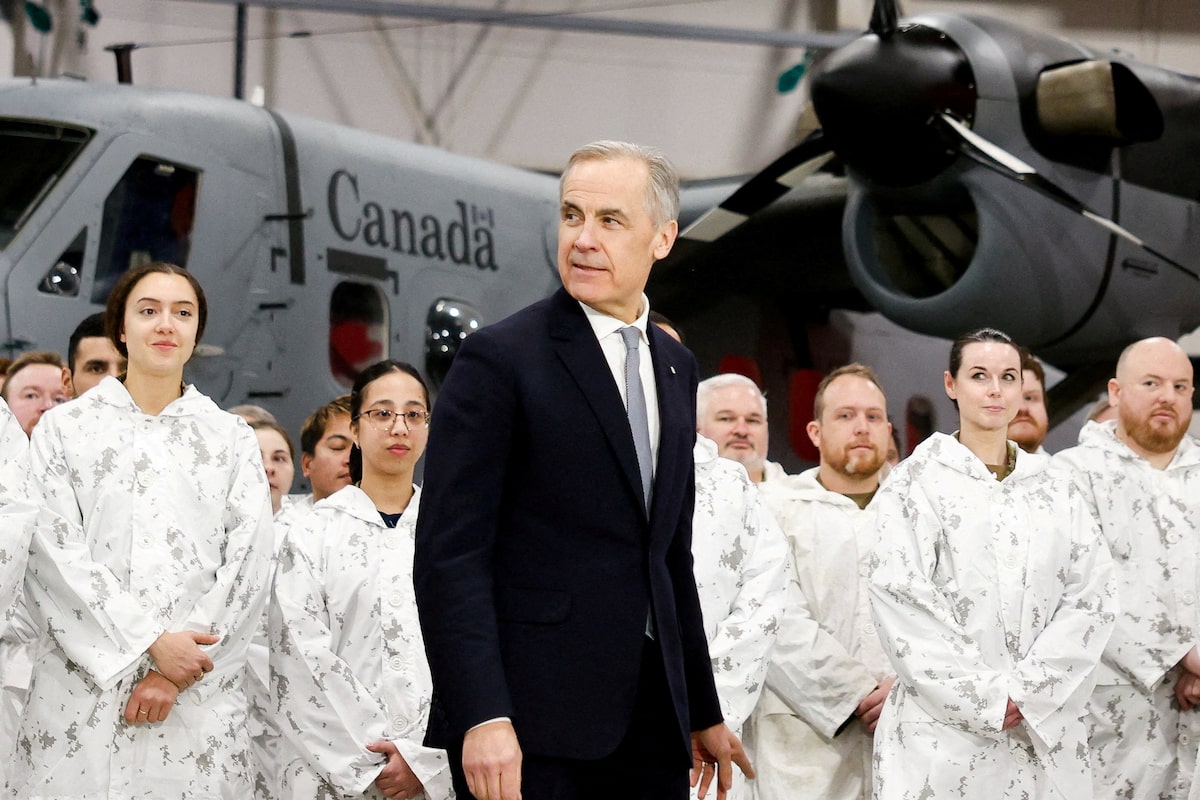
Prime Minister Mark Carney walks in front of members of the Canadian Armed Forces during his visit to the RCAF 440 Transport Squadron in Yellowknife in March.Carlos Osorio/Reuters
Prime Minister Mark Carney played down the Trump administration’s suspension of a United States-Canada defence co-operation body and rejected its suggestion Ottawa has not boosted defence spending.
Elbridge Colby, the U.S. undersecretary of defence for policy, announced Monday that Washington was putting the 86-year-old Permanent Joint Board on Defense on hold and accused Canada of failing to live up to its military responsibilities, despite Ottawa boosting defence spending over the past year.
Mr. Carney, asked about the development, noted the board – which co-ordinates continental defence – had not met since 2024.
“It has a long heritage, but I wouldn’t overplay the importance of this,” the Prime Minister told reporters Tuesday during an unrelated resource project announcement in Quebec.
Mr. Colby accused Canada of falling short on defence spending, a charge that appears to overlook a significant increase in military spending Ottawa announced in 2025.
“Unfortunately, Canada has failed to make credible progress on its defence commitments,” the U.S. defence official said Monday when he announced what he called a “pause” in the joint board.
Opinion: No ‘down payment’ on USMCA. Here’s what to offer instead
Mr. Carney pushed back at the suggestion Canada has fallen short on defence obligations. He noted that Canada in 2025 added more than $80-billion in new military spending over the next five years and exceeded a NATO commitment to spend 2 per cent of gross domestic product on defence.
“This is the first time since the fall of the Berlin Wall that Canada has reached its NATO defence spending target,” the Prime Minister said.
“Canada is acting,” he said. “Everything is changed.”
He noted Canada has committed billions to modernize North American Aerospace Defense Command over 20 years.
Mr. Carney said Canada will “diversify its defence co-operation” beyond the U.S. as it should do as a member of the North Atlantic Treaty Organization alliance and as a strong supporter of Ukraine as it resists Russia’s military assault.
“Ukraine is going to triumph, and we’re going to be on the right side of history,” the Prime Minister said.
U.S. Vice-President JD Vance on Tuesday took aim at other NATO allies, reiterating long-standing complaints from Mr. Trump that Europe is relying too heavily on Washington for its defence.
In response to a question about the U.S. freezing a plan to rotate 4,000 troops to NATO member Poland amid Russia’s invasion of Ukraine, Mr. Vance told a White House press briefing that it was time for European countries to do more for themselves.
“We want Europe to take more ownership over its own territorial integrity. We want Europe to step up in a big way,” the Vice-President said. “Europe has to stand on its own two feet.”
Mr. Vance also complained about “chirping” from the European media about the U.S.’s lack of universal health care when Washington is spending a lot of money to keep troops in Europe. “If the European media wants to attack the President of the United States, they need to start looking in the mirror.”
Mr. Trump has regularly questioned the value of NATO, as well as U.S. military aid to Ukraine. Mr. Vance did not say anything on Canada-U.S. military co-operation.
Mr. Colby’s Monday announcement also cited continuing American upset with Mr. Carney’s viral World Economic Forum speech from Davos in January, which was widely seen as critical of President Donald Trump.
Mr. Colby included a link to Mr. Carney’s Davos speech and a map of North America. “We can no longer avoid the gaps between rhetoric and reality,” Mr. Colby wrote, saying Canada should prioritize “hard power over rhetoric.”
The Permanent Joint Board on Defense, first established in 1940, is made up of military leaders and diplomats who consider major strategic issues in Canada-U.S. defence and make recommendations to both countries’ governments. It meets infrequently and some experts view it as having little influence now compared to its Cold War heyday.
Mr. Colby’s announcement follows Canada’s previous commitment to buy 88 F-35 fighter jets from U.S. defence contractor Lockheed Martin remains in limbo. After Mr. Trump began imposing protectionist tariffs on Canada, the Carney government said it was reconsidering whether to proceed with its full order of F-35s – a measure seen as an effort to gain leverage in talks with Washington.
While Canada has reached the 2-per-cent NATO target that was originally established more than a decade ago, Mr. Carney has yet to lay out a plan to hit the alliance’s newest target.
NATO leaders in June 2025 pledged to further boost defence spending to 5 per cent of GDP by 2035. This target is comprised of two parts: raising core military spending to 3.5 per cent of GDP with the remainder – 1.5 per cent of GDP – allocated to dual-use infrastructure, such as ports, which can be used by military or civilians. The Canadian government has said the 1.5-per-cent infrastructure target is readily achievable based on already-established infrastructure spending plans across Canada.
Canada’s budget watchdog, the Office of the Parliamentary Budget Officer, has noted that the Carney government has yet to detail a path to reach these higher NATO targets.
Mr. Carney on Tuesday defended this lack of detail, saying it would be irresponsible to provide details until his government verified the best plan of action given fundamental shifts – driven by new technology – in how wars are being waged.
He said Russia’s war on Ukraine is “changing fundamentally the nature of offence and defence” in a ground war, including the role of drones and artificial intelligence. Any plan that Canada might have drawn up in 2025 after the new NATO pledge would have reflected priorities five years earlier.
The Prime Minister also noted NATO has also scheduled a review of this 2035 target in 2029. The date provides NATO allies an opportunity to adjust the target – including lowering it – if circumstances warrant.
“That’s the reason why we don’t just draw a simple line, take a list that was prepared five years ago and say, ‘Yeah, we’ll have all that.’ ”
The year 2029 is also when Mr. Trump, who has pushed Western allies to boost defence spending, is supposed to retire as President.
Mr. Carney said Canada doesn’t want to waste money on defence spending that’s not appropriate for 21-century warfare given other priorities. “We want to keep taxes low, we want to support our cultural industries, we want to support health, we want to support Indigenous housing,” he said.