
San Diego will slash its controversial new trash fees at single-family homes and repeal its new paid parking in Balboa Park under a wide-ranging agreement the City Council unanimously approved Wednesday.
The agreement settles a lawsuit that challenged the city’s new fees for trash pickup, and it requires those seeking a repeal of the fees to abandon a possible November ballot measure that could have done that.
The city also agreed to repeal its highly unpopular experiment with paid parking in Balboa Park by the end of the year.
The new trash fees will not get rolled back to the $29 per month sought by plaintiffs in the lawsuit, but instead will be reduced to $38.75. That rollback will take effect in July 2027 and last for two years.
No refunds will be issued for higher trash fees paid before the rollback takes effect.
The deal would reduce city revenue by about $2.2 million in the upcoming fiscal year and by about $14.4 million in each of the two following fiscal years — about $10 million from reduced trash fees and $4.4 million from lost parking revenue in Balboa Park.
The two City Council members who spearheaded the deal — Joe LaCava and Stephen Whitburn — called the agreement a prudent move to avoid the financial risks of potentially losing the trash fee lawsuit or having the proposed ballot measure fully repeal the fees for two years.
Some estimates said the ballot measure could have blown a $150 million hole in the city’s budget.
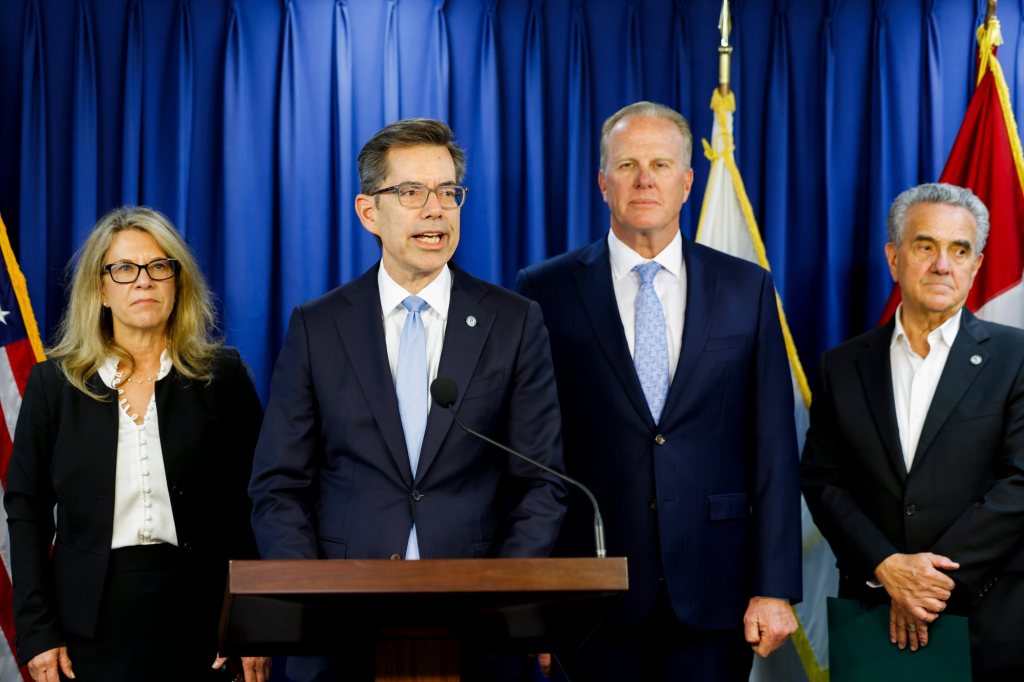
“The potential financial devastation averted by today’s action cannot be understated,” LaCava said during an afternoon City Hall news conference to announce the deal.
Critics of City Hall characterized the deal as a huge win for taxpayers and San Diego residents, contending it makes dramatic progress on two of the most controversial recent issues facing the city.
“This is a significant victory for San Diego taxpayers, working families and common sense,” said Kevin Faulconer, the former mayor who has been leading the now-abandoned ballot measure effort as chief executive of the Lincoln Club Business League.
The deal brought together politicians and community leaders of all stripes, including Democrats, Republicans, labor union officials and business leaders.
City officials said the deal was far better than previous settlement offers they had considered in recent weeks.
The deal allows the city to keep using property tax bills to collect the trash fee — a move that saves the city more than $10 million a year compared to ramping up a new city billing system.
Plaintiffs in the lawsuit had sought to bar the city from charging for trash on property tax bills but gave up that request in exchange for concessions on Balboa Park parking and other issues.
The agreement also requires an independent audit of the city’s trash collection system to more precisely determine the city’s costs, which could affect fees in future years. The city is legally prohibited from charging more than it costs to deliver the service to customers.
The plaintiffs had sought a rollback on monthly trash fees to $29, which was the high end of the $23 to $29 range that voters were told the new assessment would cost when they agreed to overturn the century-old People’s Ordinance in 2022.
The $38.75 per month included in Wednesday’s deal is equivalent to the $29 adjusted upward for inflation since 2021, the year that the $23-to-$29 range was estimated by the city’s independent budget analyst.
Monthly fees for standard service are now just under $44, but they had been scheduled to jump to $55 in July 2027 until Wednesday’s deal. They will now be $38.75 starting next year.
In July 2028, the monthly fee for standard service will be $39.91 — roughly 30% lower than the $57.55 monthly fee the city had been planning to charge.
The trash fee amounts in Wednesday’s deal can’t be adjusted upward for inflation.
Because of the rollback, city officials could revise or cancel plans to expand trash and recycling service, such as by abandoning a plan to shift to weekly recycling pickups instead of every other week.
Mayor Todd Gloria praised the deal.
“The settlement is a compromise that resolves multiple existing threats that could have forced more than $150 million in additional cuts to city services,” said Gloria. “It is not perfect or ideal, but my responsibility is to protect what matters most for San Diegans.”
The trial over the trash fees was recessed Wednesday and is likely to be dismissed as soon as Thursday.
Maria Severson, one of the attorneys for the plaintiffs, said the city made the right move.
“A trial is a risk — this is certainty,” she said.
The city’s agreement to eliminate paid parking in Balboa Park comes after several earlier retreats on the issue, which took effect Jan. 5. In late winter, the city agreed to let city residents park for free in most parking lots.
Last month, museums and other cultural institutions in the park said attendance was down by more than 30% compared with the same period last year, though they have not provided detailed data.
“This gives us a real light at the end of the tunnel,” Peter Comiskey, executive director of the Balboa Park Cultural Partnership, said Wednesday after the agreement was announced. “While this process was incredibly difficult, the ultimate resolution is very exciting for the future of Balboa Park. This is a meaningful moment that will preserve public access to one of San Diego’s most treasured public spaces.”
The settlement agreement was approved Wednesday morning in a council session closed to the public.
It took place at the same time lawyers for the city were presenting their defense in the trash fee lawsuit in San Diego Superior Court.
The council is scheduled to approve the deal a second time in open session on June 8. They are also scheduled that day to formally reverse paid parking in Balboa Park.
“This is a great day for our city,” Whitburn said during the afternoon news conference.
Whitburn acknowledged that the Lincoln Club’s agreement not to move forward with its ballot measure doesn’t prevent some other group from pursuing a similar measure — either this year or later.
But he said it would be very difficult for a campaign to gather the required signatures fast enough to meet an August deadline for a measure to qualify for the November ballot.
Mike Zucchet, leader of the city’s largest labor union, helped broker the deal and praised it Wednesday.
“We have agreed that our city and our community deserve a fair resolution and some certainty moving forward,” Zucchet said. “Our city does not need uncertain, divisive, all-or-nothing potential outcomes that carry great risk.”
Zucchet said many of the parties to the deal have allies and supporters who will say they should have held out for more. He said that’s a good sign that the deal is a fair compromise.
The San Diego Regional Chamber of Commerce also praised the deal.
“San Diegans are the real winners in this agreement, along with local businesses across San Diego,” said Chris Cate, the chamber’s chief executive. “Lowering costs, improving transparency, and creating greater predictability for business owners while protecting access to important public spaces like Balboa Park are meaningful victories for our region.”
The San Diego County Taxpayers Association offered similar sentiments.
“This agreement is a victory for San Diego taxpayers and a reminder that residents must stay vigilant when City Hall asks for more money,” said Mark Kersey, the association’s chief executive. “Transparency, accountability, and honesty in how fees are calculated are not optional.
Councilmember Raul Campillo, the only council member who voted against both the trash fees and paid parking in Balboa Park, hailed Wednesday’s deal.
“We are reducing the cost of living in San Diego and beginning the process of rebuilding San Diegans’ trust in their city government,” Campillo said.
While City Attorney Heather Ferbert didn’t attend Wednesday’s news conference, LaCava said she is fully aware of the deal and all of its elements and has signed off on it.
The city will pay the law firm that filed the trash fee lawsuit, Aguirre & Severson, an undisclosed amount of attorney’s fees. LaCava said that amount would be revealed June 8.
Whitburn said the city has the discretion to end paid parking in Balboa Park sooner than the end of the year. He said the council and mayor would discuss that option after the June 8 vote.
Wednesday’s deal has no impact on paid parking at the zoo, which is handled by zoo officials.
In a statement Wednesday evening, the zoo said “we are aware of the announced rollback of paid parking in Balboa Park and are working closely with our partners to assess next steps and timelines moving forward.”
The Lincoln Club will not be compensated or reimbursed for its efforts on the proposed ballot measure.