
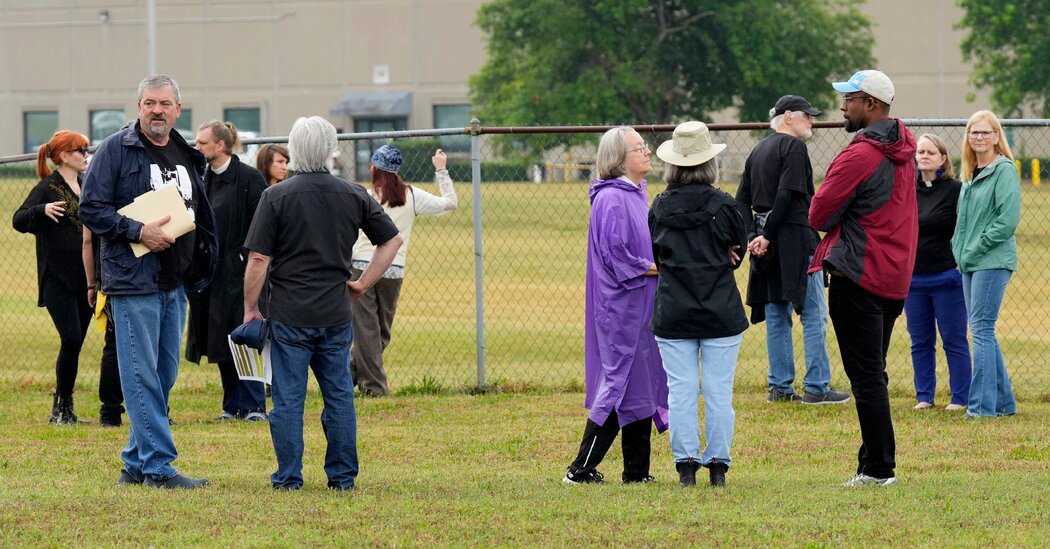
Tennessee called off the execution of Tony Carruthers, convicted in connection with three 1994 murders, after staff members were unable to find a vein to administer lethal injection drugs.
The State Department of Corrections said in a statement on Thursday that medical staff members were unable to find a “suitable vein” to administer the drugs after a series of attempts.
Lawyers for Mr. Carruthers had asked in emergency filings for the execution to be delayed. Gov. Bill Lee, a Republican, issued a reprieve on Thursday, delaying any execution of Mr. Carruthers for a year.
“Tennessee has effectively made the case against the death penalty,” said Laura Porter, the executive director of the U.S. Campaign to End the Death Penalty.
Mr. Carruthers’s case had already drawn attention as his allies and his lawyers argued that he was wrongfully convicted in connection with the murders of Marcellos Anderson; his mother, Delois Anderson; and Frederick Taylor. All three were found buried in a Memphis cemetery, and Mr. Carruthers was charged along with one other man.
In a 1996 trial, Mr. Carruthers represented himself, despite, the American Civil Liberties Union wrote in a recent clemency petition, being “plainly neither competent to stand trial nor competent to defend himself.” (Lawyers who tried to represent him said they endured personal attacks and abuse, which were later attributed to mental illness.)
The organization said Mr. Carruthers would have been the first person in more than a century to be executed after representing himself at trial. Lawyers also wrote in the petition for clemency that his mental illnesses “continue to impair his understanding of his legal situation and his impending execution.”
Mr. Carruthers’s allies and lawyers have pushed for new forensic testing that they say could help prove his innocence, a request that has been denied by multiple judges. His lawyers also filed an emergency request on Wednesday with the U.S. Supreme Court trying to stop his execution. The justices denied his request without any public dissents.
Maria DeLiberato, senior counsel at the Capital Punishment Project of the A.C.L.U., said his conviction “was already a profound injustice.”
“Today, that injustice became outright barbaric,” she said. She added that “Tennessee cannot continue torturing a man while refusing to answer serious questions about his innocence.”
Tennessee has faced a series of problems with its use of lethal injection; it paused executions for more than two years after it admitted in 2022 that the state’s drugs had not been properly tested. A group of inmates have sued Tennessee over its new injection procedure. And the state also faced scrutiny over the execution of a prisoner who had a heart device that functioned as both a pacemaker and defibrillator.
Several states have similarly canceled executions in recent years because executioners were unable to find a vein.
Alabama suspended all executions for several months from 2022 into 2023 after several executions in which officials could not access prisoners’ veins. Those cases, as well as others in Arizona and elsewhere, led the Death Penalty Information Center to describe 2022 as the “year of the botched execution.”
States have recently begun authorizing alternative methods, including the firing squad, largely because of problems obtaining lethal drugs. South Carolina executed three people last year by firing squad, the first such executions in the United States since 2010.
Three more people are set to be executed in Tennessee this year.
Abbie VanSickle contributed reporting.