
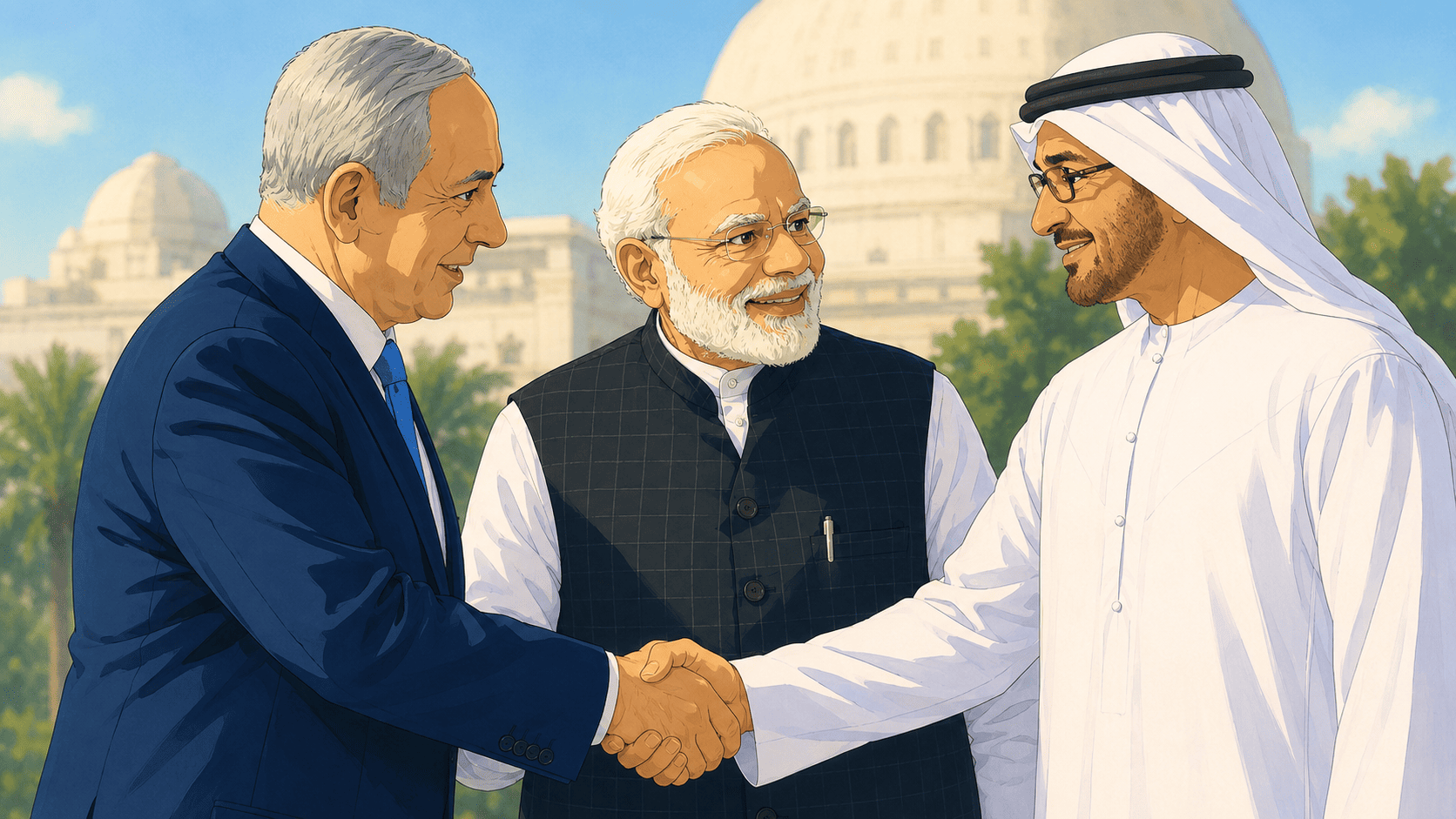
Partnerships with the UAE and Israel are helping India expand its influence not only in the Middle East but also across the larger Asia-Europe trade corridor.
Prime Minister Narendra Modi’s recent engagements in West Asia point to something much bigger than routine diplomacy. India’s approach to the Middle East is clearly changing. For years, New Delhi’s relationship with the region revolved around oil imports, remittances, and the Indian workforce in Gulf countries. That relationship still matters, but it is no longer the full picture.
Today, the Middle East has become strategically important for India in ways that go far beyond energy security. Trade routes, technology partnerships, maritime stability, and geopolitical influence are now part of the conversation. As global rivalries sharpen and supply chains become more political, India is trying to secure a stronger role in the region instead of remaining just an economic stakeholder.
One of the clearest signs of this shift is the growing cooperation between India, the UAE, and Israel. What makes this partnership stand out is India’s ability to maintain ties across competing regional camps without becoming deeply entangled in their rivalries. New Delhi can engage with Iran through forums like BRICS while also expanding defense and economic cooperation with Abu Dhabi and Tel Aviv.
That balancing strategy is especially visible in the Strait of Hormuz. India consistently supports the idea of keeping the waterway open because a large share of global energy and trade passes through it. At the same time, India avoids military coalitions against Iran. The focus remains on protecting trade and maintaining regional stability rather than escalating tensions.
The Rise of the Indo-Gulf Partnership
The India-UAE relationship has changed dramatically over the last decade. Since 2015, when Modi and UAE President Sheikh Mohamed bin Zayed Al Nahyan elevated ties to a Comprehensive Strategic Partnership, cooperation has expanded into areas that were once barely discussed between the two countries.
The UAE is home to nearly four million Indians, making the Indian community one of the largest expatriate groups in the country. Economic ties have also deepened rapidly, with Emirati investments in India crossing $22 billion. But what is really driving the relationship now is a shared long-term vision.
The UAE wants to reduce its dependence on oil and position itself as a global center for logistics, finance, artificial intelligence, and advanced technology. India, with its expanding digital economy, manufacturing ambitions, and massive consumer market, naturally fits into those plans.
Israel completes this emerging triangle. India and Israel had maintained security ties quietly for years, but the relationship became far more visible after Modi’s visit to Israel in 2017 and Benjamin Netanyahu’s visit to India the following year. Since then, cooperation has expanded into defense technology, cybersecurity, agriculture, semiconductors, and water management.
The reason this partnership works is because each country brings something different to the table. Israel contributes technological innovation and military expertise. The UAE provides investment and infrastructure. India contributes scale, manufacturing capacity, and a huge market.
This combination is already shaping collaborations in sectors like aerospace, artificial intelligence, maritime security, and semiconductor production. The broader goal is straightforward: combine Israeli innovation, Emirati capital, and Indian industrial capacity to build competitive industries for the future.
I2U2 and India’s Balancing Act
This cooperation became more structured with the creation of I2U2, a group that includes India, Israel, the UAE, and the United States. Unlike traditional alliances built mainly around military cooperation, I2U2 focuses on practical projects involving food security, clean energy, infrastructure, and technology.
One major example is the UAE’s commitment of $2 billion for integrated food parks in India that use Israeli agricultural and water-management technology. The group has also supported renewable-energy initiatives, including hybrid solar and wind projects in Gujarat.
For India, I2U2 fits neatly into its broader foreign policy strategy. Rather than choosing one geopolitical camp over another, New Delhi prefers maintaining relationships with multiple powers at the same time. India continues to work closely with Israel on technology, maintain energy ties with Iran, expand trade with the UAE, and strengthen security cooperation with the United States.
That ability to talk to competing powers without fully aligning with any single bloc has become one of India’s biggest diplomatic advantages. Very few countries today can maintain active engagement with Washington, Tehran, Moscow, Riyadh, Abu Dhabi, and Tel Aviv simultaneously.
IMEC: A Bigger Economic Vision
The India-Middle East-Europe Economic Corridor, better known as IMEC, is meant to give this larger strategy an economic backbone. The project aims to connect India with Europe through ports, railways, and shipping networks running across the UAE, Saudi Arabia, Jordan, and Israel.
Naturally, there are doubts about whether the project can fully succeed. China’s Belt and Road Initiative already has years of investment and infrastructure behind it. IMEC, meanwhile, depends heavily on political coordination in a region where tensions can rise quickly.
Still, the project has one major advantage. Unlike the more centralized structure of the Belt and Road Initiative, IMEC is designed as a partnership where participating countries have shared interests and responsibilities. The UAE acts as a logistics hub through ports like Jebel Ali, Israel provides Mediterranean access into Europe, and India contributes manufacturing power and growing naval influence in the Indian Ocean.
For Gulf countries, India is increasingly seen as a stable and reliable partner. It offers economic opportunities and strategic cooperation without the political pressure or debt concerns that often accompany major-power competition.
Moving Ahead
The growing alignment between India, Israel, and the UAE reflects a wider shift taking place across the Middle East. The region is no longer defined only by oil politics and traditional military alliances. Technology, trade corridors, infrastructure, and economic connectivity are becoming just as important.
India’s role in the region is changing alongside that transformation. It is no longer just an energy importer watching developments from a distance. Instead, India is becoming an active participant with direct stakes in regional stability, trade security, and emerging economic networks.
Partnerships with the UAE and Israel are helping India expand its influence not only in the Middle East but also across the larger Asia-Europe trade corridor. The region that once served mainly as India’s energy lifeline is now becoming an important platform for its broader global ambitions.