
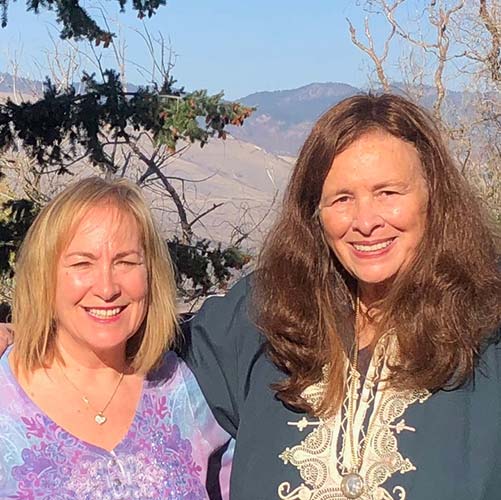
Beloved Jean Houston —
A mother to the world.
Guide the spirits
We pray to.
Help them become
All they were meant to be.
I was honored to study with Jean and spend time in her home. She was the Mother of Human Potential, and I will always carry her in my heart. “The world will dream a bigger dream for you than you can imagine…”
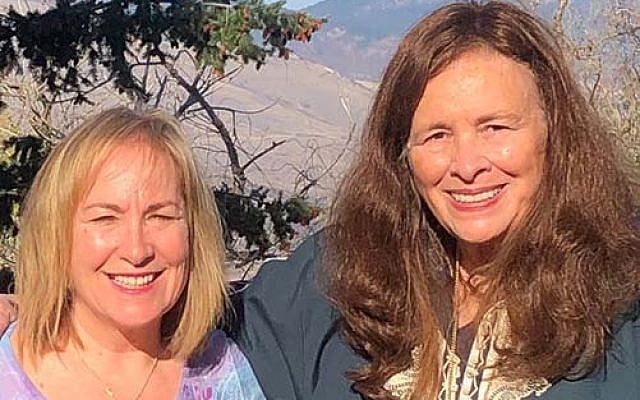
Dr. Jean Houston and Penny S. Tee
May You Rest in Peace, שלום and سلام.
Penny S. Tee, author of “BLASTED from COMPLACENCY: A Journey from Terror to Transformation in Israel,” speaker, video podcaster, writer, and Peace Advocate.
Thank you, Jean.
I wrote this through tears, in honor of our dearest Jean Houston, for a Legacy website coming in 2027.
Why write a Times of Israel blog for her? Surely Israel could use her help — as could the entire world.
If you’ve never heard of Jean Houston, her work feels like a breath of fresh air — especially in today’s turbulent world.
At times, I’m asked, “Who is Jean Houston?” It is painful to now say she was…
Jean Houston was a scholar, author, and pioneer of the Human Potential Movement. Jean believed deeply in every person’s promise and inspired them to recognize it within themselves.
She wrote more than 30 books spanning psychology, mythology, neuroscience, and spiritual traditions. To name a few:
The Possible Human
The Search for the Beloved
A Mythic Life (memoir)
The Wizard of Us
Jean Houston was a key figure in modern human development and consciousness studies. She co‑founded the Foundation for Mind Research, focusing on the development of creativity, mind expansion, and social transformation.
She also worked on social change and global leadership, advising leaders, including the Dalai Lama and the United Nations.
Though she had no children, Jean helped birth the best in everyone she encountered. She had faith in people from the core of her being — and believed deeply in our potential, wrapping everybody in a blanket of possibility.
She knew in her heart that each individual was capable of far more than they gave themselves credit for. It was her life’s work to help them see it — so they would have the courage to use their innate qualities for the good of humanity. She delighted in watching people grow into their best selves.
I ask you: what might you have the audacity to become if you truly allowed yourself?
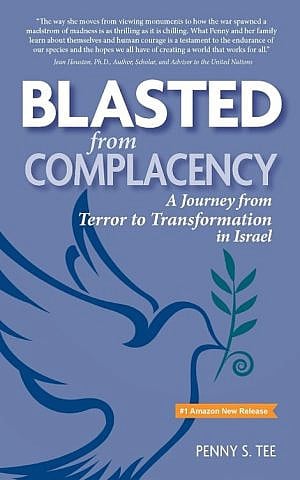
BLASTED from COMPLACENCY: A Journey from Terror to Transformation in Israel
One of the greatest honors of my life was that Jean wrote a testimonial for my book, “BLASTED from COMPLACENCY: A Journey from Terror to Transformation in Israel.” She wrote: “… a testament to the endurance of our species and the hopes we all have of creating a world that works for all.”
She had the ability to see into your soul and shine a mirror upon it so you could see it for yourself.
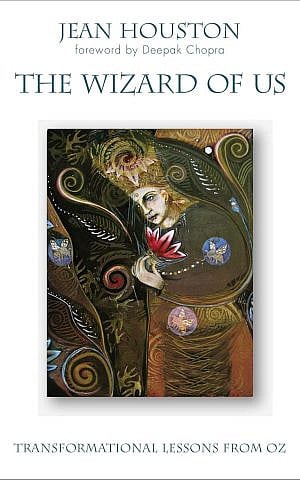
The Wizard of Us: Transformational Lessons from Oz
As Jean explored in “The Wizard of Us: Transformational Lessons from Oz,” Dorothy realizes at the end, “There is no place like home.” I’ve always loved the visualization of Somewhere Over the Rainbow. It speaks to me of the ability to accomplish our dreams as we cherry-pick the colors that speak to us. Jean provided lessons as a springboard for self-exploration. She described “home” as a return to what we truly are — “our code, our seeding, our potential destiny.” Jean offered a map to help you find it. And at the end of the story, as Glinda the Good Witch says, “You’ve always had the power, my dear. You just had to learn it for yourself.” May Jean enjoy her new life amidst the rainbows.
Applying Jean’s lens — to subjects dear to my heart, including the Israeli‑Palestinian conflict, the Israel‑Hamas War, and the 2026 Iran War, what can we discover?
I acknowledge that I am, in many ways, an observer. I do not live the tragic realities of either side, though as a Jew, I carry our shared historical traumas within me. If you feel I have no right to an opinion, I understand — the risks you face may seem far more immediate and perilous at first glance.
However, history shows that Jews are often seen as one people, regardless of where or how we live. That reality is painful—and persistent.
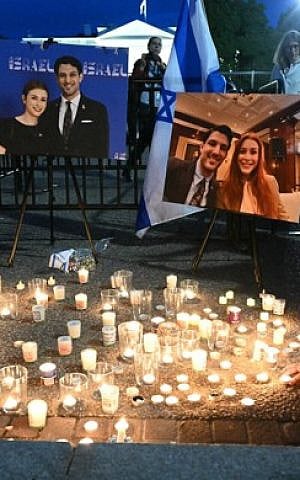
People attend a candlelight vigil at Lafayette Square across from the White House in Washington, on May 22, 2025, for the two Israeli Embassy staffers killed in a shooting at the Capital Jewish Museum the previous day. (Mandel Ngan/AFP)
Antisemitism eventually escapes the bowels of hate, each time we feel that we finally are accepted — no matter how much we long to be just like our neighbors. Yes, it stinks, but this is our reality.
It is not surprising—it simply hurts when the blinders are ripped away.
As a Jew living in the diaspora, please recognize that the world most often sees us as one — whether through sidelocks and modest dress, or even when we feel unaffiliated, secular, or dressed in the latest fashions. Hitler didn’t ask for your temple membership card as they dragged off our brethren to be exterminated.
And as we’ve seen once again at the Islamic Center of San Diego, Muslims also pay the price of being different — and of indifference. The assailants — teenagers taught to hate. Their parents should be held accountable.
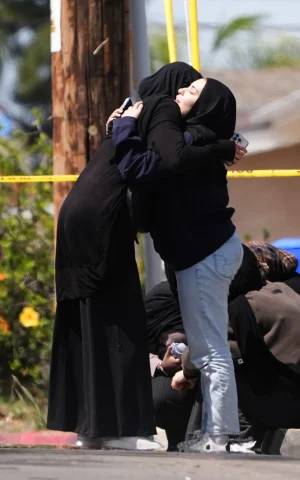
People embrace near the scene of a shooting outside the Islamic Center of San Diego Monday, May 18, 2026, in San Diego. (AP/Gregory Bull)
You’d think there would be more understanding and empathy for one another. Hopefully, someday we will emphasize what we share, rather than what divides us.
Yet both peoples live with the lingering wounds of trauma. Sometimes, amid crisis, we need an unentangled witness—someone able to reflect back what is otherwise too painful to see.
As parents, we see these wars for what they are — unbearably painful. No one can argue the point. I’m lucky to be a bystander. But that does not mean I look away from their grief. Their sorrow belongs to the world.
We could have Peace today, just permanently stop the violence. Every parent wants their kids to be able to play safely in their backyards. You can put your very legitimate grievances aside for a sane future. Will you?
Nothing can change what has already happened. Retribution is an unending, impotent loop of violence that can never soothe the pain. No side is going away, so we all must learn to live together in Peace. L’Dor V’Dor (transliteration in Hebrew), Min Jīl Ilā Jīl (transliteration in Arabic), meaning from generation to generation, please give our kids a chance to live in Peace.
Ultimately, all anyone can do is live in the present. The past is gone. The future has not yet arrived. What can we do today to make the world more Peaceful for everyone? It’s easy to see that war can never be the answer, yet here we are. How can anyone believe that killing another person’s child, no matter how old, will miraculously achieve Peace with an adversary willing to engage in constructive possibilities? There must be a better way.
As Jean would say:
Change the story, and you change perception; change perception, and you change the world.
Common sense—and nearly every religion and philosophy — offers a version of the following idea:
Rabbi Hillel (1st century BCE): “What is hateful to you, do not do to your neighbor.”
The Prophet Muhammad (7th century CE): “None of you truly believes until he loves for his brother what he loves for himself.”
Isocrates (4th century BCE): “Do not do to others what angers you if done to you.”
Confucius (around 500 BCE): “Do not impose on others what you do not wish for yourself.”
The Mahabharata (Sometime 400 BCE – 400 CE): “This is the sum of duty: do not do to others what would cause pain if done to you.”
Buddhist (5th-6th century BCE): “Hurt not others in ways that you yourself would find hurtful.”
Do you notice the similarities? We share common ground on which to build. Yet many are taught to hate, causing their souls to wither. Shame on their twisted guides. Their perilous journey challenges them to reach the mountain’s summit — Peace within — and ultimately share that harmony with the world. For too many, the climb is too steep.
Thankfully, most teachers are illuminating, encouraging, and point their students in a positive direction. They are unsung heroes.
It’s been over a decade since I’ve worked on Peace. I credit Jean with making me feel like I could publish my book, become a speaker, and work on Peace — something that once felt unimaginable. At times, it still does, but then I look at how much I’ve accomplished in almost twelve years, and I’m satisfied that while I haven’t gotten the brass ring, I feel I’ve moved the ball forward in my own way, have been able to call attention to important topics, and share stories of people making a difference in this world.
Peace is a mighty big goal, especially between Israelis and Palestinians. The way I look at it is, I can at least help.
The first way I went about it was by writing, “BLASTED from COMPLACENCY: A Journey from Terror to Transformation in Israel.” It’s the story of how I became awakened to just a bit of what war is like, and I realized I didn’t want any part of it. I felt that no one else should have to go through these experiences either.
I grew up on too much chicken soup to want to deal with running to bomb shelters and feeling the percussion of Iron Dome blowing up the Palestinian missiles in the air to avoid harming Israelis. It’s the reason why, in the past, so few Israelis were harmed compared to Palestinians. The dance had become so common that some of the people became nonchalant about following protocol and waiting ten minutes in the shelter so they didn’t get bonked in the head with falling shrapnel. Businessmen sometimes hurriedly leave, getting on with their day. Not me.
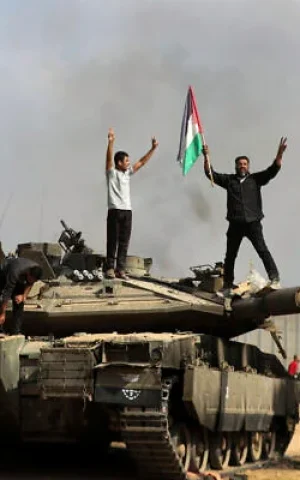
Gazans celebrate by a destroyed Israeli tank at the broken Israel-Gaza border fence, east of Khan Younis, October 7, 2023. (AP/Yousef Masoud)
October 7th changed Israelis’ sense of security forever. The oft‑claimed protective shield of the IDF had been blasted open, shocking the nation and exposing its vulnerabilities. I had often wondered whether the Israeli belief in the impenetrable IDF was a form of psychological self‑preservation. How else could they have lived with the constant terror attacks for seventy-eight years? Given Iran’s use of drones and other weapons, the times have changed further; Israel no longer feels as invulnerable as it once did—the sense of security has clearly been shattered.
After Israel defended itself from the October 7th atrocities, HAMAS has set up Israel for a worldwide public opinion disaster. No other nation, but one comprised mostly of Jews, would be expected to turn the other cheek.
Does the world care that this tiny nation was savagely attacked? As reported in the Washington Institute for Near East Policy, 1,200 Israelis and third-country nationals, including at least 29 Americans, in a country whose population is less than 10 million, were killed by Hamas. In America, that would be equivalent to killing nearly 40,000 — 13 times more than the number of Al Qaeda victims on 9/11.
As I wrote in my TOI Blog, “Israel — Can We Heal Ourselves, or Will the World Ever Let Us? Part I,” Israel has been attacked on seven fronts during the Israel-US-Iran war.
And in moments like these — I find myself returning to Jean. What would she ask of us given these circumstances? Not to turn away, nor harden, but to expand. Jean believed that even in the darkest times, we are not powerless.
Years ago, Jean suggested I start a podcast—and thus PEACE with Penny was born. It’s a video podcast (I wanted to show videos and let people see the Peacemakers) where I interview Peace organizations composed of Israelis and Palestinians who work together for Peace. It has brought me great joy to share these revelations.
Amidst the sorrow of conflict, there is a hopeful story that rarely gets the attention it deserves. After more than four years, I have built a collection of interviews with Israelis and Palestinians working together to make a difference and lay the foundations for coexistence. Many have lost loved ones; all know countless victims whose futures have been robbed. I hope you take the time to visit our PEACE with Penny YouTube Channel, find what you hear soothing, and share it.
PEACE with Penny
These organizations build bridges through shared interests—scientific advocacy, conservation, transportation, medicine, education, music, art, law, interfaith work, and economics—the opportunities are endless. The sad truth is that many participants have never actually spoken with one another.
As the learned misperceptions are demolished, space is made for understanding and a glimmer of light for the future.
There is already a patchwork quilt of Peace between Israelis and Palestinians—you just must know where to look. My goal with PEACE with Penny is to provide a hopeful vantage point— to show that what we see nightly in the news is only one part of the story. I have been privileged to meet incredible people engaged in dignified and mutually beneficial collaborations. Check out our library of heart-warming episodes on PEACE with Penny. They will put a smile on your face, challenging the narrative of hopelessness.
One organization helps bring gravely ill Palestinian children and their parents to the border, where Israelis transport them to chemotherapy treatments in Israeli hospitals—and then safely returns them to the border to be brought home. Over time, friendships and loving bonds grow.
Did you know that a Palestinian restaurant went to the effort of obtaining kosher certification so Israelis could dine there while watching the soccer finals?
These are the kinds of stories that show Peace is possible — even in times of war.
I have been working on new interviews to be released this year with various organizations. Since October 7th and the war that followed, how has this impacted their work?
Admittedly, given the volcanic eruption of antisemitism over the past year and a half, I have focused more on maintaining my own Peace of mind.
I felt I had to speak up and do what I could to address the antisemitism diaspora Jews are facing around the world. I have been writing for The Times of Israel Blogs. The diaspora could use some help from Israelis, as well as from non-Jews. We seem to be the invisible minority both internally and externally. We wanted to believe we were accepted just like anyone else. But our kids are being attacked from elementary school to universities. Antisemitic tropes are being peddled by newscasters and politicians. Have we seen this before?
Consequently, I’ve been working on a new series as part of PEACE with Penny and for my writing in The Times of Israel Blogs. I thought this blog originally would begin the series referred to as the PEACE with Penny Holocaust Survivors Series: Part II. It’s going to be filled with riveting accounts of courage and resilience. From the children of Holocaust survivors who are now, of course, adults, to surviving Torahs and violins lovingly restored, they are all stories of courage, resilience, and also carry an important warning.
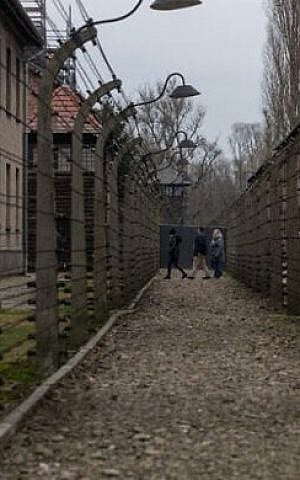
High school students from France walk on the ground of the Memorial and Museum Auschwitz-Birkenau former concentration and extermination camp in Oswiecim, southern Poland, on 5 December 2024. (Wojtek RADWANSKI / AFP)
I hope you will join us as we kvell (rejoice) that we are still here. After over eighty years, our numbers have finally returned to what they were before the Holocaust. Attention Holocaust Deniers: The Holocaust not only happened, but the Jewish people survived and thrived. It’s my way of calling attention to the current wave of hate that Jews are faced with. History shows us what happens when hatred is not confronted.
How much richer would our world be if those six million lives had been allowed to live out their dreams…
Turning back to share more about Jean, we were told that as she prepared for her final journey, the hospice workers who came to care for her were themselves drawn into her web of love—and forever changed by her. I can imagine Jean asking them about their lives, curious about their dreams, and encouraging them to bravely make them a reality. I’m sure that was a role reversal they didn’t expect. But that was Jean, always generous with her time and intentions even in her last days. Her final words: “I have loved you all…”
Jean, the world is better for having known you. I’m happy that I have your documented work and lessons to console me. I was transformed by your belief in me, and the entire world has benefited from the teachings you shared. I am forever grateful and will always miss your kindness, laugh, and smile.
Dearest Jean, May Your Memory Be a Blessing and May You Rest in Peace, שלום and سلام

PEACEFUL COEXISTENCE