
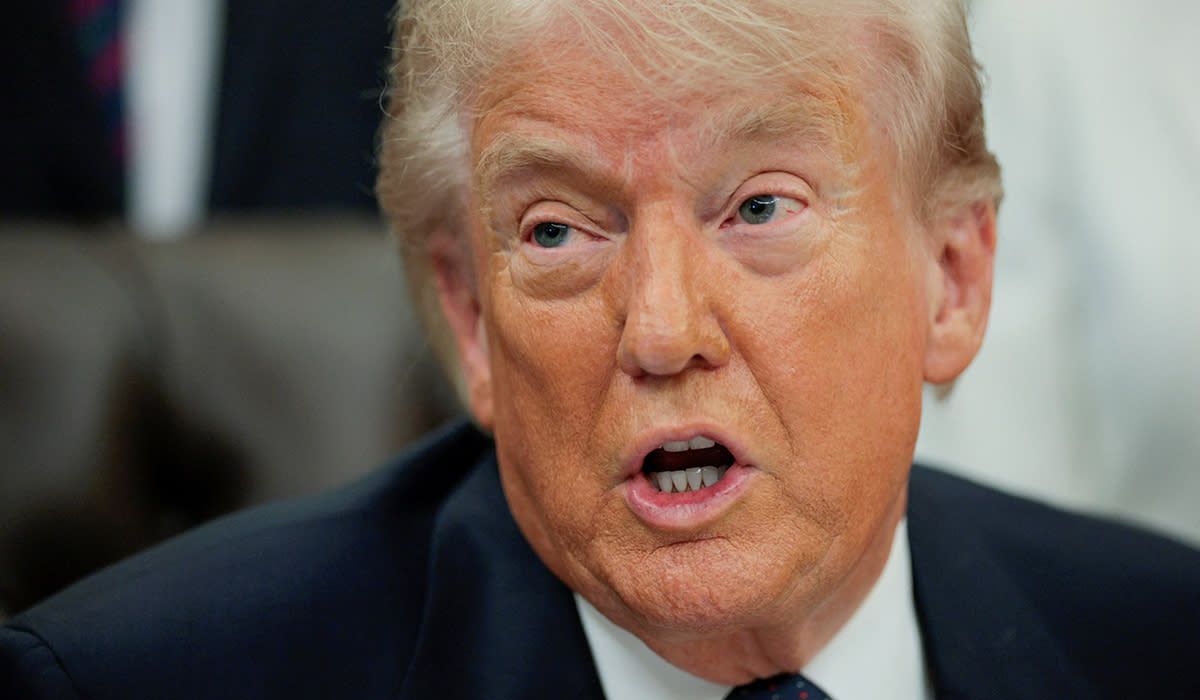
President Trump is set to hold an emergency Cabinet meeting at the White House on Wednesday as his administration continues to push for a peace deal with Iran.
The meeting was initially supposed to take place at Camp David in Maryland — a rare occurrence — but the location was changed due to weather.
The war in the Middle East is “likely to dominate the conversation,” the New York Post reported.
Yet three months in, the future of the conflict still seems as uncertain as ever. Negotiators met earlier this week in Qatar to consider the latest U.S. peace proposal — then top Iranian officials left after U.S. forces struck the Islamic Republic’s missile launch sites and mine-laying boats, triggering threats of a “decisive reciprocal response” from Tehran.
Iran also accused the United States of a “grave violation” of the current ceasefire. The U.S. claimed it was acting in self-defense.
Trump said on Saturday that an agreement had already “been largely negotiated” and would “be announced shortly.” But by Tuesday, Secretary of State Marco Rubio was telling reporters that a possible deal was still “a few days” away.
“There’s a lot of talking back and forth going on about specific language in the initial document,” Rubio said — adding that Trump is “either going to make a good deal or no deal” at all.
When an “initial, unofficial document” outlining a preliminary 14-point framework for an agreement surfaced in Iranian state media on Wednesday, the White House dismissed it as a “complete fabrication.”
“Nobody should believe what Iranian state media is putting out,” the administration wrote on social media.
So should Americans expect actual progress toward peace this week? Here’s what you need to know to catch up.
What the United States is proposing
The deal on the table is fairly straightforward.
For months, Iran has been effectively blockading the Strait of Hormuz, choking off one-fifth of the world’s oil supply. That’s why the average U.S. gas price has skyrocketed from about $2.90 in late February to about $4.50 today.
In April, Trump decided to counter with a naval blockade of his own: If Iran won’t let ships carrying cargo from other countries cross the strait, the thinking went, then ships carrying Iranian cargo can’t cross either.
The U.S. is now proposing to lift its blockade on Iranian ports, according to Axios — if Iran reopens the Strait of Hormuz and removes the mines it has deployed there. Both the Iranian economy and the global economy would get some relief.
After that, the current ceasefire would be extended for another 60 days, giving both sides “breathing room” to resolve their thornier issues.
From Iran’s perspective, this means getting the United States to agree to lift sanctions and unfreeze funds; from the U.S. perspective, it means getting Iran to agree to suspend its uranium enrichment program and relinquish its stockpile of highly enriched nuclear fuel.
A senior U.S. official told reporters on Sunday that the administration believes Iranian supreme leader Mojtaba Khamenei has “endorsed the broad template of the deal,” but “whether this becomes an agreement is still an open question.”
The big sticking points are (1) how much enriched uranium Iran would agree to dispose of and (2) how long the country would be willing to put its entire enrichment program on hold.
Why is this taking so long?
The current ceasefire started on April 8, just minutes before Trump’s threatened deadline for launching crippling attacks on Iran’s civilian infrastructure.
The Strait of Hormuz was supposed to reopen back then. But Iran didn’t comply, and Trump launched his naval blockade. When the initial two-week ceasefire was about to expire in late April, Trump decided to extend it until “discussions are concluded, one way or the other.”
In May, the president announced “Project Freedom” — an effort by U.S. forces to protect ships as they exited the strait. Only two vessels made it through, though, and Trump abandoned the initiative the following day.
Since then, “Trump has veered between talk of negotiating, bombing and blockading — sometimes all in the same day,” as the New York Times recently put it. “He has even suggested more than once that the war is already over.”
In total, Trump has “threatened to restart high-intensity fighting on at least seven different occasions,” according to Times columnist Bret Stephens. But he has “backed down every time.”
Meanwhile, the Iranian regime — seemingly emboldened by all the back-and-forth — hasn’t really budged at the negotiating table.
Even if a provisional peace deal is struck this week, the war still might not end anytime soon. The Strait of Hormuz would temporarily reopen, but it’s unclear whether the United States and Iran could resolve their deeper disagreements over Tehran’s nuclear program in the 60 days that followed.