
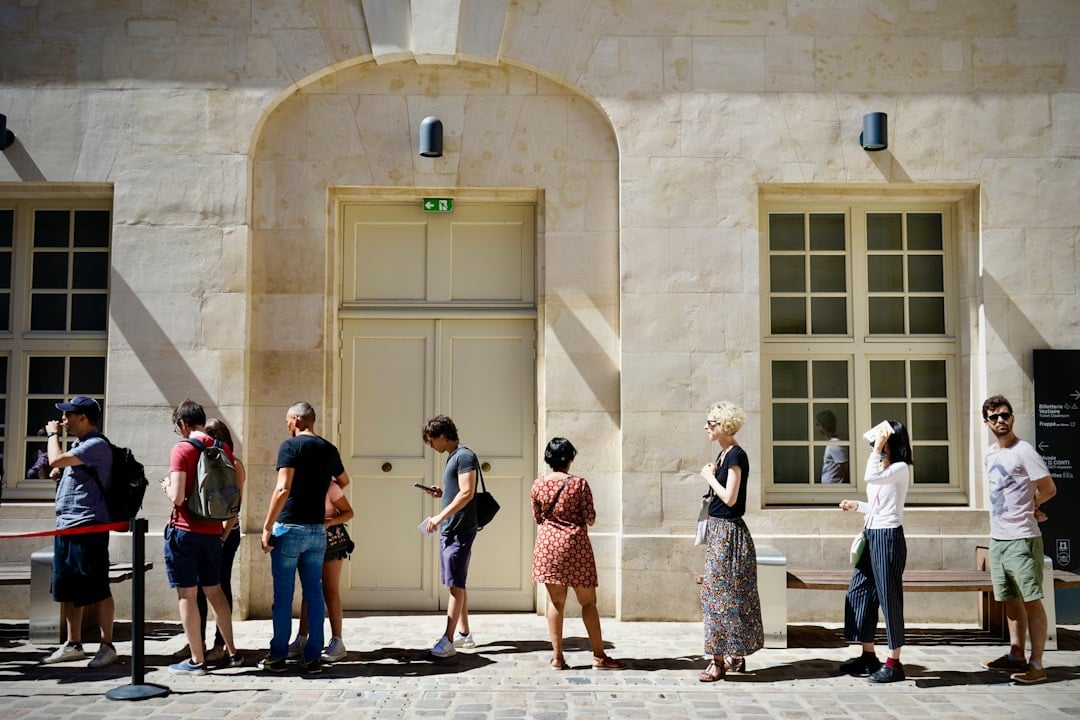
I’ve spent enough time queuing in Israel to conclude two things.
First: Israelis do not stand in line.
Second: there are only five kinds of Israelis, and somehow, all of them are always ahead of me.
I don’t consider this criticism so much as an anthropological observation.
Other countries queue. Israelis gather loosely around the concept of a line and then negotiate who goes next socially, spiritually, and occasionally militarily.
Nobody is entirely sure where the line begins or whose turn it is. But everyone is completely confident that they understand the system better than everyone else.
I’ve observed this in supermarkets, pharmacies, airport security, government offices, cafes, bakeries, and once, memorably, at a falafel stand where one man loudly declared that he was not cutting because, “I only need one thing,” as though line etiquette operated on volume rather than chronology.
Over time, I’ve identified five main archetypes.
The first is The Optimizer.
The Optimizer arrives late and leaves first.
They never explicitly cut. That would suggest rules existed to break.
Instead, they approach the counter at a forty-five-degree angle and ask a question that becomes a transaction, then a conversation, and somehow ends with them holding a receipt while everyone else is still staring at the number screen.
You hate them.
You also wonder if maybe they should run the country.
At least they’re efficient.
The second is The Historian.
The Historian is usually over sixty and appears to know everyone.
You begin the interaction as strangers.
Ten minutes later, you know where her daughter lives, which grandson is in reserve duty, what the pharmacy looked like in 1989, and why there has been a national decline in tomatoes.
Nobody appears annoyed.
In Israel, transactions are rarely allowed to remain transactions. They become relationships.
The person behind the counter is not providing a service. They are participating in society.
The third is The Security Analyst.
The Security Analyst does not work there but has nevertheless assumed operational control.
“Don’t stand here.”
“This line is fake.”
“She’s opening another register.”
“Actually, 43 already left.”
At any given moment, every Israeli is approximately three sentences away from becoming interim management.
The fourth is The Philosopher.
The Philosopher has somehow transcended the line.
Usually, they have just returned from India, work in tech, recently discovered breathwork, or are planning to move to Portugal.
They project an air of calm.
“Everything arrives when it’s supposed to.”
Then their number gets skipped, and they immediately transform into The Security Analyst.
Turns out the yoga retreat in India wasn’t actually “totally transforming, my brother.”
Finally, there is The Martyr.
The Martyr has been waiting the longest.
You will know this because you will be told.
Not angrily but with a sense of pride. Almost as though this selfless act holds sincere historical significance.
The waiting itself has become the event. There is a 50% chance this person is your mother-in-law. If not, she is certainly someone’s mother-in-law. She is the type of woman who starts preparing Shabbat dinner early Friday morning but refuses to have more than a bite of schnitzel come dinnertime.
You suggest they go ahead.
“No no,” they say.
“It’s okay.”
It is not okay.
There is something deeply Israeli about converting inconvenience into a badge of honor.
But what I’ve come to realize is that lines here aren’t really about efficiency. They’re one of the only places left where everybody becomes briefly equal.
The startup founder waits with the pensioner.
The professor waits with the soldier.
The new immigrant waits with someone whose family insists they personally built the country.
Everyone bonds over the shared inconvenience of not being next. And when your turn finally comes, you discover the undeniable truth that everyone you were just bonding with now hates you.
But until you become the hated person at the front, you hear life stories you never asked for. You get recommendations for doctors, jobs, neighborhoods, and where to buy cheaper cucumbers.
Someone inevitably asks where you’re from. Someone else asks whether you know their second cousin’s best friend’s wife, who visited your hometown once in 2006.
By the time your number is called, you’ve accidentally participated in civic life.
And maybe that’s the point.
Israeli lines are not efficient. Far from it. But they are intimate.
People advise you, judge you, correct you, and sometimes figuratively adopt you. You leave slightly irritated but a little bit less alone.
There are only five kinds of Israelis.
I know because by the end of every line, I’ve become at least three of them.
Marni Davimes is an Israeli-American writer, editor, and journalist based in Tel Aviv. Her work spans news, culture, identity, and the strange places where politics and private life overlap. She has written and edited across international media and is particularly interested in making sense of things that resist easy narratives.