
1982–87: Iranian offensive, stalemate, and the Tanker War
In May 1982 Iranian forces recaptured Khorramshahr. Iraq voluntarily withdrew its forces from all captured Iranian territory soon after and began seeking a peace agreement with Iran.
But under the leadership of Ruhollah Khomeini, who saw Saddam as an obstacle to the Islamic Revolution, Iran remained intransigent and continued the war in an effort to overthrow the Iraqi leader. In July Iranian forces invaded Iraq’s Al-Baṣrah province. Iraq’s defenses solidified once its troops were defending their own soil, and the war settled down into a stalemate with a static, entrenched front running just inside and along Iraq’s border.
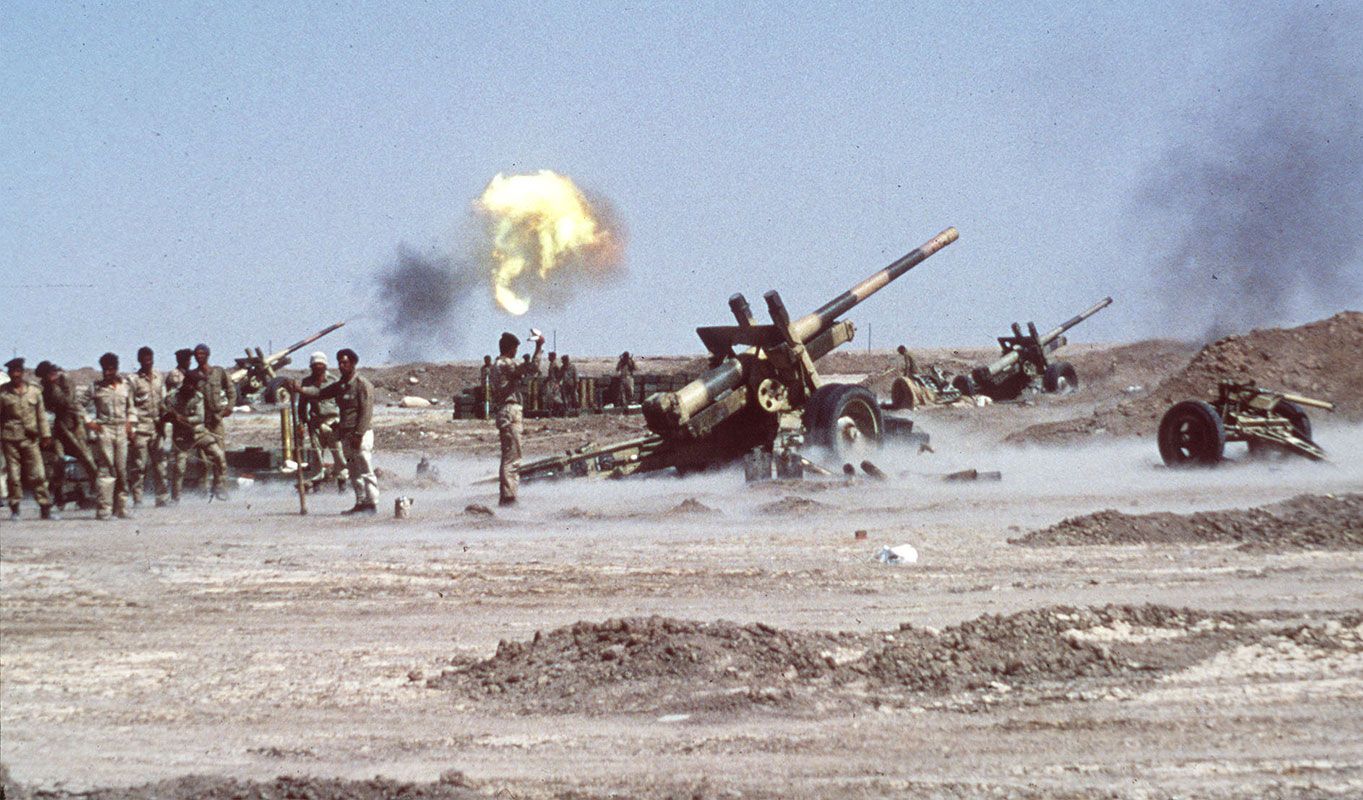
Iran repeatedly launched fruitless infantry attacks, using human assault waves composed partly of untrained and unarmed conscripts (often young boys snatched from the streets), which were repelled by the superior firepower and air power of the Iraqis. Both nations engaged in sporadic air and missile attacks against each other’s cities and military and oil installations.
Tanker WarThe Singapore-flagged Norman Atlantic tanker ablaze after being struck by an Iranian warship near the Strait of Hormuz, December 6, 1987.(more)
Despite the conflict being focused in oil-rich regions, the disruption to the global oil flow had been hitherto minimal. But in 1984, with no end to the war in sight, the two countries began attacking each other’s oil-tanker shipping in the Persian Gulf. Iran also attacked tankers headed to and from Kuwait and other Gulf states, prompting the United States and several western European nations to station warships in the Persian Gulf to ensure the flow of oil to the rest of the world. The so-called Tanker War, which included strikes on more than 100 oil tankers, marked an increase in international interest and involvement in the conflict.
The oil-exporting capacity of both nations was severely reduced at various times as a result of air strikes and pipeline shutoffs, and the consequent reduction in their income and foreign-currency earnings brought the countries’ economic development programs to a near standstill. Iraq’s war effort was openly financed by Saudi Arabia, Kuwait, and other neighboring Arab states and was tacitly supported by the United States and the Soviet Union, while Iran’s only major allies were Syria and Libya.
In 1987 the military balance began to favor Iraq, which had raised an army of about one million and had obtained state-of-the-art arms from France and the Soviet Union, including thousands of artillery pieces, tanks, and armored personnel carriers and hundreds of combat aircraft. This arsenal (enormous for a country of some 18 million inhabitants) was bolstered by the addition of substantial quantities of chemical weapons, which the regime acquired or produced throughout the 1980s. At the same time, Iraq committed substantial resources in an attempt to develop or purchase other weapons of mass destruction (WMD), including biological and nuclear arms.
In July 1987 the UN Security Council had unanimously passed Resolution 598, urging Iraq and Iran to accept a ceasefire, withdraw their forces to internationally recognized boundaries, and settle their frontier disputes by negotiations held under UN auspices. Iraq agreed to abide by the terms if Iran reciprocated. Iran, however, demanded amendments condemning Iraq as the aggressor in the war (which would have held them liable for paying war reparations) and calling on all foreign navies to leave the gulf.
1988: Escalation and ceasefire
In early 1988 Iranian forces, in cooperation with Iraqi Kurds, threatened the area from Kirkuk to the Turkish border and penetrated to the towns of Hājj ʿUmrān and Ḥalabjah in Iraq’s northeastern provinces. They met with stiff resistance in the north, however. Using chemical weapons, Iraqi forces killed as any as 5,000 Kurdish civilians in and around Ḥalabjah in March 1988.
Military operations in the gulf resumed, and in April 1988 Iraq—this time using chemical weapons against the Iranian troops—recaptured the Fāw peninsula. Later it liberated the districts of Salamcha and Majnūn, and in July Iraqi forces once again penetrated deep into Iran. That same month Iran Air flight 655, a passenger plane, was shot down by a U.S. missile cruiser after being mistaken for a fighter jet. The tragedy, which left 290 dead, accentuated the heavy toll the war had taken on civilians in Iran. Now war-weary, Iran finally accepted United Nations Resolution 598 on July 17, and the ceasefire came into force on August 20, 1988.