
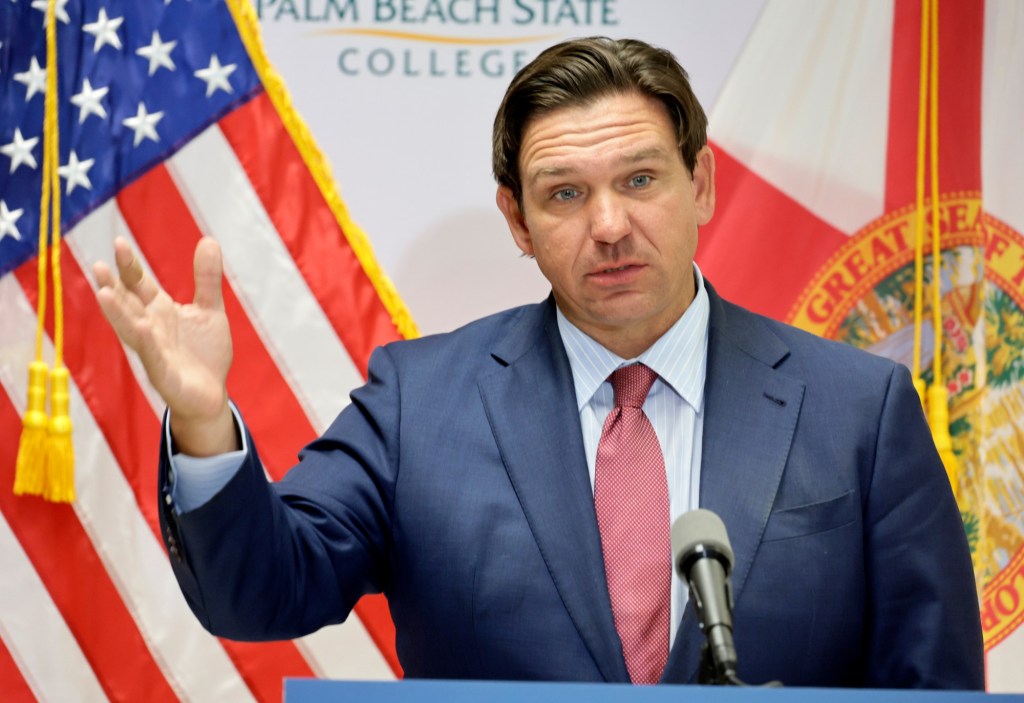
Gov. Ron DeSantis on Wednesday called for Florida to phase out property taxes on homeowners’ residences, starting by asking voters in a November ballot referendum to raise the state’s homestead exemption to $250,000.
“That’s the best way that we can make a meaningful difference in the lives of people in trying to make ends meet,” DeSantis said during a Wednesday morning press conference at a Tampa Bay hotel. He stood behind a sign that read “Save Our Homes.”
How would local governments pay for services, then? According to DeSantis, they could soak the rich. “If some billionaire from Brazil is buying properties, tax ‘em,” the governor said.
To begin tackling the issue, DeSantis said he has called a special session of the Florida Legislature to start Monday in Tallahassee. The governor needs 60% of the legislature to approve placing the proposal on the statewide ballot for the Nov. 3 general election. The ballot question would then require approval by 60% of voters.
The proposal would eliminate property taxes on homes valued at $250,000 or less, and make only the amount above $250,000 taxable for costlier homes. The Legislature also would be required during the session to set up a schedule on when the state would further reduce the homestead exemption to $500,000 and eventually reach a full exemption for homes of any value.
DeSantis said he proposed taking a step-by-step approach, rather than eliminating property taxes entirely on homesteaded homes all at once.
“I would do it full turkey, straight up. But I don’t think that’s something we would get the support in the Legislature,” DeSantis said. “And I don’t know it would necessarily pass with voters, if you did it that way.”
State Senate President Ben Albritton said in a memorandum released after DeSantis’ announcement that he “commends” the Governor for “starting what has been a robust discussion on property tax relief” and that he looks forward to next week’s special session.
It is likely the legislature will approve some sort of proposal, since the House backed property tax cuts in the regular session, but it could modify the governor’s approach. Albritton, however, spoke favorably of DeSantis’ tack.
“I can’t think of a more meaningful way to celebrate America’s 250 than the passage of $250,000 in tax relief for every Florida homeowner,” according to Albritton’s memo. “I believe this amendment will provide meaningful relief for Florida families.”
Noting that the House already passed a proposed constitutional amendment to eliminate property taxes, House Speaker Daniel Perez, R-Miami, said, “We are pleased the governor has finally gotten around to share an actual proposal. We look forward to reviewing it once we have received the language.”
House Democratic leader Fentrice Driskell lashed out at DeSantis’ proposal, saying it was a “distraction” from the the property insurance crisis.
She added that Democrats were not deterred by the large GOP majorities in both chambers.
“We will continue to speak truth to power about what property taxes pay for,” Driskell said. “People want their parks and libraries to be fully funded and don’t want to pay fees for those things.”
The percentage of homeowners who DeSantis said would be affected, however, did not match up with numbers from the state Office of Economic and Demographic Research.
DeSantis claimed the $250,000 exemption would eliminate property taxes for 60% of homesteaded homeowners and the $500,000 limit would eliminate them for 92% of homesteaded homeowners.
But the EDR states that only 47% of homesteaded properties in Florida are valued at $250,000 or less. In addition, only between 75% and 80% of homesteaded properties are valued at up to $500,000,
Currently, an estimated 5.1 million taxpayers have homestead exemptions on their primary residence, at the current exemption rate of $50,000. The law also limits future increases, according to the state Department of Revenue.
Cities and counties use property taxes to pay for schools, police, parks, libraries and other municipal services.
Seminole County Commissioner Lee Constantine said the drop in government revenue caused by getting rid of homestead property taxes would impact every resident by eliminating services such as parks and libraries that increase a home’s value.
“Clearly it’s going to be very difficult for us to provide basic services that provide the quality of life for our citizens,” he said.
But DeSantis said local governments can use revenue from non-homesteaded properties to pay for schools, police, “and the core services that we all agree on.”
“You’re going to be able to do it,” DeSantis said, describing what he would tell local government officials who complain about the tax reduction. “They’re still getting a lot of money.”
DeSantis added that he would urge the legislature to create a trust fund that would help rural counties without a large residential tax base to provide services. However, richer urban counties would not have a problem, DeSantis said.
“In Palm Beach, they’re sitting on a gold mine,” DeSantis said. “They’re [owners are] there three months of the year, and they buy $25 million homes. So that should be your tax base.”
The governor’s thinking on property taxes has shifted dramatically in the year since he first kicked off the discussion last February, when he called for a “complete repeal” of property taxes.
The Republican-controlled House ultimately pushed through a bill to ask voters to immediately eliminate all but school property taxes on homesteaded properties — a phrase that generally means homeowner-occupied residential properties — starting in January 2027.
Hours before the House vote, DeSantis posted on the social media platform X that he was working with Senate leaders on a tax plan that likely wouldn’t be ready until after the regular 60-day session ended March 13.
On Wednesday, DeSantis said he wanted to wait until the Legislature was finished with next fiscal year’s budget before announcing his support for eliminating property taxes on homesteaded homes, stating it was “better to do it right than do it quick.”
The Legislature is scheduled to vote Friday on the proposed $114.5 billion budget for the 2026-2027 fiscal year which begins July 1, and send it to DeSantis for his review.