
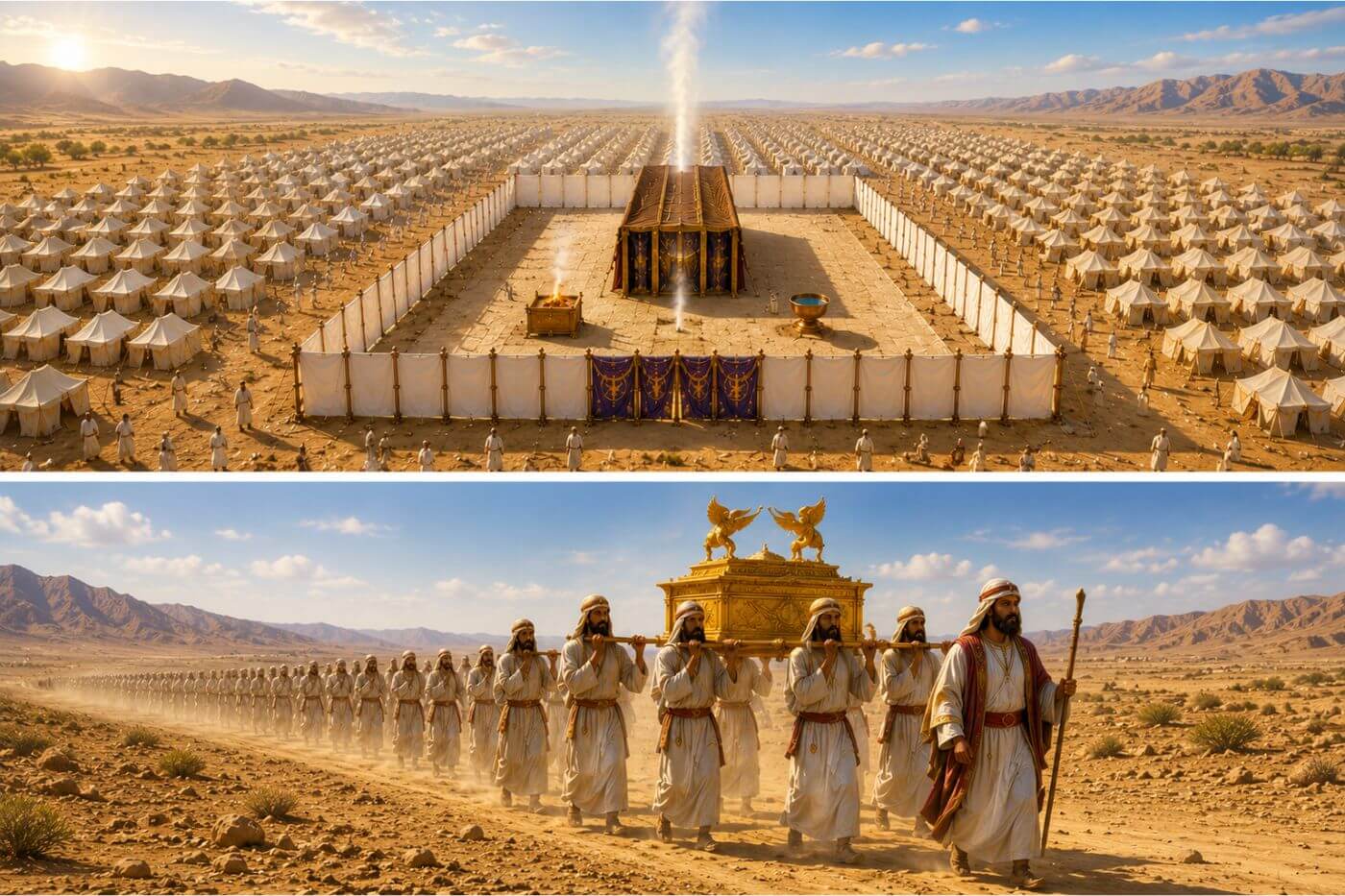
In this week’s parasha we are told that the Ark of the Covenant traveled in front of the Israelite people to lead them as they traversed the wilderness (Numbers 10:33). Yet earlier we are told that the Tabernacle, which contained the Ark of the Covenant, traveled in the middle of the camp, representing the dwelling of God’s Presence among the people (Numbers 2:17). So did the Ark travel in front of the camp or in the middle?
One approach, advanced by Ramban, suggests that under ordinary circumstances the Ark remained in its proper place within the Tabernacle at the center of the camp. At certain moments, however—especially during miraculous or significant journeys—the Ark moved ahead as a manifestation of the Divine Presence guiding Israel through the wilderness.
Another approach, cited by Rashi, claims that there were actually two separate arks:
One traveled ahead of the camp into battle and led the way.
The other remained within the Mishkan at the center of the camp.
If there were indeed two arks, what message is the Torah trying to convey, and what relevance does it hold for our own day?
Perhaps the Torah is teaching that the Jewish people require two kinds of arks.
One Ark must stand at the center of the camp. A nation requires a stable spiritual core—Torah, covenant, values, holiness, and a sense of transcendent purpose. Without an inner center, national life loses its moral compass and fragments into competing interests and tribes.
But another Ark must travel ahead. A nation also requires vision, movement, courage, and leadership into the unknown. The leading Ark symbolizes mission, initiative, and the willingness to confront danger and uncertainty in order to move history forward.
These two dimensions often exist in tension. Some emphasize preserving the sacred center; others emphasize advancing boldly into new realities and challenges. Yet the Torah suggests that Israel requires both simultaneously: a spiritual center that anchors the nation and a forward-moving force that leads it toward its destiny.
Since October 7, Israelis have witnessed both arks in powerful ways. We have seen the “forward ark” in the heroism of soldiers, commanders, intelligence officers, rescue teams, and ordinary citizens who rushed into danger to defend the nation. But we have also witnessed the “inner ark” —spiritual resilience, prayer gatherings, acts of extraordinary kindness, renewed Jewish identity, unity, and a profound rediscovery of covenantal purpose amid tragedy.
As Israel begins to think about its upcoming elections, the symbolism of the two arks becomes even more urgent. Israeli society is often torn between competing visions of the state: some emphasize security, military strength, diplomacy, and economic power, while others stress Jewish identity, Torah values, morality, and the spiritual purpose of the state. But the Torah’s image of the two arks suggests that these are not opposing missions but complementary ones. A healthy Jewish state requires both national strength and spiritual depth; both the ability to defend itself in a dangerous region and the wisdom to remember what that power is ultimately for.
The coming elections will therefore not merely determine which coalition governs the country, but will help shape the deeper question of what kind of Israel we aspire to become. The challenge facing Israelis today is to reject simplistic divisions between “the ark that goes before the camp” and “the ark that dwells within it,” and instead seek leaders and a national vision capable of integrating both — preserving Israel’s security while nurturing its covenantal and moral soul.
Shabbat Shalom.
–
For more articles, or to sign up for my newsletter, visit my website: https://davidharbater.com/
Rabbi Dr. David Harbater is a published author, Jewish educator and public speaker. His book “In the Beginnings: Discovering the Two Worldviews Hidden within Genesis 1-11” was described by the Jerusalem Post as “a work to be treasured” and by the Jewish Link as “ground-breaking, stimulating and one-of-a-kind”.
For more information, to sign up to his newsletter, and to invite him to speak in your community, visit his website: https://davidharbater.com/