

Councillors on the City of London’s planning committee approved the scheme for developer Lipton Rodgers and investor La Salle on Thursday (28 May), with councillors voting narrowly in favour of the proposals for the part 16 and part 20-storey mixed-use development by 16 to 11 votes.
SOM’s scheme was originally submitted late last year, proposing two connected buildings around 20 storeys on a 0.57ha plot at 1 Silk Street in the City of London opposite the Barbican’s Silk Street entrance, plus a shorter element.
However, public backlash led to resubmission of slightly shorter plans in February. Three storeys were cut from the proposed office building’s west side, which was reduced to 16 storeys or 10m shorter.
Other changes included updates to the appearance and materials on the façade, which turned from red to green, and the realignment of the western part of the site to create 2,282m2 of enhanced public space in front of the Barbican Centre’s main entrance.
Despite the changes, the number of objections against the scheme before the committee reached 1,827 letters, with opponents criticising the massing and scale of the development. That list included architects such as Stirling Prize winner Amanda Levete.
In her objection Levete said: ‘The building is completely inappropriate in scale and height for the setting of the Barbican development, damaging the heritage and conservation area.
‘This speculative office building is too big and of average quality.’
Statutory consultees such as The Twentieth Century Society also opposed on grounds of its impact on the neighbouring Grade II-listed Barbican estate, which is owned by the City of London.
Residents of the estate belonging to the Barbican Association formally objected too, as did SAVE Britain’s Heritage, which complained: ‘A building of vastly increased scale and mass in this location would adversely impact the setting of multiple conservation areas adjoining or in close proximity to the application site.’
When London and Chicago-based SOM first submitted plans for 1 Silk Street, Barbican Quarter Action, a group which is simultaneously opposing demolition of the Museum of London building, told the AJ that the development was ‘a devastating blow to the architectural and visual coherence of the iconic Grade II-listed Barbican’.
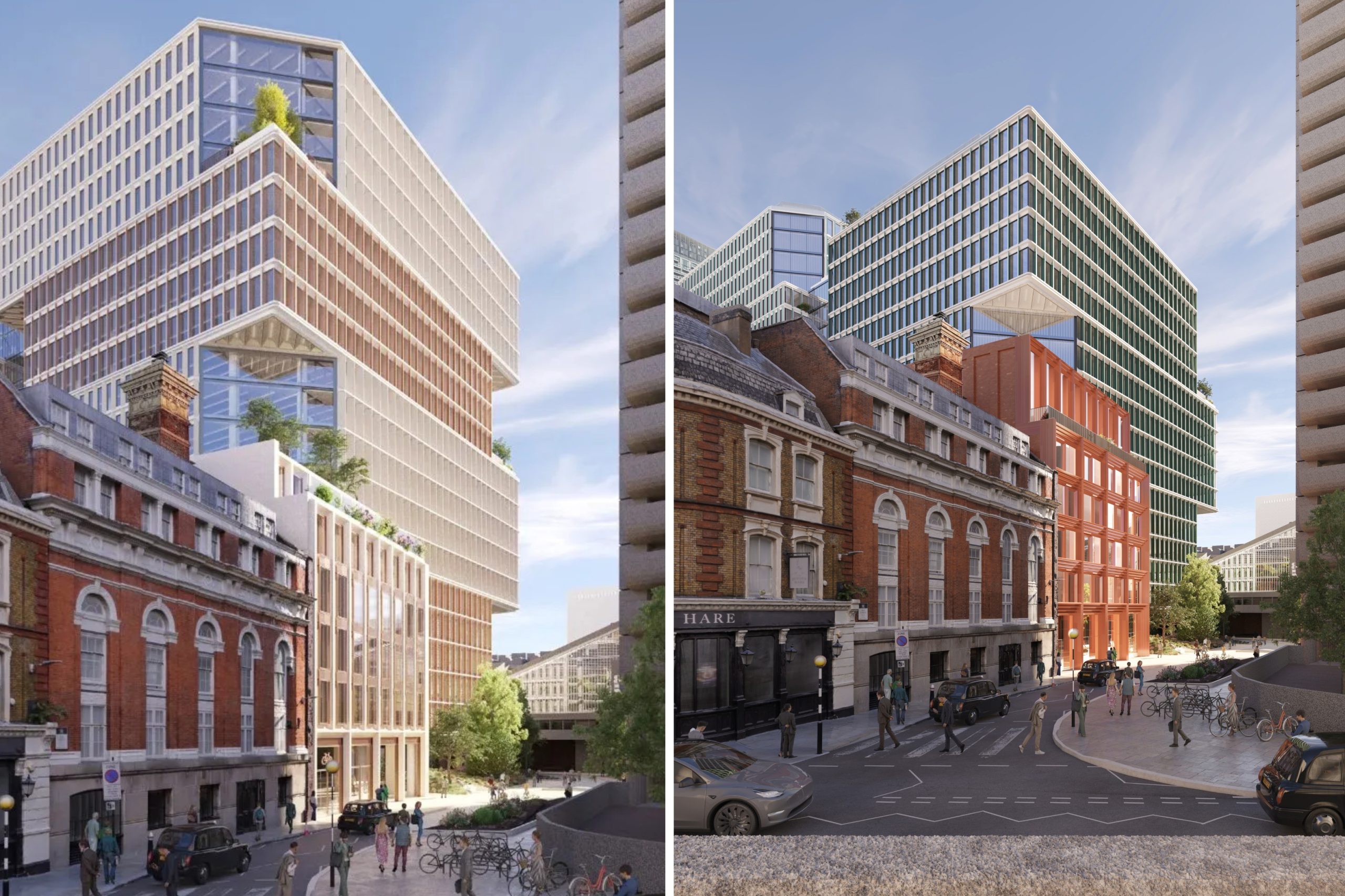
Comparison of submitted and revised schemes for SOM’s 1 Silk Street
Lipton Rogers founding partner Stuart Lipton previously said that SOM’s redesigned scheme was ‘more modest in scale, while more ambitious in public benefits. It opens itself to the community, enriches the cultural fabric of the Square Mile, and delivers clear improvements for Silk Street and its surroundings’.
The existing 1 Silk Street building consists of two interlinked towers designed by Fitzroy Robinson Partnership – the 17-storey Milton House to the east and 13-storey Shire House to the west – both featuring heavily glazed façades. Sheppard Robson refurbished the buildings between 1994 and 1996.
A scoping opinion by environmental consultant Trium, submitted to the City of London Corporation late last year, described the building as ‘a utilitarian office building that does not represent the best work by either firm of well-known architects associated with its construction and refurbishment’.
The consultant explained: ‘Architecturally, the building is not distinguished, nor does it present an innovative approach to office design; rather, its current condition reflects the office requirements of the time of its refurbishment in the mid-1990s [by Sheppard Robson].
‘The existing building is not considered to have any architectural merit, and it detracts from the streetscape as a result of the inactive frontages and lack of permeability.’
SOM said redevelopment of the site would ensure the new 1 Silk Street met Energy Performance Certificate (EPC) requirements for commercial buildings set to come into force in 2027, which would have made the current structure unlettable. It will be stripped down to its 1982 foundations, which will be retained.
The scheme also still includes a public space opposite the Silk Street entrance to the Barbican Centre, which is due to undergo its own revamp under plans by Allies and Morrison and Asif Khan, unveiled last year.
It is understood completion is scheduled for 2032.
COMMENT: Tom Sleigh, chairman of the City of London Corporation planning and transportation committee
The scheme that was approved by the committee was a stronger one than the early proposals, shaped by a long period of pre-application work and consultation with residents and statutory consultees.
The daylight impact on Barbican homes and the way the building meets the street were both reworked along the way. What it now delivers is a much needed, high-quality workspace, with the retention of much of the existing structure, rather than demolition.
Crucially, it will also transform the public realm around the Barbican, with a new public route and plaza, open to all, creating a more welcoming, inclusive environment, with new cultural and community spaces that increase the City’s vibrancy across the week.