

This week, I will fly across America to march in New York’s Israel Day Parade.
For some people, that decision makes no sense. It can be infuriating.
Why would a Muslim march in support of Israel at a time when Gaza is shattered, emotions are raw, and the world feels more divided than ever?
Because after more than a decade working in Muslim-Jewish engagement and peacebuilding, I have learned something painful but undeniable: peace becomes impossible the moment people stop talking to one another.
For years, I have sat with Israelis and Palestinians. I have listened to grieving Jewish families terrified after terror attacks, and I have listened to Palestinians describe checkpoints, war, displacement, humiliation, and fear. I have shared meals in Jewish homes and heard stories from Gazans who simply wanted their children to be educated and safe.
And I have also seen firsthand how “anti-normalization” culture has poisoned the possibility of peace.
Earlier this year in Los Angeles, we organized an event with Jewish partners titled “Breaking Bread: A New Dawn for Jewish-Muslim Unity.” It was meant to be a simple but powerful act of dialogue, friendship, and coexistence. Yet instead of encouragement, many of us were condemned and labeled “Zionists” merely for sitting together with Jews.
This reflects a dangerous reality of our time: peace-making itself is increasingly being attacked. When dialogue becomes controversial and human connection becomes treated as a political crime, we risk losing the very foundation needed for reconciliation and coexistence.
The idea that Muslims or Palestinians should not speak to Israelis, organize with Jews, or even acknowledge Jewish identity except through the lens of oppression has done catastrophic damage. It has created generations taught that dialogue itself is betrayal.
I know this personally.
I have been attacked simply for organizing with Jewish communities in Los Angeles. I have been insulted online and privately condemned for advocating Muslim-Jewish cooperation. In some activist spaces today, merely standing beside Jews — not politicians, not governments, but Jews — is treated as a moral failure.
That should alarm all of us.
Because if coexistence itself becomes taboo, then what future are we actually building?
This morning, Mohammed from Gaza wrote to me.
Not an activist. Not a politician. Just a father trying to survive.
He told me:
“We are living in hell in every sense of the word. We used to live a simple but beautiful life, but now we live in a tent after having lived in a house.”
He described losing his home, struggling to educate his children, and watching Gaza collapse around him. And yet, despite everything, he still speaks the language of peace.
“Why the violence? We want peace, to live side by side and help each other.”
Then he told me something I cannot stop thinking about:
“Hamas views the people of Gaza as mere fuel for the fire in exchange for its own survival.”
Despite living through war, displacement, and devastation, Mohammed is trying to establish a small youth center promoting coexistence, nonviolence, and respect between religions.
That is the voice I carry with me to New York.
Not the voices chanting for destruction from thousands of miles away.
Not those turning one of the world’s most painful conflicts into slogans and performance.
But ordinary Palestinians and Israelis who still believe their children deserve something better than endless funerals.
I am marching because I believe peace will only come when Palestinians and Israelis sit together directly and negotiate seriously.
Peace requires courageous political leadership.
Peace requires Palestinians to have leaders focused on building institutions instead of glorifying permanent war.
And peace requires Israelis to feel secure enough to take risks for peace without fearing another October 7.
No country in the world would experience the massacre of October 7 and simply ignore security concerns afterward. Many across the Arab and Muslim world were themselves horrified by Hamas’ atrocities.
So we must ask difficult but necessary questions:
What if Hamas surrendered its weapons?
What if Hamas stopped embedding itself among civilians?
What if Gaza’s future belonged to educators, reformers, entrepreneurs, and peacebuilders instead of armed factions?
These are not comfortable questions. But avoiding uncomfortable questions is precisely what has kept this conflict trapped for generations.
The suffering in Gaza is real. Israel must continue doing more to reduce civilian suffering and increase humanitarian relief. Palestinian life is precious.
But hatred of Zionism alone will not rebuild Gaza.
It will not educate children.
It will not create jobs.
It will not produce peace.
For too long, major American Muslim organizations such as the Council on American-Islamic Relations have helped create an atmosphere where the word “Zionist” is treated not as a political identity tied to Jewish self-determination, but as a slur.
That has caused immense damage.
Many Muslims today have never truly learned what Zionism is beyond activist caricatures. They know little about Jewish history, exile, persecution, or why Israel matters emotionally and spiritually to Jews around the world.
We do not build peace by erasing each other’s identities.
We build peace by understanding them.
As a Muslim, I do not see Jewish connection to the land of Israel as foreign to our tradition. Jewish history in that land predates modern politics by thousands of years. Many Muslims understand Jewish return through both history and theology, including Quranic tradition.
The Middle East itself is changing.
The Abraham Accords showed that former enemies can move toward cooperation.
Many Arabs and Muslims are exhausted by endless war and ideological extremism.
And many Palestinians themselves are exhausted by leaders who promise liberation while delivering devastation.
Meanwhile, antisemitism is rising openly in Western cities, including New York.
New York City — home to the largest Jewish population outside Israel — cannot become a center for normalizing hatred against Jews under the language of activism.
The decision by Mayor Zohran Mamdani not to march in the Israel Day Parade may seem like his right as an individual. But public leadership carries broader responsibilities. New York is home to the largest Jewish population outside Israel, including countless Jews for whom support for Israel is deeply tied to identity, history, family, and safety. At a time of rising antisemitism and polarization, refusing to stand alongside much of the city’s Jewish community risks further galvanizing anti-Zionism.
Criticizing Israeli policy is legitimate. Dehumanizing Israel and the Jews is not.
I march not because I support war.
I march because I refuse to surrender to hopelessness.
I march because Palestinians like Mohammed deserve more than symbolic outrage.
I march because Israelis deserve safety.
I march because Muslim-Jewish dialogue must survive.
And I march because hatred — whether against Jews, Muslims, Israelis, or Palestinians — only guarantees more suffering for everyone.
The loudest voices today profit from division.
One of the hardest truths Palestinians — including those in the diaspora — must confront is that Israel is not disappearing. Israel is a powerful nation with a strong military, a thriving economy, international alliances, and deep historical roots in the region. It will ultimately help shape the conditions and framework of any future peace process.
Refusing to acknowledge that reality has only prolonged suffering for ordinary Palestinians.
Peace will require Palestinians and their supporters around the world to move beyond rejectionism and toward serious engagement: dialogue, negotiation, institution-building, and courageous outreach to Israelis.
Real peace is never built through fantasies of elimination. It is built when two peoples recognize they are destined to share the land and must find a way to live alongside one another with dignity and security.
Israel is fighting wars on multiple fronts. Jewish communities around the world are experiencing fear, isolation, and growing hostility. This is precisely the moment when friendships matter most.
History is not changed by those who stay silent on the sidelines.
It is changed by those willing to walk together.
That is why I will march.
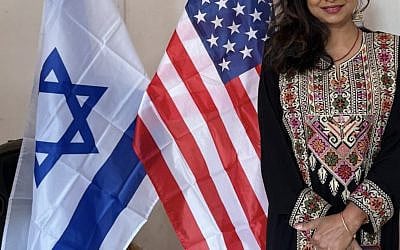
Soraya at the first Abrahamic Summit Jaffa – Israel
Photo credit- photo taken be author at the Summit.